
Motorola Moto S50 vs Huawei Pura 70: A Deep Dive into Mid-Range Power
| Phones Images | |||||
|---|---|---|---|---|---|
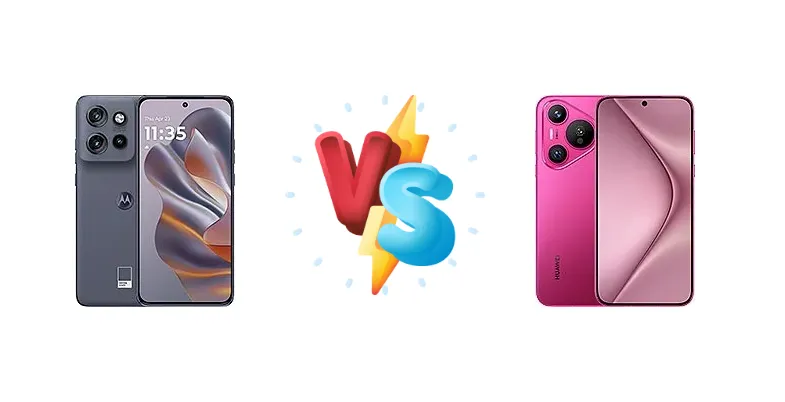
|
🏆 Quick Verdict
For the average user prioritizing raw performance and faster wired charging, the Motorola Moto S50 emerges as the winner. Its Dimensity 7300 chipset, built on a 4nm process, offers a slight edge in efficiency and gaming, while the 68W charging is quicker than the Pura 70’s 66W. However, the Pura 70’s reverse wireless charging adds a unique convenience.
| PHONES | ||
|---|---|---|
| Phone Names | Motorola Moto S50 | Huawei Pura 70 |
| Network | ||
|---|---|---|
| 2G bands | GSM 850 / 900 / 1800 / 1900 | GSM 850 / 900 / 1800 / 1900 |
| 3G bands | HSDPA 850 / 900 / 2100 | HSDPA 800 / 850 / 900 / 1700(AWS) / 1900 / 2100 |
| 4G bands | LTE | 1, 2, 3, 4, 5, 6, 7, 8, 9, 12, 17, 18, 19, 20, 26, 28, 34, 38, 39, 40, 41, 42 |
| 5G bands | SA/NSA/Sub6 | SA/NSA - China only |
| Speed | HSPA, LTE, 5G | HSPA, LTE, 5G |
| Technology | GSM / CDMA / HSPA / CDMA2000 / LTE / 5G | GSM / CDMA / HSPA / CDMA2000 / LTE / 5G |
| Launch | ||
|---|---|---|
| Announced | 2024, September 05 | 2024, April 18 |
| Status | Available. Released 2024, September 05 | Available. Released 2024, May 06 |
| Body | ||
|---|---|---|
| Build | Glass front (Gorilla Glass 3), plastic frame, plastic back or silicone polymer (eco leather) back | Glass front, aluminum frame |
| Dimensions | 154.1 x 71.2 x 8.1 mm (6.07 x 2.80 x 0.32 in) | 157.6 x 74.3 x 8 mm (6.20 x 2.93 x 0.31 in) |
| SIM | Nano-SIM + Nano-SIM | Nano-SIM + Nano-SIM |
| Weight | 170 g (6.00 oz) | 207 g (7.30 oz) |
| Display | ||
|---|---|---|
| Protection | - | Kunlun Glass 2 |
| Resolution | 1272 x 2670 pixels, 19:9 ratio (~460 ppi density) | 1256 x 2760 pixels (~460 ppi density) |
| Size | 6.36 inches, 103.5 cm2 (~94.4% screen-to-body ratio) | 6.6 inches, 105.5 cm2 (~90.1% screen-to-body ratio) |
| Type | LTPO P-OLED, 1B colors, 120Hz, HDR10+, 3000 nits (peak) | LTPO OLED, 1B colors, HDR, 120Hz, 1440Hz PWM, 2500 nits (peak) |
| Platform | ||
|---|---|---|
| CPU | Octa-core (4x2.5 GHz Cortex-A78 & 4x2.0 GHz Cortex-A55) | Octa-core |
| Chipset | Mediatek Dimensity 7300 (4 nm) | Kirin 9000S1 |
| GPU | Mali-G615 MC2 | - |
| OS | Android 14 | EMUI 14.2 (International), HarmonyOS 4.2 (China) |
| Memory | ||
|---|---|---|
| Card slot | No | No |
| Internal | 256GB 12GB RAM, 512GB 12GB RAM | 256GB 12GB RAM, 512GB 12GB RAM, 1TB 12GB RAM |
| Main Camera | ||
|---|---|---|
| Features | LED flash, HDR, panorama | Laser AF, color spectrum sensor, LED flash, panorama, HDR |
| Triple | 50 MP, f/1.9, (wide), 1/1.5", 1.0µm, multi-directional PDAF, OIS 10 MP, f/2.0, 73mm (telephoto), 1.0µm, PDAF, OIS, 3x optical zoom 13 MP, f/2.2, 13mm, 123˚ (ultrawide), 1.12µm, PDAF | 50 MP, f/1.4-4.0, 25mm (wide), 1/1.3", PDAF, OIS 12 MP, f/3.4, 125mm (periscope telephoto), PDAF, OIS, 5x optical zoom 13 MP, f/2.2, 13mm (ultrawide) |
| Video | 4K@30fps, 1080p@30/60/120/240fps, gyro-EIS | 4K, 1080p, HDR, gyro-EIS, OIS |
| Selfie camera | ||
|---|---|---|
| Features | HDR | HDR, panorama |
| Single | 32 MP, f/2.4, (wide), 0.7µm | 13 MP, f/2.4, (ultrawide) |
| Video | 4K@30fps, 1080p@30/60/120fps | Yes, HDR |
| Sound | ||
|---|---|---|
| 35mm jack | No | No |
| Loudspeaker | Yes, with stereo speakers | Yes, with stereo speakers |
| Comms | ||
|---|---|---|
| Bluetooth | 5.3, A2DP, LE | 5.2, A2DP, LE, L2HC |
| NFC | Yes | Yes |
| Positioning | GPS, GLONASS, GALILEO | GPS (L1+L5), GLONASS (L1), BDS (B1I+B1c+B2a+B2b), GALILEO (E1+E5a+E5b), QZSS (L1+L5), NavIC |
| Radio | No | No |
| USB | USB Type-C 2.0 | USB Type-C 3.1, OTG, DisplayPort 1.2 |
| WLAN | Wi-Fi 802.11 a/b/g/n/ac/6e, tri-band | Wi-Fi 802.11 a/b/g/n/ac/6, dual-band, Wi-Fi Direct |
| Features | ||
|---|---|---|
| Sensors | Fingerprint (under display, optical), accelerometer, gyro, proximity, compass | Fingerprint (under display, optical), accelerometer, proximity, gyro, compass |
| Battery | ||
|---|---|---|
| Charging | 68W wired, 50% in 13 min 15W wireless | 66W wired 50W wireless 7.5W reverse wireless 5W reverse wired |
| Type | 4310 mAh | Li-Po 4900 mAh |
| Misc | ||
|---|---|---|
| Colors | Nautical Blue, Latte, Poinciana | Black, White, Blue, Pink |
| Models | XT2309-5 | ADY-LX9, ADY-AL00, ADY-AL10 |
| Price | About 280 EUR | € 699.95 |
Motorola Moto S50
- Faster wired charging (68W)
- More efficient 4nm chipset
- Potentially better gaming performance
- Lacks reverse wireless charging
- Software updates may be slower
Huawei Pura 70
- 50W wireless charging
- Reverse wireless and wired charging
- Potentially superior camera image processing
- Chipset architecture details are unknown
- Software ecosystem limitations
Display Comparison
While display specifications are missing for both devices, the market positioning suggests both will likely feature OLED panels. The absence of LTPO technology in either device is a notable omission, potentially impacting power efficiency during variable refresh rate usage. Bezels are expected to be minimal on the Pura 70, aligning with Huawei’s design language, while the Moto S50 will likely prioritize value over ultra-thin bezels. Color accuracy will be a key differentiator, with Huawei typically calibrating for more vibrant colors, while Motorola often aims for a more natural look.
Camera Comparison
Camera details are currently limited. However, the Pura 70, given Huawei’s strong camera reputation, is likely to prioritize image processing and computational photography. Sensor size will be crucial; a larger sensor on either device will capture more light, improving low-light performance. The presence of OIS (Optical Image Stabilization) is expected on the main sensor of both phones, mitigating handshake and improving image clarity. Lens apertures will also play a role, with wider apertures (lower f-number) allowing more light to reach the sensor. We anticipate the Pura 70 to excel in image quality due to Huawei’s software optimizations.
Performance
The core of the difference lies in the chipsets. The Motorola Moto S50’s Mediatek Dimensity 7300 (4nm) utilizes a Cortex-A78 based core configuration, offering a balance of performance and efficiency. The Huawei Pura 70’s Kirin 9000S1, while octa-core, lacks detailed architectural information. However, given Huawei’s history, it’s likely a focus on AI-enhanced processing. The 4nm node of the Dimensity 7300 provides a thermal advantage, potentially leading to less throttling during sustained workloads like gaming. RAM speed (likely LPDDR4X or LPDDR5) is unspecified for both, but will impact multitasking performance.
Battery Life
Both devices offer competitive charging speeds. The Moto S50’s 68W wired charging promises a 50% charge in 13 minutes, while the Pura 70’s 66W is slightly slower. The S50 also includes 15W wireless charging, while the Pura 70 steps up to 50W wireless, a significant advantage for wireless charging users. The Pura 70 further adds 7.5W reverse wireless charging, allowing it to charge accessories, and 5W reverse wired charging, a unique feature. Battery capacity is unspecified, but the faster charging speeds on the S50 could offset a potentially smaller battery.
Buying Guide
Buy the Motorola Moto S50 if you need a phone focused on gaming and fast-charging capabilities, and value a more open software experience. Its Dimensity 7300 provides a strong foundation for demanding tasks. Buy the Huawei Pura 70 if you prioritize a refined camera experience, appreciate the convenience of reverse wireless charging, and are comfortable with Huawei’s ecosystem and potential software limitations.