
Motorola Moto S50 vs Honor Magic6 RSR Porsche Design: A Deep Dive Comparison
| Phones Images | |||||
|---|---|---|---|---|---|
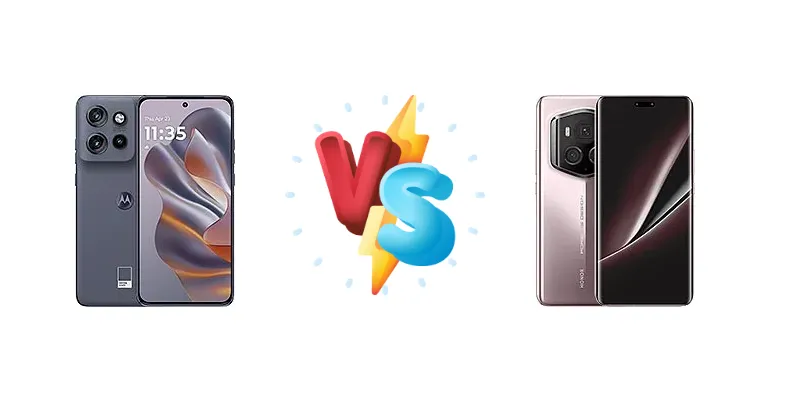
|
🏆 Quick Verdict
For the average user prioritizing battery life and a stunning display, the Honor Magic6 RSR Porsche Design is the clear winner. Its Snapdragon 8 Gen 3 chipset and exceptional 14:14 active use battery score outweigh the Moto S50’s more affordable price point. However, the Moto S50 remains a compelling option for budget-conscious buyers.
| PHONES | ||
|---|---|---|
| Phone Names | Motorola Moto S50 | Honor Magic6 RSR Porsche Design |
| Network | ||
|---|---|---|
| 2G bands | GSM 850 / 900 / 1800 / 1900 | GSM 850 / 900 / 1800 / 1900 |
| 3G bands | HSDPA 850 / 900 / 2100 | HSDPA 800 / 850 / 900 / 1700(AWS) / 1900 / 2100 |
| 4G bands | LTE | LTE |
| 5G bands | SA/NSA/Sub6 | SA/NSA |
| Speed | HSPA, LTE, 5G | HSPA, LTE, 5G |
| Technology | GSM / CDMA / HSPA / CDMA2000 / LTE / 5G | GSM / CDMA / HSPA / CDMA2000 / LTE / 5G |
| Launch | ||
|---|---|---|
| Announced | 2024, September 05 | 2024, March 18 |
| Status | Available. Released 2024, September 05 | Available. Released 2024, March 22 |
| Body | ||
|---|---|---|
| Build | Glass front (Gorilla Glass 3), plastic frame, plastic back or silicone polymer (eco leather) back | Glass front (NanoCrystal Shield), glass back (NanoCrystal Shield), titanium frame |
| Dimensions | 154.1 x 71.2 x 8.1 mm (6.07 x 2.80 x 0.32 in) | 162.5 x 75.8 x 8.9 mm (6.40 x 2.98 x 0.35 in) |
| SIM | Nano-SIM + Nano-SIM | · Nano-SIM + eSIM· Nano-SIM + Nano-SIM |
| Weight | 170 g (6.00 oz) | 237 g (8.36 oz) |
| Display | ||
|---|---|---|
| Protection | - | NanoCrystal Shield |
| Resolution | 1272 x 2670 pixels, 19:9 ratio (~460 ppi density) | 1280 x 2800 pixels, 19.5:9 ratio (~453 ppi density) |
| Size | 6.36 inches, 103.5 cm2 (~94.4% screen-to-body ratio) | 6.8 inches, 112.8 cm2 (~91.6% screen-to-body ratio) |
| Type | LTPO P-OLED, 1B colors, 120Hz, HDR10+, 3000 nits (peak) | LTPO OLED, 1B colors, 120Hz, Dolby Vision, HDR, 1800 nits (HBM), 5000 nits (peak) |
| Platform | ||
|---|---|---|
| CPU | Octa-core (4x2.5 GHz Cortex-A78 & 4x2.0 GHz Cortex-A55) | Octa-core (1x3.3 GHz Cortex-X4 & 3x3.2 GHz Cortex-A720 & 2x3.0 GHz Cortex-A720 & 2x2.3 GHz Cortex-A520) |
| Chipset | Mediatek Dimensity 7300 (4 nm) | Qualcomm SM8650-AB Snapdragon 8 Gen 3 (4 nm) |
| GPU | Mali-G615 MC2 | Adreno 750 |
| OS | Android 14 | Android 14, MagicOS 8 |
| Memory | ||
|---|---|---|
| Card slot | No | No |
| Internal | 256GB 12GB RAM, 512GB 12GB RAM | 1TB 24GB RAM |
| Main Camera | ||
|---|---|---|
| Features | LED flash, HDR, panorama | Color spectrum sensor, LED flash, HDR, panorama |
| Triple | 50 MP, f/1.9, (wide), 1/1.5", 1.0µm, multi-directional PDAF, OIS 10 MP, f/2.0, 73mm (telephoto), 1.0µm, PDAF, OIS, 3x optical zoom 13 MP, f/2.2, 13mm, 123˚ (ultrawide), 1.12µm, PDAF | 50 MP, f/1.4-2.0, 23mm (wide), 1/1.3", LiDAR AF, PDAF, OIS 180 MP, f/2.6, (periscope telephoto), 1/1.49", 0.56µm, PDAF, OIS, 2.5x optical zoom 50 MP, f/2.0, 13mm, 122˚ (ultrawide), 1/2.88", AF |
| Video | 4K@30fps, 1080p@30/60/120/240fps, gyro-EIS | 4K@24/30/60fps, 1080p@30/60/120/240fps, gyro-EIS, OIS, HDR, 10-bit video |
| Selfie camera | ||
|---|---|---|
| Features | HDR | - |
| Single | 32 MP, f/2.4, (wide), 0.7µm | 50 MP, f/2.0, 22mm (wide), 1/2.93", AF TOF 3D, (depth/biometrics sensor) |
| Video | 4K@30fps, 1080p@30/60/120fps | 4K@30fps, 1080p@30/60fps, gyro-EIS |
| Sound | ||
|---|---|---|
| 35mm jack | No | No |
| Loudspeaker | Yes, with stereo speakers | Yes, with stereo speakers |
| Comms | ||
|---|---|---|
| Bluetooth | 5.3, A2DP, LE | 5.3, A2DP, LE, aptX HD |
| Infrared port | - | Yes |
| NFC | Yes | Yes |
| Positioning | GPS, GLONASS, GALILEO | GPS (L1+L5), GLONASS, BDS (B1I+B1c+B2a), GALILEO (E1+E5a) |
| Radio | No | No |
| USB | USB Type-C 2.0 | USB Type-C 3.2, DisplayPort 1.2, OTG |
| WLAN | Wi-Fi 802.11 a/b/g/n/ac/6e, tri-band | Wi-Fi 802.11 a/b/g/n/ac/6/7, dual-band, Wi-Fi Direct |
| Features | ||
|---|---|---|
| Sensors | Fingerprint (under display, optical), accelerometer, gyro, proximity, compass | Fingerprint (under display, optical), Face ID, accelerometer, gyro, proximity, compass |
| Battery | ||
|---|---|---|
| Charging | 68W wired, 50% in 13 min 15W wireless | 80W wired 66W wireless Reverse wireless 5W reverse wired |
| Type | 4310 mAh | Si/C Li-Ion 5600 mAh |
| Misc | ||
|---|---|---|
| Colors | Nautical Blue, Latte, Poinciana | Agate Grey, Frozen Berry |
| Models | XT2309-5 | BVL-N59, BVL-AN20 |
| Price | About 280 EUR | About 3020 EUR |
Motorola Moto S50
- More affordable price point
- Decent performance for everyday tasks
- 68W fast wired charging
- Less powerful chipset compared to Snapdragon 8 Gen 3
- Likely inferior camera performance
- Potentially shorter battery life
Honor Magic6 RSR Porsche Design
- Flagship Snapdragon 8 Gen 3 performance
- Exceptional battery life (14:14h active use)
- Bright and efficient display (1731 nits)
- Higher price tag
- Porsche Design branding may not appeal to all
- Larger size and weight compared to the Moto S50 (likely)
Display Comparison
The Honor Magic6 RSR Porsche Design boasts a significantly brighter display, peaking at 1731 nits, ensuring excellent visibility even in direct sunlight. While the Moto S50’s display specs are not provided, it’s unlikely to match this peak brightness. The Magic6 RSR’s likely use of LTPO technology (common in flagship Honor devices) would also contribute to improved power efficiency by dynamically adjusting the refresh rate. This is a major advantage for users who consume a lot of media outdoors or prioritize battery life.
Camera Comparison
Without detailed camera specifications for the Moto S50, a direct comparison is limited. However, given its mid-range positioning, it’s unlikely to compete with the image processing capabilities of a flagship device like the Magic6 RSR. The Magic6 RSR likely features a more advanced image signal processor (ISP) integrated within the Snapdragon 8 Gen 3, enabling superior noise reduction, dynamic range, and overall image quality. The Porsche Design edition often includes enhanced camera tuning. The absence of details on OIS or sensor size for the Moto S50 further suggests a less sophisticated camera system.
Performance
The core difference lies in the chipsets. The Honor Magic6 RSR Porsche Design’s Snapdragon 8 Gen 3 (4nm) is a flagship processor with a Cortex-X4 prime core clocked at 3.3 GHz, offering substantially higher performance than the Motorola Moto S50’s Dimensity 7300 (4nm). The Snapdragon 8 Gen 3’s architecture – with its three Cortex-A720 cores and two Cortex-A520 cores – is designed for sustained performance and efficiency. The Dimensity 7300, while capable, utilizes older Cortex-A78 and A55 cores, resulting in lower peak performance and potentially more thermal throttling under heavy load. Gamers and power users will overwhelmingly benefit from the Snapdragon 8 Gen 3.
Battery Life
The Honor Magic6 RSR Porsche Design excels in battery life, achieving an impressive 14:14 hours of active use. While the Moto S50’s battery capacity is unknown, the Magic6 RSR’s combination of a large battery (likely 5000mAh or greater) and the power efficiency of the Snapdragon 8 Gen 3 delivers superior endurance. Charging speeds are also competitive, with the Magic6 RSR offering 80W wired and 66W wireless charging, plus reverse wireless and wired charging. The Moto S50’s 68W wired charging is respectable, but the Magic6 RSR’s wireless charging capabilities and reverse charging add significant convenience.
Buying Guide
Buy the Motorola Moto S50 if you need a reliable daily driver with decent performance for everyday tasks and appreciate a more accessible price. Buy the Honor Magic6 RSR Porsche Design if you prioritize top-tier performance for gaming and demanding applications, require exceptional battery endurance, and value a premium design and display experience.