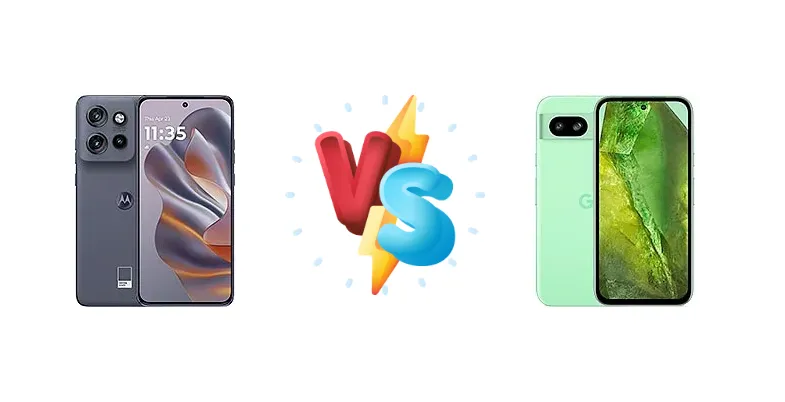
The Motorola Moto S50 and Google Pixel 8a represent compelling options in the increasingly competitive mid-range smartphone market. The S50 prioritizes charging speed and a powerful Mediatek Dimensity chipset, while the Pixel 8a leverages Google’s Tensor G3 and renowned computational photography. This comparison dissects their strengths and weaknesses to determine which device best suits your needs.
🏆 Quick Verdict
For the average user prioritizing camera quality and long-term software support, the Google Pixel 8a is the superior choice. Its Tensor G3 chip, combined with Google’s image processing, delivers consistently excellent photos. However, the Motorola Moto S50 offers significantly faster charging and a strong processor for those valuing speed and convenience.
| Network |
|---|
| 2G bands | GSM 850 / 900 / 1800 / 1900 | GSM 850 / 900 / 1800 / 1900 |
| 3G bands | HSDPA 850 / 900 / 2100 | HSDPA 800 / 850 / 900 / 1700(AWS) / 1900 / 2100 |
| 4G bands | LTE | 1, 2, 3, 4, 5, 7, 8, 12, 17, 18, 19, 20, 26, 28, 32, 38, 40, 41, 42, 66 - G6GPR (International) |
| 5G bands | SA/NSA/Sub6 | 1, 2, 3, 5, 7, 8, 12, 20, 26, 28, 38, 40, 41, 66, 75, 76, 77, 78 SA/NSA/Sub6 - G6GPR (International) |
| Speed | HSPA, LTE, 5G | HSPA, LTE, 5G |
| Technology | GSM / CDMA / HSPA / CDMA2000 / LTE / 5G | GSM / HSPA / LTE / 5G |
| Launch |
|---|
| Announced | 2024, September 05 | 2024, May 07 |
| Status | Available. Released 2024, September 05 | Available. Released 2024, May 14 |
| Body |
|---|
| Build | Glass front (Gorilla Glass 3), plastic frame, plastic back or silicone polymer (eco leather) back | Glass front (Gorilla Glass 3), aluminum frame, plastic back |
| Dimensions | 154.1 x 71.2 x 8.1 mm (6.07 x 2.80 x 0.32 in) | 152.1 x 72.7 x 8.9 mm (5.99 x 2.86 x 0.35 in) |
| SIM | Nano-SIM + Nano-SIM | Nano-SIM + eSIM |
| Weight | 170 g (6.00 oz) | 188 g (6.63 oz) |
| Display |
|---|
| Protection | - | Corning Gorilla Glass 3, Mohs level 5 |
| Resolution | 1272 x 2670 pixels, 19:9 ratio (~460 ppi density) | 1080 x 2400 pixels, 20:9 ratio (~430 ppi density) |
| Size | 6.36 inches, 103.5 cm2 (~94.4% screen-to-body ratio) | 6.1 inches, 90.3 cm2 (~81.6% screen-to-body ratio) |
| Type | LTPO P-OLED, 1B colors, 120Hz, HDR10+, 3000 nits (peak) | OLED, HDR, 120Hz, 2000 nits (peak) |
| Platform |
|---|
| CPU | Octa-core (4x2.5 GHz Cortex-A78 & 4x2.0 GHz Cortex-A55) | Nona-core (1x3.0 GHz Cortex-X3 & 4x2.45 GHz Cortex-A715 & 4x2.15 GHz Cortex-A510) |
| Chipset | Mediatek Dimensity 7300 (4 nm) | Google Tensor G3 (4 nm) |
| GPU | Mali-G615 MC2 | Immortalis-G715s MC10 |
| OS | Android 14 | Android 14, upgradable to Android 16, up to 7 major Android upgrades |
| Memory |
|---|
| Card slot | No | No |
| Internal | 256GB 12GB RAM, 512GB 12GB RAM | 128GB 8GB RAM, 256GB 8GB RAM |
| Main Camera |
|---|
| Dual | - | 64 MP (16 MP eff.), f/1.9, 26mm (wide), 1/1.73", 0.8µm, dual pixel PDAF, OIS
13 MP, f/2.2, 120˚ (ultrawide), 1.12µm |
| Features | LED flash, HDR, panorama | Dual-LED flash, Pixel Shift, Ultra HDR, panorama, Best Take |
| Triple | 50 MP, f/1.9, (wide), 1/1.5", 1.0µm, multi-directional PDAF, OIS
10 MP, f/2.0, 73mm (telephoto), 1.0µm, PDAF, OIS, 3x optical zoom
13 MP, f/2.2, 13mm, 123˚ (ultrawide), 1.12µm, PDAF | - |
| Video | 4K@30fps, 1080p@30/60/120/240fps, gyro-EIS | 4K@30/60fps, 1080p@30/60/120/240fps, OIS |
| Selfie camera |
|---|
| Features | HDR | HDR, panorama |
| Single | 32 MP, f/2.4, (wide), 0.7µm | 13 MP, f/2.2, 20mm (ultrawide), 1.12µm |
| Video | 4K@30fps, 1080p@30/60/120fps | 4K@30fps, 1080p@30/60fps |
| Sound |
|---|
| 35mm jack | No | No |
| Loudspeaker | Yes, with stereo speakers | Yes, with stereo speakers |
| Comms |
|---|
| Bluetooth | 5.3, A2DP, LE | 5.3, A2DP, LE |
| NFC | Yes | Yes |
| Positioning | GPS, GLONASS, GALILEO | GPS, GLONASS, GALILEO, BDS, QZSS, NavIC |
| Radio | No | No |
| USB | USB Type-C 2.0 | USB Type-C 3.2 |
| WLAN | Wi-Fi 802.11 a/b/g/n/ac/6e, tri-band | Wi-Fi 802.11 a/b/g/n/ac/6e, dual/tri-band (market/region dependent) |
| Features |
|---|
| Sensors | Fingerprint (under display, optical), accelerometer, gyro, proximity, compass | Fingerprint (under display, optical), accelerometer, gyro, proximity, compass, barometer |
| Battery |
|---|
| Charging | 68W wired, 50% in 13 min
15W wireless | 18W wired, PD3.0
7.5W wireless
Bypass charging |
| Type | 4310 mAh | Li-Po 4492 mAh |
| Misc |
|---|
| Colors | Nautical Blue, Latte, Poinciana | Obsidian, Porcelain, Bay, Aloe |
| Models | XT2309-5 | GKV4X, G6GPR, G8HHN, G576D |
| Price | About 280 EUR | $ 229.98 / C$ 417.99 / £ 279.00 / € 299.99 / ₹ 33,300 |
| EU LABEL |
|---|
| Battery | - | 40:06h endurance, 1000 cycles |
| Energy | - | Class B |
| Free fall | - | Class A (270 falls) |
| Repairability | - | Class B |
Motorola Moto S50
- Significantly faster 68W wired charging
- Powerful Mediatek Dimensity 7300 processor
- 15W wireless charging support
- Unknown battery capacity
- Likely inferior camera performance compared to Pixel 8a
- Less frequent software updates expected
Google Pixel 8a
- Exceptional camera quality powered by Tensor G3
- Long battery life with 40:06h endurance
- Guaranteed software updates and Google ecosystem integration
- Slower 18W wired charging
- Less raw processing power compared to the Dimensity 7300 in some tasks
- Wireless charging is slower at 7.5W
Display Comparison
The Pixel 8a boasts a significantly brighter display, reaching a measured peak of 1508 nits, making it far more usable in direct sunlight compared to the Moto S50 (brightness data unavailable). While the S50’s panel specifics are unknown, the Pixel 8a’s OLED panel delivers vibrant colors and deep blacks. The Pixel 8a’s display is likely to have a higher refresh rate, contributing to smoother scrolling and animations, though this is not explicitly stated in the provided data. The Pixel 8a’s brightness advantage is crucial for outdoor visibility.
Camera Comparison
The provided data doesn’t detail camera specs beyond the processors’ image signal processing capabilities. However, Google’s Pixel phones are renowned for their computational photography prowess, leveraging the Tensor G3’s AI engine to produce exceptional images, particularly in challenging lighting conditions. The Pixel 8a will likely excel in dynamic range and detail preservation. While the Moto S50’s Dimensity 7300 supports advanced camera features, it lacks the software optimization and AI integration that define the Pixel experience. The Pixel 8a’s camera is the clear advantage here, assuming it follows the Pixel tradition.
Performance
Both the Moto S50 and Pixel 8a utilize 4nm chipsets, indicating comparable power efficiency. However, the architectures differ significantly. The Pixel 8a’s Google Tensor G3 employs a nona-core configuration with a high-performance Cortex-X3 core clocked at 3.0 GHz, designed for AI tasks and machine learning. The Moto S50’s Dimensity 7300 uses an octa-core setup with Cortex-A78 cores at 2.5 GHz. While clock speed isn’t everything, the Tensor G3’s specialized cores give it an edge in AI-driven features like image processing and voice recognition. The Pixel 8a’s focus on AI will translate to a smoother experience with Google Assistant and enhanced camera capabilities. The Dimensity 7300 is still a very capable chip, but the Tensor G3 has a more modern architecture.
Battery Life
The Pixel 8a demonstrates impressive battery endurance, achieving 40:06 hours of total usage and 11:25 hours of active use. This suggests a highly optimized power management system. While the Moto S50’s battery capacity is unknown, its 68W wired charging is a significant advantage, achieving 50% charge in just 13 minutes. The Pixel 8a’s 18W charging is considerably slower. The Pixel 8a prioritizes longevity, while the Moto S50 focuses on rapid replenishment. The Pixel 8a also supports bypass charging, allowing it to be used while charging, which can be useful for gaming or long tasks.
Buying Guide
Buy the Motorola Moto S50 if you need blazing-fast 68W charging and prioritize raw processing power for demanding apps and games. This phone is ideal for users who frequently top up their battery throughout the day and want a responsive experience. Buy the Google Pixel 8a if you prefer a consistently excellent camera experience, guaranteed software updates, and a refined user interface. This phone is best for photography enthusiasts and those who value a seamless, Google-centric ecosystem.
Frequently Asked Questions
❓ Does the Mediatek Dimensity 7300 in the Moto S50 get hot during extended gaming sessions?
While the 4nm process helps with thermal efficiency, prolonged gaming on the Moto S50 could lead to some throttling. The Pixel 8a’s Tensor G3 also manages heat, but its architecture is optimized for sustained performance in AI tasks rather than purely graphical intensity. The S50’s cooling solution will be a key factor in maintaining consistent frame rates.
❓ How does the Pixel 8a’s 'Bypass Charging' feature improve the user experience?
The Pixel 8a’s bypass charging allows you to use the phone while it’s charging without significantly impacting battery health. This is particularly useful for gamers or those engaged in long video calls, as it prevents the battery from constantly cycling between charging and discharging, extending its lifespan.
❓ Is the 7.5W wireless charging on the Pixel 8a slow compared to other phones?
Yes, 7.5W is relatively slow for wireless charging in 2024. The Moto S50’s 15W wireless charging is faster, but the Pixel 8a’s slower speed is offset by its exceptional battery endurance. Wireless charging is more about convenience than speed on the Pixel 8a.