
Motorola Moto S30 Pro vs. Realme GT2 Pro: A Deep Dive into Flagship Performance
| Phones Images | |||||
|---|---|---|---|---|---|
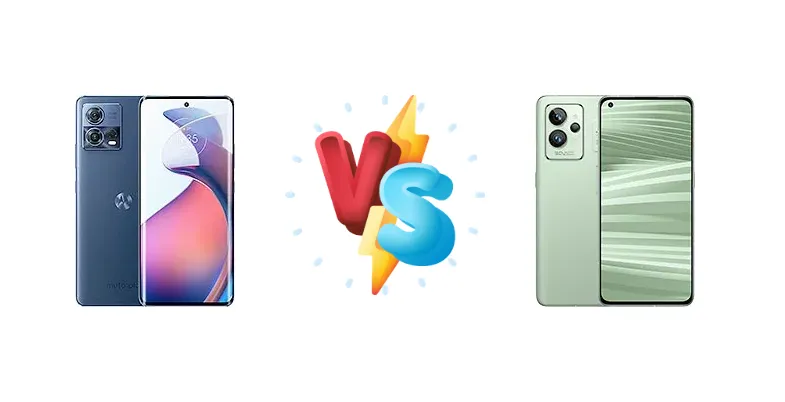
|
🏆 Quick Verdict
For most users, the Realme GT2 Pro emerges as the stronger choice. Its Snapdragon 8 Gen 1 chipset provides a noticeable performance uplift, and the 65W charging, completing a full charge in 33 minutes, is more convenient than the Moto S30 Pro’s 68W, which only reaches 50% in 10 minutes. While both offer similar battery endurance ratings, the GT2 Pro’s superior processing power justifies the slight trade-off.
| PHONES | ||
|---|---|---|
| Phone Names | Motorola Moto S30 Pro | Realme GT2 Pro |
| Network | ||
|---|---|---|
| 2G bands | GSM 850 / 900 / 1800 / 1900 | GSM 850 / 900 / 1800 / 1900 |
| 3G bands | HSDPA 850 / 900 / 1800 / 1900 / 2100 | HSDPA 800 / 850 / 900 / 1700(AWS) / 1900 / 2100 |
| 4G bands | LTE | 1, 2, 3, 4, 5, 7, 8, 12, 13, 17, 18, 19, 20, 25, 26, 28, 66 - International |
| 5G bands | SA/NSA/Sub6 | 1, 3, 5, 7, 8, 20, 28, 38, 40, 41, 66, 77, 78 SA/NSA |
| Speed | HSPA, LTE, 5G | HSPA, LTE, 5G |
| Technology | GSM / CDMA / HSPA / LTE / 5G | GSM / CDMA / HSPA / EVDO / LTE / 5G |
| CDMA 800 / 1900 | 1, 2, 3, 4, 5, 7, 8, 12, 13, 17, 18, 19, 20, 25, 26, 28, 34, 38, 39, 40, 41, 42, 66 - China, India | |
| Launch | ||
|---|---|---|
| Announced | 2022, August 11 | 2022, January 04 |
| Status | Available. Released 2022, August 11 | Available. Released 2022, January 08 |
| Body | ||
|---|---|---|
| Build | Glass front, glass back (Gorilla Glass 5) | - |
| Dimensions | 158.5 x 71.2 x 7.5 mm or 7.7 mm | 163.2 x 74.7 x 8.2 mm (6.43 x 2.94 x 0.32 in) |
| SIM | Nano-SIM + Nano-SIM | Nano-SIM + Nano-SIM |
| Weight | 172 g / 167 g (5.89 oz) | 189 / 199 g (6.67 oz) |
| Splash and dust resistant | Splash resistant | |
| Display | ||
|---|---|---|
| Protection | - | Corning Gorilla Glass Victus |
| Resolution | 1080 x 2400 pixels, 20:9 ratio (~402 ppi density) | 1440 x 3216 pixels, 20:9 ratio (~526 ppi density) |
| Size | 6.55 inches, 103.6 cm2 (~91.8% screen-to-body ratio) | 6.7 inches, 108.0 cm2 (~88.6% screen-to-body ratio) |
| Type | P-OLED, 1B colors, 144Hz, HDR10+ | LTPO2 AMOLED, 1B colors, 120Hz, HDR10+, 500 nits (typ), 800 nits (HBM), 1400 nits (peak) |
| Platform | ||
|---|---|---|
| CPU | Octa-core (1x2.99 GHz Cortex-X1 & 3x2.42 GHz Cortex-A78 & 4x1.80 GHz Cortex-A55) | Octa-core (1x3.00 GHz Cortex-X2 & 3x2.50 GHz Cortex-A710 & 4x1.80 GHz Cortex-A510) |
| Chipset | Qualcomm SM8350 Snapdragon 888+ 5G (5 nm) | Qualcomm SM8450 Snapdragon 8 Gen 1 (4 nm) |
| GPU | Adreno 660 | Adreno 730 |
| OS | Android 12, MYUI 4.0 | Android 12, upgradable to Android 13, Realme UI 4.0 |
| Memory | ||
|---|---|---|
| Card slot | No | No |
| Internal | 128GB 8GB RAM, 256GB 8GB RAM, 256GB 12GB RAM, 512GB 12GB RAM | 128GB 8GB RAM, 256GB 8GB RAM, 256GB 12GB RAM, 512GB 12GB RAM |
| UFS 3.1 | UFS 3.1 | |
| Main Camera | ||
|---|---|---|
| Features | LED flash, panorama, HDR | Color spectrum sensor, Dual-LED dual-tone flash, HDR, panorama |
| Single | - | 32 MP, f/2.4, 26mm (wide), 1/2.74", 0.8µm |
| Triple | 50 MP, f/1.8, (wide), 1/1.55", 1.0µm, PDAF, OIS 13 MP, f/2.2, 123˚ (ultrawide), 1.12µm Auxiliary lens | 50 MP, f/1.8, 24mm (wide), 1/1.56", 1.0µm, multi-directional PDAF, OIS 50 MP, f/2.2, 15mm, 150˚ (ultrawide), 1/2.76", 0.64µm 3 MP, f/3.3, 20mm (microscope), AF, 40x magnification |
| Video | 4K@30fps, 1080p@30ps, gyro-EIS | 8K@24fps, 4K@30/60fps, 1080p@30/60/240fps, gyro-EIS |
| Selfie camera | ||
|---|---|---|
| Features | - | HDR, panorama |
| Single | 32 MP, f/2.2, (wide), 1/2.8", AF | 32 MP, f/2.4, 26mm (wide), 1/2.74", 0.8µm |
| Video | 1080p@30fps | 1080p@30fps |
| Sound | ||
|---|---|---|
| 3.5mm jack | No | No |
| 35mm jack | No | No |
| Loudspeaker | Yes | Yes, with stereo speakers |
| - | 24-bit/192kHz audio | |
| Comms | ||
|---|---|---|
| Bluetooth | 5.2, A2DP, LE, aptX HD, aptX Adaptive | 5.2, A2DP, LE, aptX HD |
| NFC | Yes | Yes (dual side) |
| Positioning | GPS (L1+L5), GLONASS, BDS (B1I+B1c), GALILEO | GPS (L1+L5), GLONASS, BDS, GALILEO, QZSS, NavIC |
| Radio | No | No |
| USB | USB Type-C | USB Type-C 2.0, OTG |
| WLAN | Wi-Fi 802.11 a/b/g/n/ac/6e, dual-band, Wi-Fi Direct | Wi-Fi 802.11 a/b/g/n/ac/6, dual-band, Wi-Fi Direct |
| Features | ||
|---|---|---|
| Sensors | Fingerprint (under display, optical), accelerometer, gyro, proximity, compass | Fingerprint (under display, optical), accelerometer, gyro, proximity, compass |
| Ready For 3.5 support | - | |
| Battery | ||
|---|---|---|
| Charging | 68W wired, 50% in 10 min | 65W wired, 100% in 33 min |
| Type | Li-Po 4400 mAh | 5000 mAh |
| Misc | ||
|---|---|---|
| Colors | Blue, Black | Paper White, Paper Green, Steel Black, Titanium Blue |
| Models | XT2243-2 | RMX3301, RMX3300 |
| Price | About 330 EUR | € 221.41 |
| SAR | - | 1.16 W/kg (head) 0.53 W/kg (body) |
| Tests | ||
|---|---|---|
| Battery life | - | Endurance rating 117h |
| Camera | - | Photo / Video |
| Display | - | Contrast ratio: Infinite (nominal) |
| Loudspeaker | - | -26.3 LUFS (Good) |
| Performance | - | AnTuTu: 966251 (v9) GeekBench: 3501 (v5.1) GFXBench: 48fps (ES 3.1 onscreen) |
Motorola Moto S30 Pro
- Potentially lower price point
- Proven Snapdragon 888+ stability
- Competent overall performance
- Slower charging speed (0-100%)
- Older chipset architecture
- Display specs are unknown
Realme GT2 Pro
- Faster Snapdragon 8 Gen 1 processor
- Faster 65W full-charge capability
- Brighter display (778 nits)
- Potential for thermal throttling under sustained load
- May be more expensive
- Camera details are lacking
Display Comparison
The Realme GT2 Pro boasts a measured peak brightness of 778 nits, suggesting a more visible display in direct sunlight compared to the Moto S30 Pro (brightness data unavailable). While both feature an 'infinite' contrast ratio (nominal), the GT2 Pro’s display technology likely benefits from more advanced calibration. Without specific panel type information for the Moto S30 Pro, it’s difficult to assess potential differences in color accuracy or viewing angles, but Realme’s focus on display quality typically translates to a superior visual experience.
Camera Comparison
Both devices are listed as having Photo/Video capabilities, but detailed sensor information is missing. Without specifics, it’s impossible to definitively declare a winner. However, Realme often prioritizes camera performance in its 'GT' series, suggesting a potentially more sophisticated camera system. The absence of details regarding sensor size, aperture, or optical image stabilization (OIS) makes a precise comparison impossible. We can assume both will offer competent image capture, but the GT2 Pro likely benefits from more advanced image processing algorithms.
Performance
The core difference lies in the chipsets. The Realme GT2 Pro’s Snapdragon 8 Gen 1 (4nm) represents a significant architectural leap over the Moto S30 Pro’s Snapdragon 888+ (5nm). The Gen 1 features the newer Cortex-X2 prime core clocked at 3.00 GHz versus the X1 in the 888+ at 2.99 GHz, alongside more efficient Cortex-A710 cores. This translates to faster processing speeds and improved efficiency. While the 888+ remains capable, the 4nm process of the Gen 1 offers better thermal management, potentially reducing throttling during prolonged gaming sessions. Both phones utilize octa-core configurations, but the Gen 1’s architecture provides a clear advantage.
Battery Life
Both the Motorola Moto S30 Pro and Realme GT2 Pro share an endurance rating of 117 hours, indicating similar real-world battery life. However, the charging speeds differ significantly. The Realme GT2 Pro’s 65W charging completes a full charge in 33 minutes, offering a more convenient top-up experience. The Moto S30 Pro’s 68W charging, while seemingly faster, only reaches 50% in 10 minutes, implying a slower overall charge time. This difference in charging efficiency is a key advantage for the GT2 Pro.
Buying Guide
Buy the Motorola Moto S30 Pro if you prioritize a proven, thermally stable chipset and are seeking a potentially lower price point. It’s ideal for users who value consistent performance over raw power and don’t heavily rely on sustained, demanding tasks. Buy the Realme GT2 Pro if you demand the latest processing capabilities for gaming, video editing, or other intensive applications, and appreciate faster charging speeds. It’s the better choice for power users who want a future-proofed device.