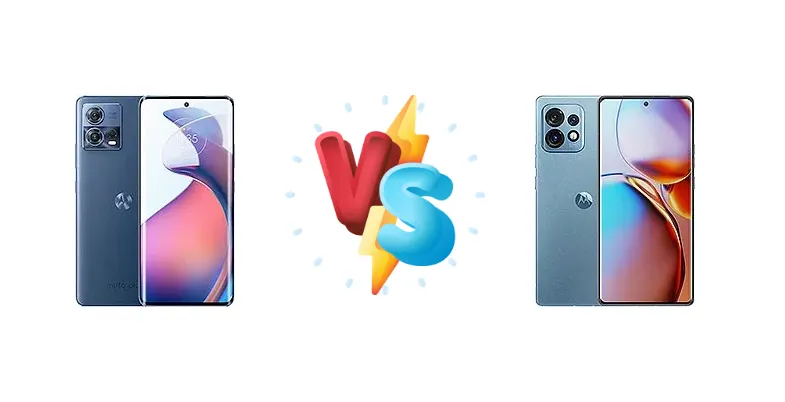
Motorola's lineup offers compelling options, but choosing between the Moto S30 Pro and the newer Moto X40 can be tricky. Both phones pack impressive features, but cater to slightly different users. This comprehensive comparison will help you decide which one deserves your money.
🏆 Quick Verdict
The Moto X40 is the clear winner, boasting a significantly faster Snapdragon 8 Gen 2 chipset, vastly superior charging speeds (125W!), and a more modern design. While the S30 Pro offers a solid experience, the X40's advancements make it the better overall choice for most users.
| Network |
|---|
| 2G bands | GSM 850 / 900 / 1800 / 1900 | GSM 850 / 900 / 1800 / 1900 |
| 3G bands | HSDPA 850 / 900 / 1800 / 1900 / 2100 | HSDPA 850 / 900 / 1700(AWS) / 1900 / 2100 |
| 4G bands | LTE | 1, 2, 3, 4, 5, 7, 8, 12, 13, 17, 18, 19, 20, 25, 26, 28, 32, 38, 39, 40, 41, 42, 43, 48, 66 |
| 5G bands | SA/NSA/Sub6 | 1, 2, 3, 5, 7, 8, 20, 28, 38, 40, 41, 66, 77, 78 SA/NSA/Sub6 |
| Speed | HSPA, LTE, 5G | HSPA, LTE, 5G |
| Technology | GSM / CDMA / HSPA / LTE / 5G | GSM / CDMA / HSPA / LTE / 5G |
| | CDMA 800 / 1900 | CDMA 800 |
| Launch |
|---|
| Announced | 2022, August 11 | 2022, December 15 |
| Status | Available. Released 2022, August 11 | Available. Released 2022, December 22 |
| Body |
|---|
| Build | Glass front, glass back (Gorilla Glass 5) | Glass front, glass back (Gorilla Glass Victus), aluminum frame |
| Dimensions | 158.5 x 71.2 x 7.5 mm or 7.7 mm | 161.2 x 74 x 8.6 mm (6.35 x 2.91 x 0.34 in) |
| SIM | Nano-SIM + Nano-SIM | Nano-SIM + Nano-SIM |
| Weight | 172 g / 167 g (5.89 oz) | 199 g (7.02 oz) |
| | Splash and dust resistant | IP68 dust/water resistant (up to 1.5m for 30 min) |
| Display |
|---|
| Resolution | 1080 x 2400 pixels, 20:9 ratio (~402 ppi density) | 1080 x 2400 pixels, 20:9 ratio (~393 ppi density) |
| Size | 6.55 inches, 103.6 cm2 (~91.8% screen-to-body ratio) | 6.7 inches, 108.4 cm2 (~90.9% screen-to-body ratio) |
| Type | P-OLED, 1B colors, 144Hz, HDR10+ | OLED, 1B colors, 165Hz, HDR10+ |
| Platform |
|---|
| CPU | Octa-core (1x2.99 GHz Cortex-X1 & 3x2.42 GHz Cortex-A78 & 4x1.80 GHz Cortex-A55) | Octa-core (1x3.2 GHz Cortex-X3 & 2x2.8 GHz Cortex-A715 & 2x2.8 GHz Cortex-A710 & 3x2.0 GHz Cortex-A510) |
| Chipset | Qualcomm SM8350 Snapdragon 888+ 5G (5 nm) | Qualcomm SM8550-AB Snapdragon 8 Gen 2 (4 nm) |
| GPU | Adreno 660 | Adreno 740 |
| OS | Android 12, MYUI 4.0 | Android 13, upgradable to Android 14, MYUI 6.0 |
| Memory |
|---|
| Card slot | No | No |
| Internal | 128GB 8GB RAM, 256GB 8GB RAM, 256GB 12GB RAM, 512GB 12GB RAM | 128GB 8GB RAM, 256GB 12GB RAM, 512GB 12GB RAM |
| | UFS 3.1 | UFS 3.1 - 128GB
UFS 4.0 - 256GB/512GB |
| Main Camera |
|---|
| Features | LED flash, panorama, HDR | Dual-LED flash, panorama, HDR |
| Triple | 50 MP, f/1.8, (wide), 1/1.55", 1.0µm, PDAF, OIS
13 MP, f/2.2, 123˚ (ultrawide), 1.12µm
Auxiliary lens | 50 MP, f/1.9, (wide), 1/1.55", 1.0µm, dual pixel PDAF, OIS
12 MP, f/1.6, (telephoto), 1/2.93", 1.22µm, PDAF, 2x optical zoom
50 MP, f/2.2, 117˚ (ultrawide), 1/2.76", 0.64µm, AF |
| Video | 4K@30fps, 1080p@30ps, gyro-EIS | 8K@30fps, 4K@30/60fps, 1080p@30/60/120/240/960fps, 10-bit HDR10+, gyro-EIS |
| Selfie camera |
|---|
| Features | - | HDR |
| Single | 32 MP, f/2.2, (wide), 1/2.8", AF | 60 MP, f/2.2, (wide), 1/2.8", 0.61µm |
| Video | 1080p@30fps | 4K@30fps, 1080p@30/60fps |
| Sound |
|---|
| 3.5mm jack | No | No |
| 35mm jack | No | No |
| Loudspeaker | Yes | Yes, with stereo speakers |
| Comms |
|---|
| Bluetooth | 5.2, A2DP, LE, aptX HD, aptX Adaptive | 5.3, A2DP, LE, aptX HD, aptX Adaptive |
| NFC | Yes | Yes |
| Positioning | GPS (L1+L5), GLONASS, BDS (B1I+B1c), GALILEO | GPS (L1+L5), GLONASS (L1), BDS (B1I+B1c+B2a), GALILEO (E1+E5a), QZSS (L1+L5) |
| Radio | No | No |
| USB | USB Type-C | USB Type-C, OTG |
| WLAN | Wi-Fi 802.11 a/b/g/n/ac/6e, dual-band, Wi-Fi Direct | Wi-Fi 802.11 a/b/g/n/ac/6e, dual-band, Wi-Fi Direct |
| Features |
|---|
| Sensors | Fingerprint (under display, optical), accelerometer, gyro, proximity, compass | Fingerprint (under display, optical), accelerometer, gyro, proximity, compass |
| | Ready For 3.5 support | Ready For 3.5 support |
| Battery |
|---|
| Charging | 68W wired, 50% in 10 min | 125W wired, PD3.0, QC5, 50% in 7 min
15W wireless
5W reverse wired |
| Type | Li-Po 4400 mAh | Li-Po 4600 mAh |
| Misc |
|---|
| Colors | Blue, Black | Black, Blue |
| Models | XT2243-2 | XT2301-5 |
| Price | About 330 EUR | About 540 EUR |
Motorola Moto S30 Pro
- Good value for money
- Smooth performance for everyday tasks
- Decent camera system
- 68W fast charging
- Older chipset
- Slower charging compared to X40
- Less premium design
- May lack some of the latest features
Motorola Moto X40
- Flagship Snapdragon 8 Gen 2 performance
- Blazing-fast 125W charging
- Likely superior display
- Improved camera system
- Premium design and build quality
- Higher price point
- Wireless charging may not be for everyone
Display Comparison
The Moto X40 likely features a brighter, higher resolution OLED display with a faster refresh rate (likely 144Hz) compared to the S30 Pro. Expect improved color accuracy and overall visual clarity on the X40. The S30 Pro's display is still good, but not in the same league.
Camera Comparison
While both phones offer capable camera systems, the Moto X40 likely has a more advanced setup with a larger sensor and improved image processing. Expect better low-light performance, more detail, and potentially more versatile shooting modes on the X40. The S30 Pro's camera is still respectable, but the X40 should offer a noticeable upgrade.
Performance
The Snapdragon 8 Gen 2 in the Moto X40 provides a substantial performance boost over the Snapdragon 888+ in the S30 Pro. Expect faster app loading, smoother multitasking, and significantly better gaming performance on the X40. The X40's newer architecture also offers improved power efficiency.
Battery Life
The Moto X40's 125W charging is a game-changer, allowing for incredibly fast charging times. The S30 Pro's 68W charging is still fast, but significantly slower. Both phones likely have similar battery capacities, but the X40's efficiency and charging speed give it a clear advantage.
Buying Guide
The Moto S30 Pro is a good choice for budget-conscious buyers who prioritize a smooth experience and don't need the absolute latest technology. The Moto X40 is ideal for power users, gamers, and anyone who values fast charging, top-tier performance, and a premium feel.
Frequently Asked Questions
❓ Is the Moto X40 worth the extra money?
If you prioritize performance, fast charging, and a premium experience, the Moto X40 is definitely worth the investment. However, if you're on a tighter budget, the S30 Pro still offers a solid Motorola experience.
❓ What is the difference between the Snapdragon 888+ and the Snapdragon 8 Gen 2?
The Snapdragon 8 Gen 2 is a significantly newer and more powerful chipset than the 888+. It offers improved CPU and GPU performance, better power efficiency, and advanced features like AI processing.