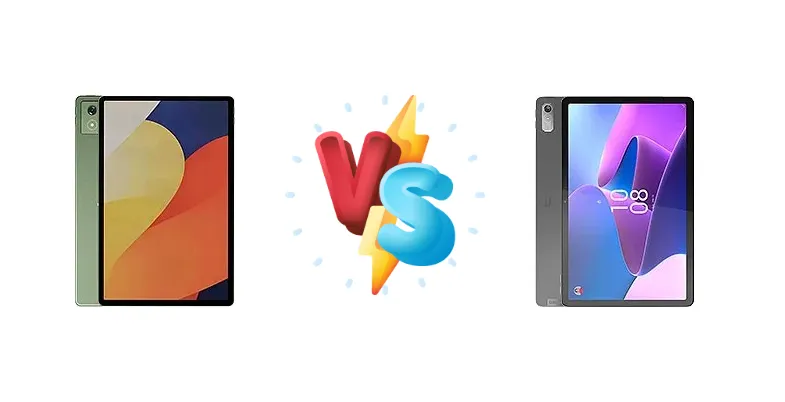
The Android tablet market is heating up, with the Motorola Moto Pad 60 Pro and Lenovo Tab P11 Pro Gen 2 vying for attention. While both aim to deliver a premium experience, they take distinctly different approaches to performance and value. The Moto Pad 60 Pro leverages a newer, more powerful chipset, while the Lenovo Tab P11 Pro Gen 2 focuses on a refined experience within a more established product line.
🏆 Quick Verdict
For users prioritizing raw performance and future-proofing, the Motorola Moto Pad 60 Pro is the clear winner. Its Mediatek Dimensity 8300 chipset offers a significant leap in processing power over the Lenovo Tab P11 Pro Gen 2’s Kompanio 1300T. However, the Lenovo remains a compelling option for those seeking a balanced experience at a potentially lower price point.
| Network |
|---|
| 2G bands | N/A | GSM 850 / 900 / 1800 / 1900 |
| 3G bands | N/A | HSDPA 850 / 900 / 1900 / 2100 |
| 4G bands | N/A | LTE |
| EDGE | No | - |
| GPRS | No | - |
| Speed | - | HSPA, LTE - cellular model only |
| Technology | No cellular connectivity | GSM / HSPA / LTE |
| Launch |
|---|
| Announced | 2025, April 17 | 2022, September 01 |
| Status | Available. Released 2025, April 23 | Available. Released 2022, September 01 |
| Body |
|---|
| Build | Glass front, aluminum frame, aluminum back | Glass front, plastic back, plastic frame |
| Dimensions | 291.8 x 189.1 x 6.9 mm (11.49 x 7.44 x 0.27 in) | 263.7 x 166.7 x 6.8 mm (10.38 x 6.56 x 0.27 in) |
| SIM | No | Nano-SIM (cellular model only) |
| Weight | 620 g (1.37 lb) | 480 g (1.06 lb) |
| | - | Stylus support (magnetic) |
| Display |
|---|
| Resolution | 2944 x 1840 pixels, 16:10 ratio (~273 ppi density) | 1536 x 2560 pixels, 5:3 ratio (~267 ppi density) |
| Size | 12.7 inches, 467.7 cm2 (~84.8% screen-to-body ratio) | 11.2 inches, 357.0 cm2 (~81.2% screen-to-body ratio) |
| Type | IPS LCD, 144Hz, HDR10, 400 nits | OLED, HDR10+, Dolby Vision, 120Hz, 420 nits (typ), 600 nits (peak) |
| Platform |
|---|
| CPU | Octa-core (1x3.35 GHz Cortex-A715 & 3x3.20 GHz Cortex-A715 & 4x2.20 GHz Cortex-A510) | Octa-core (4x2.6 GHz Cortex-A78 & 4x2.0 GHz Cortex-A55) |
| Chipset | Mediatek Dimensity 8300 (4 nm) | Mediatek MT8797 Kompanio 1300T (6 nm) |
| GPU | Mali G615-MC6 | Mali-G77 MC9 |
| OS | Android 14, up to 2 major Android upgrades | Android 12, upgradable to Android 13 |
| Memory |
|---|
| Card slot | microSDXC | microSDXC (dedicated slot) |
| Internal | 128GB 8GB RAM, 256GB 12GB RAM | 128GB 4GB RAM, 128GB 6GB RAM, 256GB 8GB RAM |
| | - | UFS 3.1 |
| Main Camera |
|---|
| Features | LED flash | LED flash |
| Single | 13 MP, (wide), AF | 13 MP, f/2.4, (wide), AF |
| Video | Yes | 1080p@30fps |
| Selfie camera |
|---|
| Single | 8 MP | 8 MP |
| Video | 1080p@30fps | 1080p@30fps |
| Sound |
|---|
| 3.5mm jack | - | No |
| 35mm jack | No | No |
| Loudspeaker | Yes, with stereo speakers (4 speakers) | Yes, with stereo speakers (4 speakers) |
| | - | Tuned by JBL |
| Comms |
|---|
| Bluetooth | 5.3, A2DP, LE | 5.1, A2DP, LE |
| NFC | No | No |
| Positioning | GPS, GALILEO, GLONASS | GPS, GLONASS - cellular model only |
| Radio | No | No |
| USB | USB Type-C 3.2, DisplayPort, OTG, accessory connector pins | USB Type-C 3.0, OTG, magnetic connector, video output |
| WLAN | Wi-Fi 802.11 a/b/g/n/ac/6e, dual-band, Wi-Fi Direct | Wi-Fi 802.11 a/b/g/n/ac/6, dual-band, Wi-Fi Direct |
| Features |
|---|
| Sensors | Fingerprint (side-mounted), accelerometer, gyro, proximity (accessories only), compass | Accelerometer, gyro, proximity, compass |
| Battery |
|---|
| Charging | 45W wired
Reverse wired | 20W wired, QC3 |
| Type | Li-Po 10200 mAh | Li-Po 8200 mAh |
| Misc |
|---|
| Colors | Pantone: Bronze Green | Storm Grey, Oat |
| Models | - | ZAB50194GB, ZAB50043SE |
| Price | About 280 EUR | About 500 EUR |
| Tests |
|---|
| Performance | - |
AnTuTu: 616573 (v9)
GeekBench: 2827 (v5.1) |
Motorola Moto Pad 60 Pro
- Significantly more powerful processor (Dimensity 8300)
- Faster 45W wired charging
- Potentially better thermal management due to 4nm process
- Price may be higher than the Lenovo Tab P11 Pro Gen 2
- Specific display details currently unknown
Lenovo Tab P11 Pro Gen 2
- Potentially more affordable price point
- Refined and established product line
- Likely features a high-quality OLED display
- Less powerful processor (Kompanio 1300T)
- Slower 20W charging
- 6nm process may lead to more thermal throttling
Display Comparison
While specific display specs are missing, the Lenovo Tab P11 Pro Gen 2 is known for its high-quality OLED panel. The Moto Pad 60 Pro’s display details are currently unavailable, but given its positioning, it likely features an LCD or OLED panel. The key difference lies in the underlying processing power driving the display; the Dimensity 8300 in the Moto Pad 60 Pro will likely handle graphically intensive tasks more smoothly, resulting in a more fluid visual experience. Bezels are likely comparable, given both target a similar premium aesthetic.
Camera Comparison
Camera details are limited for both devices. However, given the market segment, we can expect both tablets to feature capable cameras for video conferencing and casual photography. The Moto Pad 60 Pro, being the newer device, may benefit from more advanced image processing algorithms. Without specific sensor size or aperture information, it’s difficult to definitively declare a winner, but the newer chipset in the Moto Pad 60 Pro suggests a potential edge in image quality.
Performance
The Motorola Moto Pad 60 Pro’s Mediatek Dimensity 8300 (4nm) is a significant upgrade over the Lenovo Tab P11 Pro Gen 2’s Mediatek MT8797 Kompanio 1300T (6nm). The 4nm process node of the Dimensity 8300 translates to improved power efficiency and reduced thermal throttling, crucial for sustained performance. The CPU architecture also favors the Moto Pad 60 Pro; its Cortex-A715 cores, clocked up to 3.35 GHz, offer a performance advantage over the Lenovo’s Cortex-A78 cores at 2.6 GHz. This difference will be most noticeable in demanding applications and multitasking scenarios. The Moto Pad 60 Pro is expected to have faster LPDDR5x RAM, further boosting performance.
Battery Life
The Moto Pad 60 Pro’s 45W wired charging is a substantial advantage over the Lenovo Tab P11 Pro Gen 2’s 20W charging with QC3. This means significantly faster recharge times for the Moto Pad 60 Pro. While battery capacity isn’t specified for either device, the faster charging speed mitigates any potential disadvantage if the Moto Pad 60 Pro has a slightly smaller battery. The Lenovo’s QC3 support offers some fast charging capability, but it’s considerably slower than the Moto Pad 60 Pro’s 45W implementation.
Buying Guide
Buy the Motorola Moto Pad 60 Pro if you need a tablet capable of handling demanding tasks like video editing, gaming, or running multiple applications simultaneously. Its superior chipset and faster charging will be invaluable for power users. Buy the Lenovo Tab P11 Pro Gen 2 if you prioritize a refined, all-around tablet experience for media consumption, light productivity, and casual gaming, and are looking for a potentially more affordable option.
Frequently Asked Questions
❓ Will the Mediatek Dimensity 8300 in the Moto Pad 60 Pro handle demanding games like Genshin Impact at high settings?
Yes, the Dimensity 8300 is a powerful chipset capable of running demanding games like Genshin Impact at high settings with smooth frame rates. The 4nm process and advanced CPU architecture will minimize throttling during extended gaming sessions, providing a consistent experience.
❓ Is the 20W charging on the Lenovo Tab P11 Pro Gen 2 slow compared to modern smartphones?
While 20W is slower than the 45W charging on the Moto Pad 60 Pro, it's still a reasonable charging speed for a tablet. Expect a full charge to take around 2-3 hours. However, users who frequently need to top up their tablet quickly will find the Moto Pad 60 Pro's 45W charging significantly more convenient.
❓ Does the Lenovo Tab P11 Pro Gen 2 support stylus input and keyboard accessories?
Yes, the Lenovo Tab P11 Pro Gen 2 is designed to be used with stylus input and keyboard accessories, enhancing its productivity capabilities. Lenovo often offers official accessories specifically designed for their tablets.
❓ How does the Kompanio 1300T chipset perform with multitasking and running multiple apps simultaneously?
The Kompanio 1300T is capable of handling moderate multitasking. However, compared to the Dimensity 8300, it may exhibit some slowdowns when running a large number of apps or demanding applications concurrently. The Moto Pad 60 Pro will provide a smoother multitasking experience.