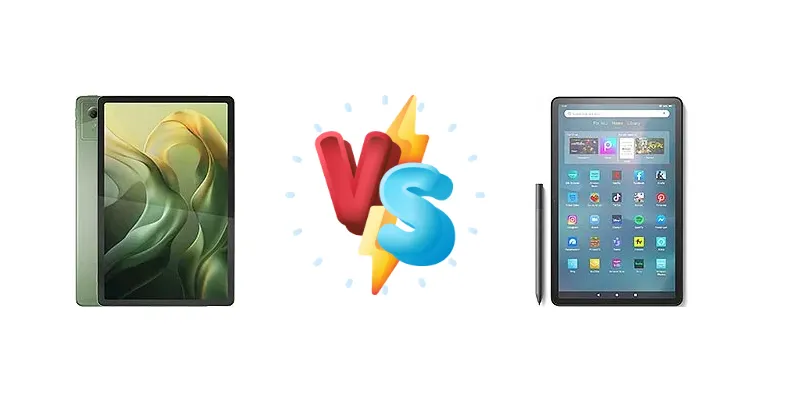
The Motorola Moto Pad 60 Neo and Amazon Fire Max 11 occupy a similar price bracket, aiming to deliver a compelling tablet experience without breaking the bank. However, they take distinctly different approaches to achieving this. The Moto Pad 60 Neo prioritizes a more modern chipset and faster charging, while the Fire Max 11 leverages Amazon’s ecosystem and a slightly different processor architecture. This comparison dives deep into the specifics to determine which tablet best suits your needs.
🏆 Quick Verdict
For most users, the Motorola Moto Pad 60 Neo emerges as the stronger choice. Its Mediatek Dimensity 6300 chipset, built on a 6nm process, offers a performance edge over the Fire Max 11’s MT8188J, translating to smoother multitasking and a more responsive user experience. While the Fire Max 11 benefits from Amazon’s software optimizations, the Neo’s raw processing power and faster 20W charging provide a more well-rounded package.
| Network |
|---|
| 2G bands | GSM 850 / 900 / 1800 / 1900 | N/A |
| 3G bands | HSDPA 850 / 900 / 2100 | - |
| 4G bands | LTE | - |
| 5G bands | SA/NSA/Sub6 | - |
| EDGE | - | No |
| GPRS | - | No |
| Speed | HSPA, LTE, 5G | - |
| Technology | GSM / HSPA / LTE / 5G | No cellular connectivity |
| Launch |
|---|
| Announced | 2025, September 12 | 2023, May 23 |
| Status | Available. Released 2025, September 22 | Available. Released 2023, May 23 |
| Body |
|---|
| Build | Glass front, aluminum frame, aluminum back | - |
| Dimensions | 254.6 x 166.2 x 7 mm (10.02 x 6.54 x 0.28 in) | 259.1 x 163.7 x 7.5 mm (10.20 x 6.44 x 0.30 in) |
| SIM | Nano-SIM | No |
| Weight | 480 g (1.06 lb) | 490 g (1.08 lb) |
| Display |
|---|
| Resolution | 1600 x 2560 pixels, 16:10 ratio (~274 ppi density) | 2000 x 1200 pixels, 5:3 ratio (~212 ppi density) |
| Size | 11.0 inches, 350.9 cm2 (~82.9% screen-to-body ratio) | 11.0 inches, 344.4 cm2 (~81.2% screen-to-body ratio) |
| Type | IPS LCD, 90Hz, 500 nits | IPS LCD |
| Platform |
|---|
| CPU | Octa-core (2x2.4 GHz Cortex-A76 & 6x2.0 GHz Cortex-A55) | Octa-core (2x2.2 GHz Cortex-A78 & 6x2.0 GHz Cortex-A55) |
| Chipset | Mediatek Dimensity 6300 (6 nm) | Mediatek MT8188J |
| GPU | Mali-G57 MC2 | Mali-G57 MC2 |
| OS | Android 15 | Android 11, Fire OS 8 |
| Memory |
|---|
| Card slot | microSDXC | microSDXC (dedicated slot) |
| Internal | 128GB 8GB RAM | 64GB 4GB RAM, 128GB 4GB RAM |
| Main Camera |
|---|
| Features | LED flash | - |
| Single | 8 MP, (wide) | 8 MP, AF |
| Video | Yes | 1080p |
| Selfie camera |
|---|
| Single | 5 MP | 8 MP |
| Video | Yes | 1080p |
| Sound |
|---|
| 35mm jack | Yes | No |
| Loudspeaker | Yes, with stereo speakers, Dolby Atmos (4 speakers) | Yes, with stereo speakers |
| Comms |
|---|
| Bluetooth | 5.2, A2DP, LE | 5.3, A2DP, LE |
| NFC | No | No |
| Positioning | GPS, GALILEO, GLONASS | No |
| Radio | No | No |
| USB | USB Type-C 2.0 | USB Type-C 2.0, OTG, magnetic accessory connector |
| WLAN | Wi-Fi 802.11 a/b/g/n/ac, dual-band | Wi-Fi 802.11 a/b/g/n/ac/6, dual-band |
| Features |
|---|
| Sensors | Accelerometer, proximity (accessories only) | Fingerprint (side-mounted), accelerometer, proximity (accessories only) |
| Battery |
|---|
| Charging | 20W wired | 15W wired |
| Type | 7040 mAh | Li-Ion |
| Misc |
|---|
| Colors | Pantone: Bronze Green | Gray |
| Models | - | KFSNWI |
| Price | About 170 EUR | About 270 EUR |
Motorola Moto Pad 60 Neo
- Faster processor (Dimensity 6300)
- Faster charging (20W)
- More efficient 6nm process
- Amazon ecosystem integration absent
- Camera specs unknown
Amazon Fire Max 11
- Amazon ecosystem integration
- Show Mode and Alexa support
- Potentially longer battery life (depending on capacity)
- Slower processor (MT8188J)
- Slower charging (15W)
- Less powerful GPU
Display Comparison
While both tablets likely feature LCD panels (specifications not provided), the core difference lies in the processing power driving them. Display quality details like resolution and refresh rate are missing, but the chipset’s ability to efficiently render graphics will impact perceived smoothness. Bezels are a key factor, and without specific data, it's difficult to assess which device offers a more immersive viewing experience. Color accuracy is also unknown, but the Dimensity 6300’s integrated image signal processor (ISP) *could* contribute to better color reproduction during photo and video playback.
Camera Comparison
Camera details are sparse for both devices. Without knowing sensor sizes, apertures, or image processing capabilities, a direct comparison is challenging. However, the Dimensity 6300’s ISP is likely more advanced than the one found in the MT8188J, potentially leading to better image quality in various lighting conditions. The presence of Optical Image Stabilization (OIS) would be a significant advantage, but this information is unavailable. It’s safe to assume both tablets prioritize basic photography for casual use rather than high-end image capture.
Performance
The Mediatek Dimensity 6300 in the Moto Pad 60 Neo, fabricated on a 6nm node, represents a significant architectural advantage over the Fire Max 11’s Mediatek MT8188J. The Neo’s CPU configuration – 2x2.4 GHz Cortex-A76 and 6x2.0 GHz Cortex-A55 – provides a performance boost over the Fire Max 11’s 2x2.2 GHz Cortex-A78 and 6x2.0 GHz Cortex-A55. The Cortex-A76 cores in the Dimensity 6300 are generally more efficient and powerful than the A78 cores in the MT8188J. This translates to faster app loading times, smoother multitasking, and improved gaming performance. The 6nm process also contributes to better thermal management, potentially reducing throttling during sustained workloads. RAM specifications are missing, but faster LPDDR5x RAM would further enhance the Neo’s performance.
Battery Life
Battery capacity is not specified for either device. However, the Moto Pad 60 Neo’s 20W wired charging is a clear advantage over the Fire Max 11’s 15W charging. This means the Neo will reach a full charge significantly faster, minimizing downtime. While a larger battery capacity on the Fire Max 11 could offset the slower charging, the Dimensity 6300’s 6nm efficiency could result in comparable or even better battery life despite a potentially smaller battery size. Real-world usage will ultimately determine which tablet offers superior endurance.
Buying Guide
Buy the Motorola Moto Pad 60 Neo if you need a tablet for demanding tasks like gaming, video editing, or running multiple apps simultaneously. Its superior chipset and faster charging are crucial for power users. Buy the Amazon Fire Max 11 if you are deeply embedded in the Amazon ecosystem, primarily consume media (streaming video, reading), and value the integrated features like Show Mode and Alexa voice control. It’s a solid choice for casual users who prioritize simplicity and content consumption.
Frequently Asked Questions
❓ Will the Mediatek Dimensity 6300 in the Moto Pad 60 Neo handle demanding games like Genshin Impact?
The Dimensity 6300 is a capable mid-range chipset. While it won't deliver flagship-level performance, it should be able to run Genshin Impact at medium settings with acceptable frame rates. The 6nm process helps mitigate thermal throttling, allowing for sustained performance during gaming sessions. However, expect some compromises in graphical fidelity.
❓ How much does Amazon’s Fire OS affect the user experience on the Fire Max 11 compared to standard Android?
Amazon’s Fire OS is a heavily customized version of Android. It prioritizes Amazon’s services and content, with a strong emphasis on the Amazon Appstore. This means you may not have access to the full Google Play Store and its extensive app library. The interface is also different, and you’ll encounter Amazon’s advertising and recommendations throughout the system. This can be a benefit for Amazon loyalists, but a drawback for those who prefer a stock Android experience.
❓ Is the lack of Google Play Services on the Fire Max 11 a major limitation?
Yes, the absence of Google Play Services is a significant limitation for many users. It means you can't directly install apps that rely on Google's APIs, such as Google Maps, Gmail, and many popular games. While workarounds exist (sideloading apps), they are not officially supported and can be complex for less tech-savvy users.