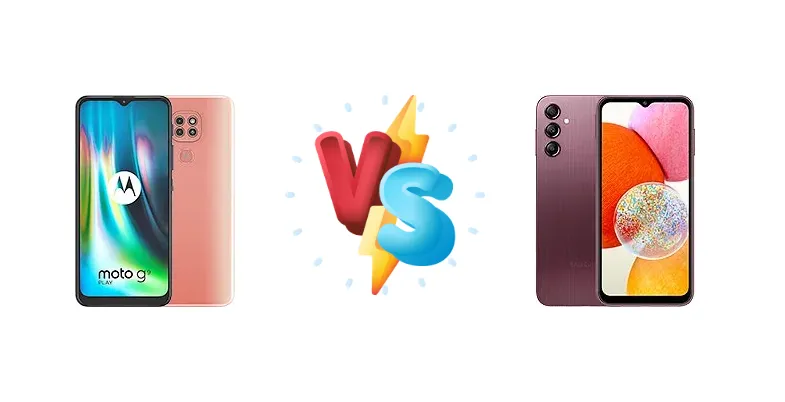
The budget smartphone market is fiercely competitive, offering incredible value for money. Today, we're pitting two popular contenders against each other: the Motorola Moto G9 Play and the Samsung Galaxy A14. Let's dive into a detailed comparison to see which phone reigns supreme.
🏆 Quick Verdict
The Samsung Galaxy A14 edges out the Moto G9 Play thanks to its more modern chipset, potentially better software support, and slightly more refined design. While the Moto G9 Play offers a strong contrast ratio display, the A14's overall package provides a more compelling experience for most users.
| Network |
|---|
| 2G bands | GSM 850 / 900 / 1800 / 1900 | GSM 850 / 900 / 1800 / 1900 |
| 3G bands | HSDPA 850 / 900 / 1900 / 2100 | HSDPA 850 / 900 / 2100 |
| 4G bands | 1, 2, 3, 5, 7, 8, 18, 19, 20, 26, 28, 38, 40, 41 | 1, 3, 5, 7, 8, 20, 28, 38, 40, 41 |
| EDGE | Class 10 | - |
| GPRS | Class 10 | - |
| Speed | HSPA 42.2/5.76 Mbps, LTE Cat4 150/50 Mbps | HSPA, LTE |
| Technology | GSM / HSPA / LTE | GSM / HSPA / LTE |
| Launch |
|---|
| Announced | 2020, August 24. Released 2020, August 28 | 2023, February 28 |
| Status | Discontinued | Available. Released 2023, March 27 |
| Body |
|---|
| Build | Glass front, plastic back, plastic frame | Glass front, plastic back, plastic frame |
| Dimensions | 165.2 x 75.7 x 9.2 mm (6.50 x 2.98 x 0.36 in) | 167.7 x 78 x 9.1 mm (6.60 x 3.07 x 0.36 in) |
| Keyboard | QWERTY | - |
| SIM | · Nano-SIM· Nano-SIM + Nano-SIM | · Nano-SIM· Nano-SIM + Nano-SIM |
| Weight | 200 g (7.05 oz) | 201 g (7.09 oz) |
| | Water-repellent coating | - |
| Display |
|---|
| Resolution | 720 x 1600 pixels, 20:9 ratio (~269 ppi density) | 1080 x 2408 pixels, 20:9 ratio (~400 ppi density) |
| Size | 6.5 inches, 102.8 cm2 (~82.2% screen-to-body ratio) | 6.6 inches, 104.9 cm2 (~80.2% screen-to-body ratio) |
| Type | IPS LCD | PLS LCD |
| Platform |
|---|
| CPU | Octa-core (4x2.0 GHz Kryo 260 Gold & 4x1.8 GHz Kryo 260 Silver) | Octa-core (2x2.0 GHz Cortex-A75 & 6x1.8 GHz Cortex-A55) - Version AOcta-core (4x2.0 GHz Cortex-A55 & 4x2.0 GHz Cortex-A55) - Version B |
| Chipset | Qualcomm SM6115 Snapdragon 662 (11 nm) | Mediatek MT6769 Helio G80 (12 nm) - Version AExynos 850 (8 nm) - Version B |
| GPU | Adreno 610 | Mali-G52 MC2 |
| OS | Android 10, upgradable to Android 11 | Android 13, upgradable to Android 15, One UI 7 |
| Memory |
|---|
| Card slot | microSDXC (uses shared SIM slot) | microSDXC (dedicated slot) |
| Internal | 64GB 4GB RAM, 128GB 4GB RAM | 64GB 4GB RAM, 128GB 4GB RAM, 128GB 6GB RAM |
| Main Camera |
|---|
| Features | LED flash, HDR, panorama | LED flash, panorama, HDR |
| Single | 1.3 MP | 13 MP, f/2.0, (wide) |
| Triple | 48 MP, f/1.7, (wide), 1/2.0", 0.8µm, PDAF
2 MP (macro)
Auxiliary lens | 50 MP, f/1.8, 26mm (wide), 1/2.75", 0.64µm, PDAF
5 MP, f/2.2, 17mm (ultrawide), 1/5.0", 1.12µm
2 MP (macro) |
| Video | 1080p@30/60fps | 1080p@30fps |
| Selfie camera |
|---|
| Features | HDR | - |
| Single | 8 MP, f/2.2, 1.12µm | 13 MP, f/2.0, 26mm (wide), 1/3.1", 1.12µm |
| Video | 1080p@30fps | 1080p@30fps |
| Sound |
|---|
| 3.5mm jack | Yes | Yes |
| 35mm jack | Yes | Yes |
| Loudspeaker | Yes | Yes |
| Comms |
|---|
| Bluetooth | 5.0, A2DP, LE | 5.1 or 5.3, A2DP, LE |
| Infrared port | Yes | - |
| NFC | Yes | Yes (market/region dependent) |
| Positioning | GPS, GLONASS, GALILEO | GPS, GALILEO, GLONASS, BDS, QZSS |
| Radio | FM radio | Unspecified |
| USB | USB Type-C 2.0 | USB Type-C 2.0 |
| WLAN | Wi-Fi 802.11 a/b/g/n/ac, dual-band, Wi-Fi Direct | Wi-Fi 802.11 a/b/g/n/ac, dual-band, Wi-Fi Direct |
| Features |
|---|
| Browser | WAP 2.0/xHTML, HTML (PocketIE) | - |
| Sensors | Fingerprint (rear-mounted), accelerometer, gyro, proximity | Fingerprint (side-mounted), accelerometer, proximity, compass |
| Battery |
|---|
| Charging | 20W wired | 15W wired |
| Type | Li-Po 5000 mAh | Li-Po 5000 mAh |
| Misc |
|---|
| Colors | Forest Green, Sapphire Blue, Spring Pink | Black, Dark Red, Silver, Green |
| Models | XT2083, XT2083-1 | SM-A145F, SM-A145F/DSN, SM-A145M, SM-A145M/DS, SM-A145P, SM-A145R |
| Price | About 430 EUR | € 85.76 / $ 147.60 / £ 79.95 |
| SAR EU | - | 0.46 W/kg (head) 1.37 W/kg (body) |
| Tests |
|---|
| Camera |
Photo / Video | - |
| Display |
Contrast ratio: 1944:1 | - |
| Loudspeaker |
-27.6 LUFS (Good)
| - |
| Performance |
AnTuTu: 170064 (v8)
GeekBench: 1402 (v5.1)
GFXBench: 13fps (ES 3.1 onscreen) | - |
Motorola Moto G9 Play
- Excellent contrast ratio display
- Clean Android experience
- Potentially longer battery life due to larger capacity
- Older chipset
- Potentially shorter software support
- Camera performance not exceptional
Samsung Galaxy A14
- More modern chipset (Exynos 850 or Helio G80)
- Likely longer software support
- Potentially better camera processing
- Slightly more premium design
- Slower charging (15W)
- LCD display (likely)
- Performance can vary depending on chipset version
Display Comparison
The Moto G9 Play boasts an impressive 1944:1 contrast ratio, promising deep blacks and vibrant colors. Its 465 nits brightness is respectable. The Galaxy A14's display is likely to be a standard LCD, though specific brightness and contrast details are not provided. Expect good color accuracy but potentially less dramatic contrast than the Moto G9 Play.
Camera Comparison
Both phones offer 'Photo / Video' capabilities, but specifics are lacking. The Galaxy A14 is likely to have a more versatile camera system with potentially better image processing due to Samsung's software expertise. The Moto G9 Play's camera performance is generally considered adequate but not exceptional.
Performance
The Samsung Galaxy A14, particularly the Exynos 850 version, generally offers better performance than the Moto G9 Play's Snapdragon 662. The A14's CPU architecture (Cortex-A75 cores) provides a performance boost for demanding tasks. The Moto G9 Play's Snapdragon 662 is still capable for everyday use, but may struggle with heavier gaming or multitasking.
Battery Life
Both phones likely offer all-day battery life. The Moto G9 Play typically has a larger battery capacity (5000mAh), which could translate to slightly longer usage. However, the Galaxy A14's more efficient chipset could offset this difference.
Buying Guide
The Motorola Moto G9 Play is ideal for users prioritizing a high contrast display and a simple, straightforward Android experience. The Samsung Galaxy A14 is a better choice for those seeking a more modern chipset, longer software support, and a slightly more premium feel.
Frequently Asked Questions
❓ Which phone has better gaming performance?
The Samsung Galaxy A14, especially with the Exynos 850 chipset, generally offers better gaming performance due to its more modern CPU architecture.
❓ How long will Samsung support the Galaxy A14 with software updates?
Samsung typically provides longer software support for its Galaxy A series devices compared to Motorola, so the A14 is likely to receive more updates over its lifespan.