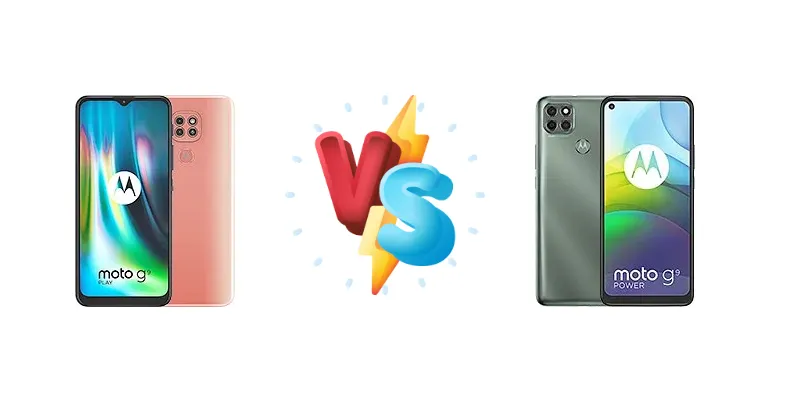
Motorola's G-series consistently delivers excellent value, and the Moto G9 Play and G9 Power are no exception. Both offer compelling features at affordable prices, but cater to slightly different needs. This comprehensive comparison will help you decide which phone is the right fit for you.
🏆 Quick Verdict
The Moto G9 Power wins for most users thanks to its massive battery and brighter display. However, the G9 Play offers a slightly better contrast ratio and a more competitive price point, making it a solid choice for those prioritizing affordability and a decent screen.
| Network |
|---|
| 2G bands | GSM 850 / 900 / 1800 / 1900 | GSM 850 / 900 / 1800 / 1900 |
| 3G bands | HSDPA 850 / 900 / 1900 / 2100 | HSDPA 850 / 900 / 1700(AWS) / 1900 / 2100 |
| 4G bands | 1, 2, 3, 5, 7, 8, 18, 19, 20, 26, 28, 38, 40, 41 | 1, 2, 3, 4, 5, 7, 8, 18, 19, 20, 26, 28, 38, 40, 41 - Europe, APEM |
| EDGE | Class 10 | - |
| GPRS | Class 10 | - |
| Speed | HSPA 42.2/5.76 Mbps, LTE Cat4 150/50 Mbps | HSPA, LTE |
| Technology | GSM / HSPA / LTE | GSM / HSPA / LTE |
| | - | 1, 2, 3, 4, 5, 7, 28, 66 - LATAM |
| Launch |
|---|
| Announced | 2020, August 24. Released 2020, August 28 | 2020, November 05. Released 2020, December 05 |
| Status | Discontinued | Discontinued |
| Body |
|---|
| Build | Glass front, plastic back, plastic frame | Glass front (Gorilla Glass 2), plastic back, plastic frame |
| Dimensions | 165.2 x 75.7 x 9.2 mm (6.50 x 2.98 x 0.36 in) | 172.1 x 76.8 x 9.7 mm (6.78 x 3.02 x 0.38 in) |
| Keyboard | QWERTY | - |
| SIM | · Nano-SIM· Nano-SIM + Nano-SIM | · Nano-SIM· Nano-SIM + Nano-SIM |
| Weight | 200 g (7.05 oz) | 221 g (7.80 oz) |
| | Water-repellent coating | Water-repellent coating |
| Display |
|---|
| Protection | - | Corning Gorilla Glass 2 |
| Resolution | 720 x 1600 pixels, 20:9 ratio (~269 ppi density) | 720 x 1640 pixels (~263 ppi density) |
| Size | 6.5 inches, 102.8 cm2 (~82.2% screen-to-body ratio) | 6.8 inches, 109.8 cm2 (~83.1% screen-to-body ratio) |
| Type | IPS LCD | IPS LCD |
| Platform |
|---|
| CPU | Octa-core (4x2.0 GHz Kryo 260 Gold & 4x1.8 GHz Kryo 260 Silver) | Octa-core (4x2.0 GHz Kryo 260 Gold & 4x1.8 GHz Kryo 260 Silver) |
| Chipset | Qualcomm SM6115 Snapdragon 662 (11 nm) | Qualcomm SM6115 Snapdragon 662 (11 nm) |
| GPU | Adreno 610 | Adreno 610 |
| OS | Android 10, upgradable to Android 11 | Android 10, upgradable to Android 11 |
| Memory |
|---|
| Card slot | microSDXC (uses shared SIM slot) | microSDXC (uses shared SIM slot) |
| Internal | 64GB 4GB RAM, 128GB 4GB RAM | 64GB 4GB RAM, 128GB 4GB RAM |
| Main Camera |
|---|
| Features | LED flash, HDR, panorama | LED flash, HDR, panorama |
| Single | 1.3 MP | 8 MP, f/2.6, 1/3", AF |
| Triple | 48 MP, f/1.7, (wide), 1/2.0", 0.8µm, PDAF
2 MP (macro)
Auxiliary lens | 64 MP, f/1.8, 26mm (wide), 1/1.97", 0.7µm, PDAF
2 MP (macro), AF
Auxiliary lens |
| Video | 1080p@30/60fps | 1080p@30/60fps |
| Selfie camera |
|---|
| Features | HDR | HDR |
| Single | 8 MP, f/2.2, 1.12µm | 16 MP, f/2.2, 1.0µm |
| Video | 1080p@30fps | 1080p@30fps |
| Sound |
|---|
| 3.5mm jack | Yes | Yes |
| 35mm jack | Yes | Yes |
| Loudspeaker | Yes | Yes |
| Comms |
|---|
| Bluetooth | 5.0, A2DP, LE | 5.0, A2DP, LE |
| Infrared port | Yes | - |
| NFC | Yes | Yes (market/region dependent) |
| Positioning | GPS, GLONASS, GALILEO | GPS, GLONASS, GALILEO |
| Radio | FM radio | FM radio |
| USB | USB Type-C 2.0 | USB Type-C 2.0 |
| WLAN | Wi-Fi 802.11 a/b/g/n/ac, dual-band, Wi-Fi Direct | Wi-Fi 802.11 a/b/g/n/ac, dual-band, Wi-Fi Direct |
| Features |
|---|
| Browser | WAP 2.0/xHTML, HTML (PocketIE) | - |
| Sensors | Fingerprint (rear-mounted), accelerometer, gyro, proximity | Fingerprint (rear-mounted), accelerometer, gyro, proximity |
| Battery |
|---|
| Charging | 20W wired | 20W wired |
| Stand-by | - | Up to 590 h (2G) / Up to 790 h (3G) |
| Talk time | - | Up to 21 h 40 min (2G) / Up to 11 h 40 min (3G) |
| Type | Li-Po 5000 mAh | Li-Po 6000 mAh |
| Misc |
|---|
| Colors | Forest Green, Sapphire Blue, Spring Pink | Electric Violet, Metallic Sage |
| Models | XT2083, XT2083-1 | XT2091-3, XT2091-4 |
| Price | About 430 EUR | About 260 EUR |
| SAR | - | 0.55 W/kg (head) 1.49 W/kg (body) |
| SAR EU | - | 0.21 W/kg (head) |
| Pricing |
|---|
| 128GB 4GB RAM | - | $ 149.99 |
| 64GB 4GB RAM | - | $ 485.00 |
| Tests |
|---|
| Audio quality | - |
Noise -90.3dB / Crosstalk -92.6dB |
| Battery life | - |
Endurance rating 155h
|
| Camera |
Photo / Video |
Photo / Video |
| Display |
Contrast ratio: 1944:1 |
Contrast ratio: 1680:1 (nominal) |
| Loudspeaker |
-27.6 LUFS (Good)
|
-28.6 LUFS (Average)
|
| Performance |
AnTuTu: 170064 (v8)
GeekBench: 1402 (v5.1)
GFXBench: 13fps (ES 3.1 onscreen) |
AnTuTu: 182875 (v8)
GeekBench: 1374 (v5.1)
GFXBench: 13fps (ES 3.1 onscreen) |
Motorola Moto G9 Play
- Slightly better contrast ratio
- More affordable price
- Compact size (generally)
- Shorter battery life
- Lower brightness
- Potentially less versatile camera
Motorola Moto G9 Power
- Massive battery life
- Brighter display
- Potentially more versatile camera system
- Competitive pricing (especially 128GB model)
- Lower contrast ratio
- Larger size (can be unwieldy)
- Performance similar to G9 Play
Display Comparison
The Moto G9 Play boasts a 1944:1 contrast ratio, offering deeper blacks and potentially more vibrant colors. However, the Moto G9 Power compensates with a higher measured brightness of 521 nits compared to the G9 Play's 465 nits, making it easier to see in direct sunlight. Both use similar LCD panels, so expect decent but not exceptional color accuracy.
Camera Comparison
Camera details are sparse in the provided data. Both are described as 'Photo / Video'. Based on general knowledge, the G9 Power typically has a slightly more versatile camera system, often including a macro lens and potentially a higher resolution main sensor. Image quality will be adequate for casual use in good lighting conditions.
Performance
Both phones share the same Qualcomm Snapdragon 662 chipset and CPU configuration. Expect similar performance for everyday tasks, browsing, and light gaming. Don't expect flagship-level performance, but they're capable for their price range. RAM configurations are similar, impacting multitasking ability.
Battery Life
This is where the Moto G9 Power truly shines. Its 'Endurance rating' of 155h is exceptional, promising days of use on a single charge. The G9 Play's battery life is respectable, but significantly shorter than the Power's. This is a key differentiator for many users.
Buying Guide
Who should buy the Motorola Moto G9 Play? Users prioritizing a slightly better display contrast and a lower price tag. Who should buy the Motorola Moto G9 Power? Users who need exceptional battery life and a brighter screen for outdoor visibility.
Frequently Asked Questions
❓ Which phone is better for gaming?
Both phones offer similar gaming performance due to the same chipset. Neither is ideal for demanding games, but they can handle lighter titles.
❓ Is the Moto G9 Power too big?
The Moto G9 Power is a large phone. If you prefer a more compact device, the G9 Play might be a better choice.
❓ What is the difference in storage options?
The Moto G9 Power offers both 64GB and 128GB storage options, while the G9 Play typically has a single 64GB option. Consider your storage needs when making a decision.