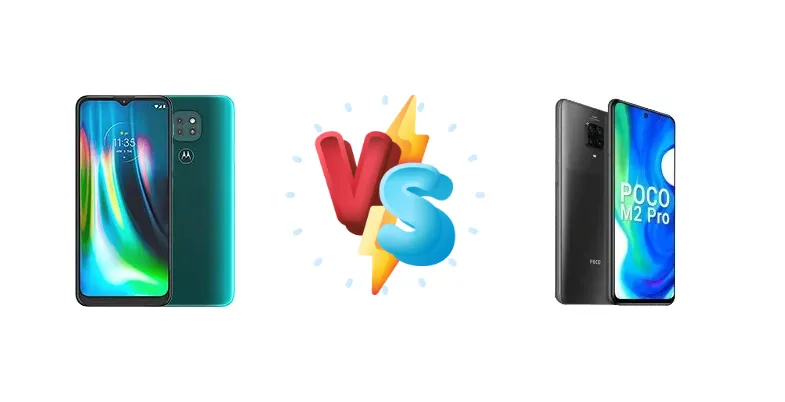
The sub-₹17,000 (approximately $200 USD) smartphone segment in India is fiercely competitive. The Motorola Moto G9 and Xiaomi Poco M2 Pro both aim to deliver a solid experience without breaking the bank, but they take different approaches. The Moto G9 focuses on a clean software experience and reliable brand reputation, while the Poco M2 Pro prioritizes raw performance and fast charging. This comparison dissects their key differences to help you choose the right device.
🏆 Quick Verdict
For the average user prioritizing performance and convenience, the Xiaomi Poco M2 Pro is the clear winner. Its Snapdragon 720G chipset and 33W fast charging offer a noticeable upgrade over the Moto G9’s Snapdragon 662 and 20W charging, justifying the slight price premium. However, those seeking a simpler, bloatware-free experience might still find the Moto G9 appealing.
| Network |
|---|
| 2G bands | GSM 850 / 900 / 1800 / 1900 | GSM 850 / 900 / 1800 / 1900 |
| 3G bands | HSDPA 850 / 900 / 1900 / 2100 | HSDPA 850 / 900 / 1700(AWS) / 1900 / 2100 |
| 4G bands | 1, 2, 3, 5, 7, 8, 18, 19, 20, 26, 28, 38, 40, 41 | 1, 3, 5, 8, 40, 41 |
| Speed | HSPA, LTE | HSPA, LTE |
| Technology | GSM / HSPA / LTE | GSM / HSPA / LTE |
| Launch |
|---|
| Announced | 2020, August 24. Released 2020, August 31 | 2020, July 07. Released 2020, July 14 |
| Status | Discontinued | Discontinued |
| Body |
|---|
| Build | Glass front, plastic back, plastic frame | Glass front (Gorilla Glass 5), glass back (Gorilla Glass 5), plastic frame |
| Dimensions | 165.2 x 75.7 x 9.2 mm (6.50 x 2.98 x 0.36 in) | 165.8 x 76.7 x 8.8 mm (6.53 x 3.02 x 0.35 in) |
| SIM | · Nano-SIM· Nano-SIM + Nano-SIM | Nano-SIM + Nano-SIM |
| Weight | 200 g (7.05 oz) | 209 g (7.37 oz) |
| | Water-repellent coating | Water-repellent coating |
| Display |
|---|
| Protection | - | Corning Gorilla Glass 5 |
| Resolution | 720 x 1600 pixels, 20:9 ratio (~269 ppi density) | 1080 x 2400 pixels, 20:9 ratio (~395 ppi density) |
| Size | 6.5 inches, 102.8 cm2 (~82.2% screen-to-body ratio) | 6.67 inches, 107.4 cm2 (~84.5% screen-to-body ratio) |
| Type | IPS LCD | IPS LCD, HDR10, 450 nits (typ) |
| Platform |
|---|
| CPU | Octa-core (4x2.0 GHz Kryo 260 Gold & 4x1.8 GHz Kryo 260 Silver) | Octa-core (2x2.3 GHz Kryo 465 Gold & 6x1.8 GHz Kryo 465 Silver) |
| Chipset | Qualcomm SM6115 Snapdragon 662 (11 nm) | Qualcomm SM7125 Snapdragon 720G (8 nm) |
| GPU | Adreno 610 | Adreno 618 |
| OS | Android 10 | Android 10, MIUI 12 |
| Memory |
|---|
| Card slot | microSDXC (uses shared SIM slot) | microSDXC (dedicated slot) |
| Internal | 64GB 4GB RAM | 64GB 4GB RAM, 64GB 6GB RAM, 128GB 6GB RAM |
| | eMMC 5.1 | UFS 2.1 |
| Main Camera |
|---|
| Features | LED flash, HDR, panorama | LED flash, HDR, panorama |
| Quad | - | 48 MP, f/1.8, 26mm (wide), 1/2.0", 0.8µm, PDAF
8 MP, f/2.2, 119˚ (ultrawide), 1/4.0", 1.12µm
5 MP (macro), AF
Auxiliary lens |
| Triple | 48 MP, f/1.7, (wide), 1/2.0", 0.8µm, PDAF
2 MP (macro)
Auxiliary lens | - |
| Video | 1080p@30/60fps | 4K@30fps, 1080p@30/60/120fps, 720p@960fps, gyro-EIS |
| Selfie camera |
|---|
| Features | HDR | HDR, panorama |
| Single | 8 MP, f/2.2, 1.12µm | 16 MP, f/2.5, (wide), 1/3.06" 1.0µm |
| Video | 1080p@30fps | 1080p@30/120fps |
| Sound |
|---|
| 3.5mm jack | Yes | Yes |
| 35mm jack | Yes | Yes |
| Loudspeaker | Yes | Yes |
| Comms |
|---|
| Bluetooth | 5.0, A2DP, LE | 5.0, A2DP, LE |
| Infrared port | - | Yes |
| NFC | Yes | No |
| Positioning | GPS, GLONASS, GALILEO | GPS, GLONASS, GALILEO, BDS |
| Radio | FM radio | FM radio, recording |
| USB | USB Type-C 2.0 | USB Type-C 2.0, OTG |
| WLAN | Wi-Fi 802.11 a/b/g/n/ac, dual-band, Wi-Fi Direct | Wi-Fi 802.11 a/b/g/n/ac, dual-band, Wi-Fi Direct |
| Features |
|---|
| Sensors | Fingerprint (rear-mounted), accelerometer, gyro, proximity | Fingerprint (side-mounted), accelerometer, gyro, proximity, compass |
| Battery |
|---|
| Charging | 20W wired | 33W wired |
| Type | Li-Po 5000 mAh | Li-Po 5000 mAh |
| Misc |
|---|
| Colors | Forest Green, Sapphire Blue | Out Of The Blue, Green and Greener, Two Shades of Black |
| Price | About 130 EUR | About 170 EUR |
| SAR EU | - | 0.91 W/kg (head) 0.56 W/kg (body) |
| Pricing |
|---|
| 128GB 6GB RAM | - | ₹ 16,999 |
| 64GB 6GB RAM | - | ₹ 9,999 |
Motorola Moto G9 (India)
- Clean Android experience with minimal bloatware
- Reliable Motorola brand reputation
- Potentially longer software support
- Less powerful Snapdragon 662 chipset
- Slower 20W charging
- Less capable camera ISP
Xiaomi Poco M2 Pro
- More powerful Snapdragon 720G chipset
- Faster 33W fast charging
- Potentially faster storage speeds
- MIUI software can be bloated with pre-installed apps
- Potentially shorter software support compared to Motorola
- Aggressive battery optimization may require user adjustments
Display Comparison
Neither device boasts a particularly standout display. Both likely utilize IPS LCD panels, a common choice in this price bracket. The key difference lies under the hood: processing power. Display specs beyond panel type are not provided, so we must assume similar quality in terms of color accuracy and viewing angles. However, the Poco M2 Pro’s more powerful chipset could potentially drive a higher refresh rate display in future iterations, a feature absent on the Moto G9.
Camera Comparison
Without detailed camera sensor information, a direct comparison is difficult. However, the Snapdragon 720G’s image signal processor (ISP) is significantly more advanced than the 662’s, enabling better image processing, noise reduction, and dynamic range. While both phones likely feature a multi-camera setup, the Poco M2 Pro’s ISP will likely extract more detail and produce better-looking photos, especially in challenging lighting conditions. The Moto G9’s camera system will likely be adequate for casual photography, but the Poco M2 Pro offers a more capable imaging experience.
Performance
The Poco M2 Pro’s Snapdragon 720G (8nm) is the clear performance champion. Built on a smaller 8nm process compared to the Moto G9’s Snapdragon 662 (11nm), the 720G offers superior power efficiency and sustained performance. The CPU configuration further highlights this: 2x2.3 GHz Kryo 465 Gold cores in the Poco M2 Pro versus 4x2.0 GHz Kryo 260 Gold cores in the Moto G9. This translates to faster app loading times, smoother multitasking, and a more enjoyable gaming experience on the Poco M2 Pro. The 64GB/128GB storage options on the Poco M2 Pro also suggest potentially faster storage speeds, impacting overall system responsiveness.
Battery Life
Both phones likely feature batteries in the 5000mAh range, typical for this segment. However, the Poco M2 Pro’s 33W fast charging is a game-changer. This allows for a significantly faster 0-100% charge time compared to the Moto G9’s 20W charging. While battery life will likely be comparable in real-world usage, the convenience of quickly topping up the Poco M2 Pro is a major advantage. The more efficient Snapdragon 720G may also contribute to slightly better battery endurance under heavy load.
Buying Guide
Buy the Motorola Moto G9 (India) if you need a dependable daily driver with a clean Android experience and value long-term software support over peak performance. Buy the Xiaomi Poco M2 Pro if you prefer a more powerful processor for gaming and demanding apps, and if fast charging is a high priority. The Poco M2 Pro is also the better choice for users who frequently transfer large files due to its potentially faster storage speeds.
Frequently Asked Questions
❓ Does the Poco M2 Pro's Snapdragon 720G handle demanding games like PUBG Mobile smoothly?
Yes, the Snapdragon 720G is well-equipped to handle PUBG Mobile at high settings. While it may not achieve the absolute highest frame rates possible on flagship devices, it provides a consistently smooth and enjoyable gaming experience. The 8nm process also helps to mitigate thermal throttling during extended gaming sessions.
❓ Is the MIUI software on the Poco M2 Pro heavily customized, and can it be easily cleaned up?
MIUI is known for its extensive customization options, but it also comes with a fair amount of pre-installed apps (bloatware). Fortunately, many of these apps can be uninstalled or disabled, allowing you to streamline the software experience to your liking. There are also numerous themes and customization options available within MIUI.
❓ How long does it realistically take to fully charge the Moto G9 with the 20W charger?
Expect a full 0-100% charge on the Moto G9 to take approximately 2 to 2.5 hours with the included 20W charger. While 20W is considered fast charging, it's significantly slower than the 33W charging on the Poco M2 Pro.
❓ Does the Poco M2 Pro support VoLTE on all Indian carriers?
The Poco M2 Pro generally supports VoLTE on major Indian carriers like Jio, Airtel, and Vi. However, it's always recommended to check the latest compatibility information on Xiaomi's official website or with your carrier to ensure full support.