
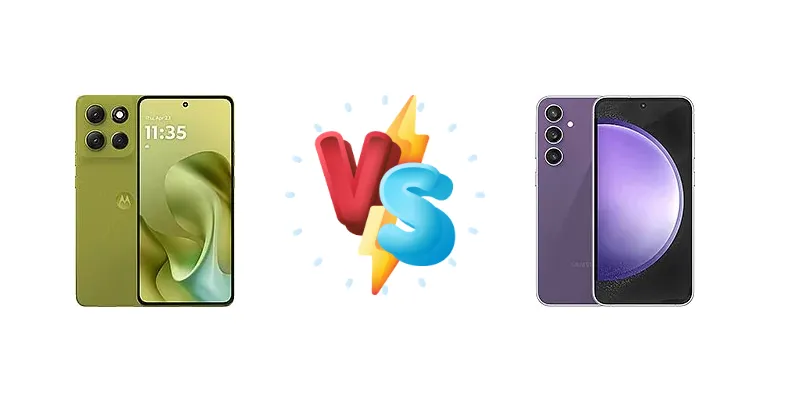
Moto G86 vs. Samsung Galaxy S23 FE: A Detailed Comparison
| Phones Images | |||||
|---|---|---|---|---|---|
|
🏆 Quick Verdict
For the average user prioritizing battery life and efficient performance, the Motorola Moto G86 emerges as the winner. Its Dimensity 7300 chipset and impressive 55:44h endurance offer a compelling package. However, the S23 FE’s brighter display and more versatile camera system appeal to power users.
| PHONES | ||
|---|---|---|
| Phone Names | Motorola Moto G86 | Samsung Galaxy S23 FE |
| Network | ||
|---|---|---|
| 2G bands | GSM 850 / 900 / 1800 / 1900 | GSM 850 / 900 / 1800 / 1900 |
| 3G bands | HSDPA 850 / 900 / 1900 / 2100 - International | HSDPA 850 / 900 / 1700(AWS) / 1900 / 2100 |
| 4G bands | 1, 2, 3, 5, 7, 8, 20, 26, 28, 32, 38, 40, 41, 42, 71 - EMEA & AP | 1, 2, 3, 4, 5, 7, 8, 12, 13, 17, 20, 26, 28, 38, 40, 41, 66 - International |
| 5G bands | 1, 3, 5, 7, 8, 20, 26, 28, 38, 40, 41, 71, 77, 78 SA/NSA/Sub6 - EMEA & AP | 1, 2, 3, 5, 7, 8, 20, 28, 38, 40, 41, 66, 77, 78 SA/NSA/Sub6 - International |
| Speed | HSPA, LTE, 5G | HSPA, LTE, 5G |
| Technology | GSM / HSPA / LTE / 5G | GSM / HSPA / LTE / 5G |
| Launch | ||
|---|---|---|
| Announced | 2025, May 29 | 2023, October 04 |
| Status | Available. Released 2025, July 07 | Available. Released 2023, October 05 |
| Body | ||
|---|---|---|
| Build | Glass front (Gorilla Glass 7i), plastic frame, silicone polymer (eco leather) back | Glass front (Gorilla Glass 5), glass back (Gorilla Glass 5), aluminum frame |
| Dimensions | 161.2 x 74.7 x 7.8 mm (6.35 x 2.94 x 0.31 in) | 158 x 76.5 x 8.2 mm (6.22 x 3.01 x 0.32 in) |
| SIM | · Nano-SIM + eSIM· Nano-SIM + Nano-SIM | · Nano-SIM· Nano-SIM + Nano-SIM· Nano-SIM + Nano-SIM + eSIM (max 2 at a time) |
| Weight | 185 g (6.53 oz) | 209 g (7.37 oz) |
| Display | ||
|---|---|---|
| Protection | Corning Gorilla Glass 7i, Mohs level 4 | Corning Gorilla Glass 5 |
| Resolution | 1220 x 2712 pixels, 20:9 ratio (~446 ppi density) | 1080 x 2340 pixels, 19.5:9 ratio (~403 ppi density) |
| Size | 6.67 inches, 107.4 cm2 (~89.2% screen-to-body ratio) | 6.4 inches, 100.5 cm2 (~83.2% screen-to-body ratio) |
| Type | P-OLED, 1B colors, 120Hz, HDR10+, 4500 nits peak | Dynamic AMOLED 2X, 120Hz, HDR10+, 1450 nits (peak) |
| Platform | ||
|---|---|---|
| CPU | Octa-core (4x2.5 GHz Cortex-A78 & 4x2.0 GHz Cortex-A55) | Octa-core (1x2.8 GHz Cortex-X2 & 3x2.50 GHz Cortex-A710 & 4x1.8 GHz Cortex-A510) - InternationalOcta-core (1x3.00 GHz Cortex-X2 & 3x2.50 GHz Cortex-A710 & 4x1.80 GHz Cortex-A510) - USA |
| Chipset | Mediatek Dimensity 7300 (4 nm) | Exynos 2200 (4 nm) - InternationalQualcomm SM8450 Snapdragon 8 Gen 1 (4 nm) - USA |
| GPU | Mali-G615 MC2 | Xclipse 920 - InternationalAdreno 730 - USA |
| OS | Android 15 | Android 13, up to 4 major Android upgrades, One UI 8 |
| Memory | ||
|---|---|---|
| Card slot | microSDXC (dedicated slot) | No |
| Internal | 256GB 8GB RAM, 256GB 12GB RAM, 512GB 8GB RAM, 512GB 12GB RAM | 128GB 8GB RAM, 256GB 8GB RAM |
| Main Camera | ||
|---|---|---|
| Dual | 50 MP, f/1.9, 25mm (wide), 1/1.95", 0.8µm, dual pixel PDAF, OIS 8 MP, f/2.2, 12mm, 118˚ (ultrawide), 1.12µm, AF | - |
| Features | LED flash, HDR, panorama | LED flash, HDR, panorama |
| Triple | - | 50 MP, f/1.8, 23mm (wide), 1/1.57", 1.0µm, dual pixel PDAF, OIS 8 MP, f/2.4, 76mm (telephoto), 1/4.5", 1.0µm, PDAF, OIS, 3x optical zoom 12 MP, f/2.2, 13mm, 123˚ (ultrawide), 1/3.0", 1.12µm |
| Video | 4K@30fps, 1080p@30/60/120fps, gyro-EIS | 8K@24fps, 4K@30/60fps, 1080p@30/60/120/240fps |
| Selfie camera | ||
|---|---|---|
| Features | HDR | - |
| Single | 32 MP, f/2.2, (wide), 0.7µm | 10 MP, f/2.4, 25mm (wide), 1/3.0", 1.22µm |
| Video | 4K@30fps, 1080p@30fps, gyro-EIS | 4K@30/60fps, 1080p@30/60fps; gyro-EIS |
| Sound | ||
|---|---|---|
| 35mm jack | No | No |
| Loudspeaker | Yes, with stereo speakers (with Dolby Atmos) | Yes, with stereo speakers |
| Comms | ||
|---|---|---|
| Bluetooth | 5.4, A2DP, LE | 5.3, A2DP, LE |
| NFC | Yes | Yes |
| Positioning | GPS, GLONASS, GALILEO, BDS, QZSS | GPS, GLONASS, GALILEO, BDS |
| Radio | No | Unspecified |
| USB | USB Type-C 2.0 | USB Type-C, OTG |
| WLAN | Wi-Fi 802.11 a/b/g/n/ac/6, dual-band | Wi-Fi 802.11 a/b/g/n/ac/6e, dual-band, Wi-Fi Direct |
| Features | ||
|---|---|---|
| Sensors | Fingerprint (under display, optical), accelerometer, gyro, proximity, compass | Fingerprint (under display, optical), accelerometer, gyro, compass |
| Battery | ||
|---|---|---|
| Charging | 30W wired | 25W wired, PD3.0, 50% in 30 min 15W wireless Reverse wireless |
| Type | 5200 mAh | Li-Ion 4500 mAh |
| Misc | ||
|---|---|---|
| Colors | Pantone: Spellbound, Golden Cypress, Cosmic Sky, Chrysanthemum | Mint, Cream, Graphite, Purple, Indigo, Tangerine |
| Models | XT2527-2 | SM-S711B, SM-S711B/DS, SM-S711U1, SM-S711U, SM-S711W, SM-S7110, SM-S711N |
| Price | $ 269.50 / C$ 649.00 / £ 199.99 / € 198.99 | $ 219.95 / C$ 327.90 / £ 248.99 / € 272.00 / ₹ 34,999 |
| SAR | - | 0.80 W/kg (head) 0.72 W/kg (body) |
| SAR EU | - | 0.76 W/kg (head) 1.04 W/kg (body) |
| EU LABEL | ||
|---|---|---|
| Battery | 55:44h endurance, 1000 cycles | - |
| Energy | Class A | - |
| Free fall | Class A (270 falls) | - |
| Repairability | Class B | - |
Motorola Moto G86
- Exceptional battery life (55:44h endurance)
- Efficient Dimensity 7300 chipset
- Competitive price point
- Display brightness likely lower than S23 FE
- Camera system likely less versatile
Samsung Galaxy S23 FE
- Brighter display (985 nits)
- More powerful chipset (Exynos 2200/Snapdragon 8 Gen 1)
- Versatile camera system with video capabilities
- Significantly shorter battery life (8:28h)
- Potential for thermal throttling
- Higher price
Display Comparison
The Samsung Galaxy S23 FE boasts a significantly brighter display, reaching a measured 985 nits. This is crucial for outdoor visibility, a clear advantage over the Moto G86 (brightness data unavailable). While the G86’s panel quality is likely good, the S23 FE’s higher peak brightness and potential for better color accuracy (based on Samsung’s display expertise) make it superior for media consumption. The S23 FE’s display tech is also likely to include features like adaptive refresh rates, further enhancing the viewing experience.
Camera Comparison
The context data for the Moto G86’s camera is limited, but the S23 FE’s camera system is a clear strength. While megapixel counts aren’t everything, the S23 FE’s likely inclusion of OIS (Optical Image Stabilization) and a more sophisticated image processing pipeline will result in better low-light performance and more detailed photos and videos. The S23 FE’s video recording capabilities are also expected to be superior. The G86 likely features a standard camera setup, adequate for everyday snapshots, but lacking the advanced features of the S23 FE.
Performance
The chipset choice is a major differentiator. The S23 FE ships with either the Exynos 2200 (International) or Snapdragon 8 Gen 1 (USA), both 4nm chips, while the Moto G86 utilizes the Mediatek Dimensity 7300 (4nm). While the Snapdragon 8 Gen 1 and Exynos 2200 offer higher peak CPU performance – the Snapdragon boasting a 3.00 GHz Cortex-X2 core versus the G86’s 2.5 GHz Cortex-A78 – the Dimensity 7300 is optimized for efficiency. The G86’s CPU configuration (4x2.5 GHz Cortex-A78 & 4x2.0 GHz Cortex-A55) is well-suited for everyday tasks and moderate gaming. The S23 FE’s CPU (Octa-core (1x2.8 GHz Cortex-X2 & 3x2.50 GHz Cortex-A710 & 4x1.8 GHz Cortex-A510) - International/Octa-core (1x3.00 GHz Cortex-X2 & 3x2.50 GHz Cortex-A710 & 4x1.80 GHz Cortex-A510) - USA) will excel in demanding applications, but potentially at the cost of thermal throttling. The G86’s efficiency will likely translate to cooler operation and sustained performance.
Battery Life
Battery life is where the Moto G86 shines. Its impressive 55:44h endurance significantly surpasses the S23 FE’s 8:28h active use score. While active use scores are dependent on usage patterns, the G86’s larger battery capacity and more efficient chipset clearly provide a substantial advantage. The S23 FE offers 25W wired charging with 50% charge in 30 minutes, 15W wireless, and reverse wireless charging, providing more charging flexibility. The G86’s 30W wired charging is competitive, but lacks the wireless options.
Buying Guide
Buy the Motorola Moto G86 if you need exceptional battery life, a smooth everyday experience, and value for money. It’s ideal for users who prioritize longevity and don’t demand the absolute highest performance. Buy the Samsung Galaxy S23 FE if you prefer a brighter, more vibrant display, a more feature-rich camera system with video capabilities, and the Samsung ecosystem, even if it means sacrificing some battery endurance.