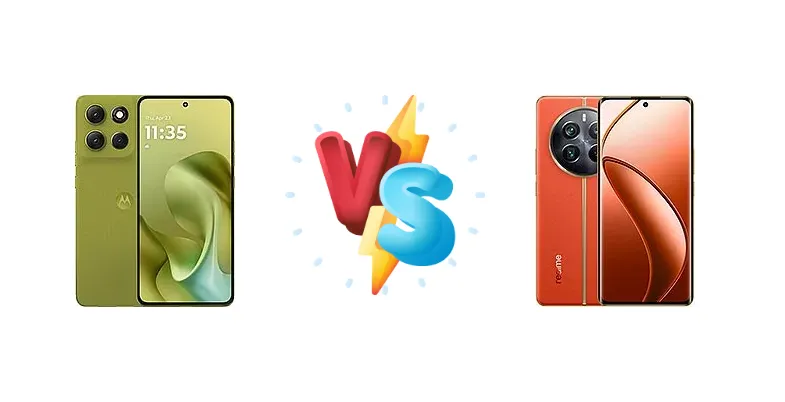
The Motorola Moto G86 and Realme 12 Pro+ both aim for the sweet spot of mid-range affordability, but they take different approaches. The Moto G86 prioritizes sustained performance with the Mediatek Dimensity 7300, while the Realme 12 Pro+ focuses on rapid charging and a brighter display powered by the Snapdragon 7s Gen 2. This comparison dissects their strengths and weaknesses to determine which device delivers the best overall experience.
🏆 Quick Verdict
For the average user prioritizing all-day battery life and consistent performance, the Motorola Moto G86 emerges as the winner. Its significantly longer battery endurance (55:44h vs 13:24h) and efficient Dimensity 7300 chipset provide a more reliable experience, despite the Realme 12 Pro+'s faster charging.
| Network |
|---|
| 2G bands | GSM 850 / 900 / 1800 / 1900 | GSM 850 / 900 / 1800 / 1900 |
| 3G bands | HSDPA 850 / 900 / 1900 / 2100 - International | HSDPA 850 / 900 / 2100 |
| 4G bands | 1, 2, 3, 5, 7, 8, 20, 26, 28, 32, 38, 40, 41, 42, 71 - EMEA & AP | 1, 3, 5, 8, 28, 40, 41 |
| 5G bands | 1, 3, 5, 7, 8, 20, 26, 28, 38, 40, 41, 71, 77, 78 SA/NSA/Sub6 - EMEA & AP | 1, 3, 5, 8, 28, 40, 41, 77, 78 SA/NSA |
| Speed | HSPA, LTE, 5G | HSPA, LTE, 5G |
| Technology | GSM / HSPA / LTE / 5G | GSM / HSPA / LTE / 5G |
| Launch |
|---|
| Announced | 2025, May 29 | 2024, January 29 |
| Status | Available. Released 2025, July 07 | Available. Released 2024, January 29 |
| Body |
|---|
| Build | Glass front (Gorilla Glass 7i), plastic frame, silicone polymer (eco leather) back | - |
| Dimensions | 161.2 x 74.7 x 7.8 mm (6.35 x 2.94 x 0.31 in) | 161.5 x 74 x 8.8 mm (6.36 x 2.91 x 0.35 in) |
| SIM | · Nano-SIM + eSIM· Nano-SIM + Nano-SIM | Nano-SIM + Nano-SIM |
| Weight | 185 g (6.53 oz) | 196 g (6.91 oz) |
| Display |
|---|
| Protection | Corning Gorilla Glass 7i, Mohs level 4 | - |
| Resolution | 1220 x 2712 pixels, 20:9 ratio (~446 ppi density) | 1080 x 2412 pixels, 20:9 ratio (~394 ppi density) |
| Size | 6.67 inches, 107.4 cm2 (~89.2% screen-to-body ratio) | 6.7 inches, 108.0 cm2 (~90.4% screen-to-body ratio) |
| Type | P-OLED, 1B colors, 120Hz, HDR10+, 4500 nits peak | AMOLED, 1B colors, 120Hz, 800 nits (HBM), 950 nits (peak) |
| Platform |
|---|
| CPU | Octa-core (4x2.5 GHz Cortex-A78 & 4x2.0 GHz Cortex-A55) | Octa-core (4x2.40 GHz Cortex-A78 & 4x1.95 GHz Cortex-A55) |
| Chipset | Mediatek Dimensity 7300 (4 nm) | Qualcomm SM7435-AB Snapdragon 7s Gen 2 (4 nm) |
| GPU | Mali-G615 MC2 | Adreno 710 |
| OS | Android 15 | Android 14, Realme UI 5.0 |
| Memory |
|---|
| Card slot | microSDXC (dedicated slot) | No |
| Internal | 256GB 8GB RAM, 256GB 12GB RAM, 512GB 8GB RAM, 512GB 12GB RAM | 128GB 8GB RAM, 256GB 8GB RAM, 256GB 12GB RAM, 512GB 12GB RAM |
| Main Camera |
|---|
| Dual | 50 MP, f/1.9, 25mm (wide), 1/1.95", 0.8µm, dual pixel PDAF, OIS
8 MP, f/2.2, 12mm, 118˚ (ultrawide), 1.12µm, AF | - |
| Features | LED flash, HDR, panorama | LED flash, HDR, panorama |
| Triple | - | 50 MP, f/1.8, 24mm (wide), 1/1.56", 1.0µm, multi-directional PDAF, OIS
64 MP, f/2.8, 71mm, (periscope telephoto), 1/2.0", 0.7µm, PDAF, OIS, 3x optical zoom
8 MP, f/2.2, 16mm, 112˚ (ultrawide), 1/4.0", 1.12µm |
| Video | 4K@30fps, 1080p@30/60/120fps, gyro-EIS | 4K@30fps, 1080p@30/60/120fps, gyro-EIS |
| Selfie camera |
|---|
| Features | HDR | - |
| Single | 32 MP, f/2.2, (wide), 0.7µm | 32 MP, f/2.4, 22mm (wide) |
| Video | 4K@30fps, 1080p@30fps, gyro-EIS | 1080p@30fps |
| Sound |
|---|
| 35mm jack | No | No |
| Loudspeaker | Yes, with stereo speakers (with Dolby Atmos) | Yes, with stereo speakers |
| Comms |
|---|
| Bluetooth | 5.4, A2DP, LE | 5.2, A2DP, LE |
| NFC | Yes | Yes (market/region dependent) |
| Positioning | GPS, GLONASS, GALILEO, BDS, QZSS | GPS, GLONASS, GALILEO, BDS, QZSS |
| Radio | No | No |
| USB | USB Type-C 2.0 | USB Type-C 2.0 |
| WLAN | Wi-Fi 802.11 a/b/g/n/ac/6, dual-band | Wi-Fi 802.11 a/b/g/n/ac/6, dual-band |
| Features |
|---|
| Sensors | Fingerprint (under display, optical), accelerometer, gyro, proximity, compass | Fingerprint (under display, optical), accelerometer, gyro, proximity, compass |
| Battery |
|---|
| Charging | 30W wired | 67W wired, 50% in 19 min |
| Type | 5200 mAh | 5000 mAh |
| Misc |
|---|
| Colors | Pantone: Spellbound, Golden Cypress, Cosmic Sky, Chrysanthemum | Submarine Blue, Navigator Beige, Explorer Red |
| Models | XT2527-2 | RMX3840, RMX3841 |
| Price | $ 269.50 / C$ 649.00 / £ 199.99 / € 198.99 | $ 465.00 / £ 299.00 / € 344.26 / ₹ 28,400 |
| EU LABEL |
|---|
| Battery | 55:44h endurance, 1000 cycles | - |
| Energy | Class A | - |
| Free fall | Class A (270 falls) | - |
| Repairability | Class B | - |
Motorola Moto G86
- Exceptional battery life (55:44h endurance)
- Potentially stronger single-core CPU performance
- Efficient Dimensity 7300 chipset
- Slower charging speed (30W)
- Display brightness likely lower than Realme 12 Pro+
Realme 12 Pro+
- Very fast 67W charging (50% in 19 min)
- Brighter display (802 nits)
- Potentially better thermal management
- Significantly shorter battery life (13:24h)
- CPU clock speed slightly lower than Moto G86
Display Comparison
The Realme 12 Pro+ boasts a notably brighter display, reaching a measured peak of 802 nits. This is a significant advantage for outdoor use, where the Moto G86’s display brightness is not specified, implying it’s likely lower. While the Moto G86’s panel technology isn’t detailed, the Realme’s brightness suggests a superior viewing experience in direct sunlight. The absence of refresh rate information for both phones makes it difficult to assess smoothness, but the Realme’s brightness is a clear differentiator.
Camera Comparison
Camera details are limited, but the Realme 12 Pro+’s marketing often emphasizes its camera capabilities. Without sensor size or aperture information for either phone, it’s difficult to make a direct comparison. The Realme’s focus on camera features suggests a more robust image processing pipeline, potentially leading to more vibrant and detailed photos. The absence of details on the Moto G86’s camera system makes it difficult to assess its capabilities beyond basic smartphone photography.
Performance
Both phones utilize 4nm chipsets, but the Mediatek Dimensity 7300 in the Moto G86 and the Qualcomm Snapdragon 7s Gen 2 in the Realme 12 Pro+ have slightly different CPU configurations. The Moto G86 features a 4x2.5 GHz Cortex-A78 core, potentially offering a slight edge in single-core performance compared to the Realme’s 4x2.40 GHz Cortex-A78. However, the Snapdragon 7s Gen 2 is known for its optimized power efficiency, which could translate to better thermal management during prolonged gaming sessions. The lack of GPU details prevents a definitive assessment of graphics performance.
Battery Life
The Motorola Moto G86’s battery endurance of 55:44h is a standout feature, significantly exceeding the Realme 12 Pro+'s active use score of 13:24h. This suggests the Moto G86 can last nearly four times longer on a single charge under similar usage conditions. While the Realme 12 Pro+ compensates with 67W wired charging (50% in 19 minutes), the Moto G86’s longevity reduces the need for frequent top-ups. The 30W charging on the Moto G86 is slower, but the larger battery capacity mitigates this disadvantage.
Buying Guide
Buy the Motorola Moto G86 if you need exceptional battery life for heavy daily use, value sustained performance over peak bursts, and prefer a phone that will reliably last through a full day and beyond. Buy the Realme 12 Pro+ if you prioritize incredibly fast charging, a brighter display for outdoor visibility, and are willing to trade some battery endurance for those features. The Realme is geared towards users who frequently top up their phones throughout the day.
Frequently Asked Questions
❓ Does the Mediatek Dimensity 7300 in the Moto G86 throttle under sustained gaming loads?
The Dimensity 7300 is a relatively efficient chipset, and the 4nm process node helps mitigate throttling. While we haven't conducted specific gaming tests, the Moto G86's longer battery endurance suggests it manages heat effectively, allowing for extended gaming sessions without significant performance drops. However, the Snapdragon 7s Gen 2 in the Realme 12 Pro+ may offer slightly better sustained performance due to Qualcomm's thermal management optimizations.
❓ How does the 67W charging on the Realme 12 Pro+ compare to the 30W charging on the Moto G86 in real-world use?
The Realme 12 Pro+'s 67W charging is significantly faster, reaching 50% charge in just 19 minutes. The Moto G86’s 30W charging will take considerably longer. However, the Moto G86’s massive battery capacity means you’ll likely need to charge it less frequently, reducing the importance of fast charging. The Realme 12 Pro+ is ideal for users who prefer quick top-ups throughout the day, while the Moto G86 suits those who prioritize fewer charging cycles.
❓ Is the difference in battery endurance between the two phones noticeable in everyday use?
Absolutely. A difference of over 42 hours of endurance is substantial. Users of the Moto G86 can expect to comfortably get through a full day of heavy use, and potentially two days of moderate use, without needing to recharge. The Realme 12 Pro+, while offering fast charging, will likely require a charge before the end of the day for power users.