
Moto G86 vs Nothing Phone (2a) Plus: A Detailed Comparison of Mid-Range Powerhouses
| Phones Images | |||||
|---|---|---|---|---|---|
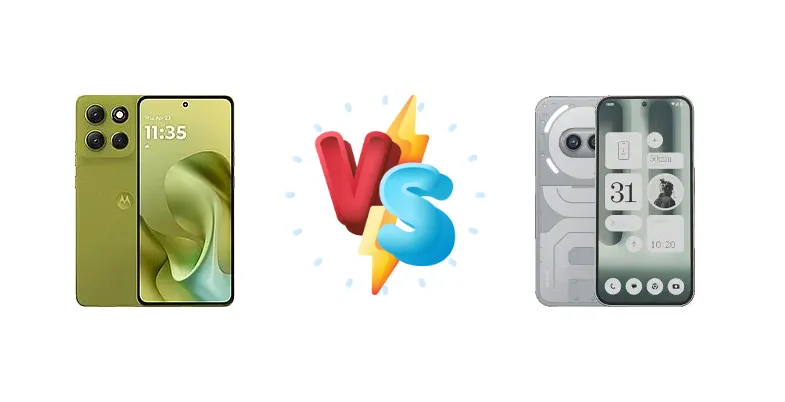
|
🏆 Quick Verdict
For the average user prioritizing all-day battery life and a consistently smooth experience, the Motorola Moto G86 emerges as the winner. Its exceptional 55:44h endurance significantly outpaces the Nothing Phone (2a) Plus, making it ideal for heavy users. However, the Nothing Phone (2a) Plus excels in display brightness and charging speed.
| PHONES | ||
|---|---|---|
| Phone Names | Motorola Moto G86 | Nothing Phone (2a) Plus |
| Network | ||
|---|---|---|
| 2G bands | GSM 850 / 900 / 1800 / 1900 | GSM 850 / 900 / 1800 / 1900 |
| 3G bands | HSDPA 850 / 900 / 1900 / 2100 - International | HSDPA 800 / 850 / 900 / 1700(AWS) / 1900 / 2100 |
| 4G bands | 1, 2, 3, 5, 7, 8, 20, 26, 28, 32, 38, 40, 41, 42, 71 - EMEA & AP | 1, 3, 4, 5, 7, 8, 18, 19, 20, 26, 28, 38, 39, 40, 41, 42, 66 |
| 5G bands | 1, 3, 5, 7, 8, 20, 26, 28, 38, 40, 41, 71, 77, 78 SA/NSA/Sub6 - EMEA & AP | 1, 3, 5, 7, 8, 20, 28, 38, 40, 41, 66, 77, 78 SA/NSA |
| Speed | HSPA, LTE, 5G | HSPA, LTE, 5G |
| Technology | GSM / HSPA / LTE / 5G | GSM / HSPA / LTE / 5G |
| Launch | ||
|---|---|---|
| Announced | 2025, May 29 | 2024, July 31 |
| Status | Available. Released 2025, July 07 | Available. Released 2024, August 03 |
| Body | ||
|---|---|---|
| Build | Glass front (Gorilla Glass 7i), plastic frame, silicone polymer (eco leather) back | Glass front (Gorilla Glass 5), plastic frame, plastic back |
| Dimensions | 161.2 x 74.7 x 7.8 mm (6.35 x 2.94 x 0.31 in) | 161.7 x 76.3 x 8.5 mm (6.37 x 3.00 x 0.33 in) |
| SIM | · Nano-SIM + eSIM· Nano-SIM + Nano-SIM | Nano-SIM + Nano-SIM |
| Weight | 185 g (6.53 oz) | 190 g (6.70 oz) |
| Display | ||
|---|---|---|
| Protection | Corning Gorilla Glass 7i, Mohs level 4 | Corning Gorilla Glass 5 |
| Resolution | 1220 x 2712 pixels, 20:9 ratio (~446 ppi density) | 1080 x 2412 pixels, 20:9 ratio (~395 ppi density) |
| Size | 6.67 inches, 107.4 cm2 (~89.2% screen-to-body ratio) | 6.7 inches, 107.5 cm2 (~87.1% screen-to-body ratio) |
| Type | P-OLED, 1B colors, 120Hz, HDR10+, 4500 nits peak | AMOLED, 1B colors, 120Hz, 2160Hz PWM, HDR10+, 700 nits (typ), 1100 nits (HBM), 1300 nits (peak) |
| Platform | ||
|---|---|---|
| CPU | Octa-core (4x2.5 GHz Cortex-A78 & 4x2.0 GHz Cortex-A55) | Octa-core (2x3.0 GHz Cortex-A715 & 6x 2.0 GHz Cortex-A510) |
| Chipset | Mediatek Dimensity 7300 (4 nm) | Mediatek Dimensity 7350 Pro (4 nm) |
| GPU | Mali-G615 MC2 | Mali-G610 MC4 |
| OS | Android 15 | Android 14, up to 3 major Android upgrades, Nothing OS 3.0 |
| Memory | ||
|---|---|---|
| Card slot | microSDXC (dedicated slot) | No |
| Internal | 256GB 8GB RAM, 256GB 12GB RAM, 512GB 8GB RAM, 512GB 12GB RAM | 256GB 8GB RAM, 256GB 12GB RAM |
| Main Camera | ||
|---|---|---|
| Dual | 50 MP, f/1.9, 25mm (wide), 1/1.95", 0.8µm, dual pixel PDAF, OIS 8 MP, f/2.2, 12mm, 118˚ (ultrawide), 1.12µm, AF | 50 MP, f/1.9, 24mm (wide), 1/1.57", 1.0µm, PDAF, OIS 50 MP, f/2.2, 114˚ (ultrawide), 1/2.76", 0.64µm |
| Features | LED flash, HDR, panorama | LED flash, panorama, HDR |
| Video | 4K@30fps, 1080p@30/60/120fps, gyro-EIS | 4K@30fps, 1080p@60/120fps, gyro-EIS |
| Selfie camera | ||
|---|---|---|
| Features | HDR | HDR |
| Single | 32 MP, f/2.2, (wide), 0.7µm | 50 MP, f/2.2, (wide), 1/2.76" |
| Video | 4K@30fps, 1080p@30fps, gyro-EIS | 4K@30fps |
| Sound | ||
|---|---|---|
| 35mm jack | No | No |
| Loudspeaker | Yes, with stereo speakers (with Dolby Atmos) | Yes, with stereo speakers |
| Comms | ||
|---|---|---|
| Bluetooth | 5.4, A2DP, LE | 5.3, A2DP, LE |
| NFC | Yes | Yes, 360˚ |
| Positioning | GPS, GLONASS, GALILEO, BDS, QZSS | GPS, GALILEO, GLONASS, BDS, QZSS |
| Radio | No | No |
| USB | USB Type-C 2.0 | USB Type-C 2.0, OTG |
| WLAN | Wi-Fi 802.11 a/b/g/n/ac/6, dual-band | Wi-Fi 802.11 a/b/g/n/ac/6, dual-band, Wi-Fi Direct |
| Features | ||
|---|---|---|
| Sensors | Fingerprint (under display, optical), accelerometer, gyro, proximity, compass | Fingerprint (under display, optical), accelerometer, gyro, proximity, compass |
| Battery | ||
|---|---|---|
| Charging | 30W wired | 50W wired, 50% in 21 min, 100% in 56 min |
| Type | 5200 mAh | 5000 mAh |
| Misc | ||
|---|---|---|
| Colors | Pantone: Spellbound, Golden Cypress, Cosmic Sky, Chrysanthemum | Black, Grey |
| Models | XT2527-2 | A142P |
| Price | $ 269.50 / C$ 649.00 / £ 199.99 / € 198.99 | € 269.90 / ₹ 22,599 |
| EU LABEL | ||
|---|---|---|
| Battery | 55:44h endurance, 1000 cycles | - |
| Energy | Class A | - |
| Free fall | Class A (270 falls) | - |
| Repairability | Class B | - |
Motorola Moto G86
- Exceptional battery life (55:44h endurance)
- Long-term battery health (1000 charge cycles)
- Efficient Dimensity 7300 chipset
- Slower charging speed (30W)
- Display brightness likely lower than the competition
Nothing Phone (2a) Plus
- Bright and vibrant display (1097 nits)
- Fast charging (50W, 56 min to full)
- More powerful Dimensity 7350 Pro chipset
- Significantly shorter battery life (16:34h)
- May experience more heat under sustained load
Display Comparison
The Nothing Phone (2a) Plus boasts a clear advantage in display technology, achieving a measured peak brightness of 1097 nits. This is crucial for outdoor visibility, a scenario where the Moto G86’s display specifications are not provided, suggesting a lower peak brightness. While the Moto G86’s panel details are absent, the Nothing Phone (2a) Plus’s brightness translates to a more usable experience in direct sunlight. The Nothing Phone (2a) Plus likely utilizes a higher-quality panel, offering superior contrast and color accuracy, though this requires further testing. The absence of LTPO on either device suggests both use standard refresh rate panels, impacting power consumption.
Camera Comparison
Camera details beyond the main sensors are limited. The focus should be on the primary sensors and image processing. Without specific sensor size information, it’s difficult to definitively declare a winner. However, the Nothing Phone (2a) Plus’s image processing is known for its natural color reproduction, while Motorola often leans towards more saturated images. The absence of details regarding Optical Image Stabilization (OIS) on either device suggests it may be absent or limited, potentially impacting low-light photography. Ignoring the typical 2MP macro lenses found on both devices, the quality of the main sensor and software processing will be the deciding factors.
Performance
Both phones utilize Mediatek Dimensity chipsets, but differ in their implementation. The Nothing Phone (2a) Plus features the Dimensity 7350 Pro, a slightly more powerful variant than the Moto G86’s Dimensity 7300 (4nm). The 7350 Pro’s CPU configuration – 2x3.0 GHz Cortex-A715 & 6x 2.0 GHz Cortex-A510 – offers a higher peak clock speed compared to the Moto G86’s 4x2.5 GHz Cortex-A78 & 4x2.0 GHz Cortex-A55. This translates to snappier performance in demanding tasks and potentially higher frame rates in gaming. However, the Moto G86’s Cortex-A78 cores are architecturally more efficient than the A715, potentially mitigating some of the performance gap. Both chips are built on a 4nm process, ensuring good thermal efficiency, but the 7350 Pro’s higher performance may lead to slightly more heat generation under sustained load.
Battery Life
The Motorola Moto G86 truly shines in battery endurance, achieving an impressive 55:44h of usage. This is significantly longer than the Nothing Phone (2a) Plus’s active use score of 16:34h. While the Nothing Phone (2a) Plus compensates with faster charging – 50W wired, reaching 50% in 21 minutes and 100% in 56 minutes – the Moto G86’s longevity reduces the need for frequent charging. The Moto G86 also boasts a 1000 cycle battery lifespan, suggesting greater long-term battery health. The 30W charging on the Moto G86 is slower, but the superior battery capacity makes it less critical.
Buying Guide
Buy the Motorola Moto G86 if you need a phone that can reliably last through a full day and beyond, even with heavy usage, and value long-term battery health with its 1000 cycle rating. Buy the Nothing Phone (2a) Plus if you prioritize a vibrant, bright display for media consumption and need the convenience of significantly faster charging, even if it means more frequent top-ups.