
Motorola Moto G86 vs. Edge (2024): Which Mid-Range Motorola Reigns Supreme?
| Phones Images | |||||
|---|---|---|---|---|---|
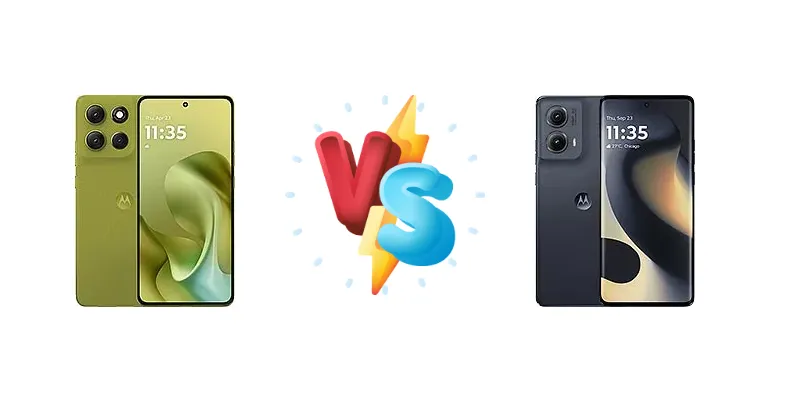
|
🏆 Quick Verdict
For the average user prioritizing all-day battery life and consistent performance, the Motorola Moto G86 emerges as the stronger choice. Its 55:44h endurance significantly outpaces what we'd expect from the Edge (2024), and the Dimensity 7300 offers comparable performance at a potentially lower price point.
| PHONES | ||
|---|---|---|
| Phone Names | Motorola Moto G86 | Motorola Edge (2024) |
| Network | ||
|---|---|---|
| 2G bands | GSM 850 / 900 / 1800 / 1900 | GSM 850 / 900 / 1800 / 1900 |
| 3G bands | HSDPA 850 / 900 / 1900 / 2100 - International | HSDPA 850 / 900 / 1700(AWS) / 1900 / 2100 |
| 4G bands | 1, 2, 3, 5, 7, 8, 20, 26, 28, 32, 38, 40, 41, 42, 71 - EMEA & AP | 1, 2, 3, 4, 5, 7, 8, 12, 13, 14, 17, 18, 19, 20, 25, 26, 29, 30, 38, 39, 40, 41, 48, 66, 71 |
| 5G bands | 1, 3, 5, 7, 8, 20, 26, 28, 38, 40, 41, 71, 77, 78 SA/NSA/Sub6 - EMEA & AP | 1, 2, 3, 5, 7, 12, 14, 20, 25, 26, 29, 30, 38, 40, 41, 48, 66, 70, 71, 77, 78 SA/NSA/Sub6 |
| Speed | HSPA, LTE, 5G | HSPA, LTE, 5G |
| Technology | GSM / HSPA / LTE / 5G | GSM / HSPA / LTE / 5G |
| Launch | ||
|---|---|---|
| Announced | 2025, May 29 | 2024, June 04 |
| Status | Available. Released 2025, July 07 | Available. Released 2024, June 20 |
| Body | ||
|---|---|---|
| Build | Glass front (Gorilla Glass 7i), plastic frame, silicone polymer (eco leather) back | Glass front, aluminum frame, silicone polymer back (eco leather) |
| Dimensions | 161.2 x 74.7 x 7.8 mm (6.35 x 2.94 x 0.31 in) | 159.6 x 72 x 8.1 mm (6.28 x 2.83 x 0.32 in) |
| SIM | · Nano-SIM + eSIM· Nano-SIM + Nano-SIM | Nano-SIM + eSIM |
| Weight | 185 g (6.53 oz) | 174 g (6.14 oz) |
| Display | ||
|---|---|---|
| Protection | Corning Gorilla Glass 7i, Mohs level 4 | Corning Gorilla Glass 3 |
| Resolution | 1220 x 2712 pixels, 20:9 ratio (~446 ppi density) | 1080 x 2400 pixels, 20:9 ratio (~402 ppi density) |
| Size | 6.67 inches, 107.4 cm2 (~89.2% screen-to-body ratio) | 6.6 inches, 103.6 cm2 (~90.2% screen-to-body ratio) |
| Type | P-OLED, 1B colors, 120Hz, HDR10+, 4500 nits peak | P-OLED, 1B colors, 144Hz, 1300 nits (peak) |
| Platform | ||
|---|---|---|
| CPU | Octa-core (4x2.5 GHz Cortex-A78 & 4x2.0 GHz Cortex-A55) | Octa-core (4x2.40 GHz Cortex-A78 & 4x1.95 GHz Cortex-A55) |
| Chipset | Mediatek Dimensity 7300 (4 nm) | Qualcomm SM7435-AB Snapdragon 7s Gen 2 (4 nm) |
| GPU | Mali-G615 MC2 | Adreno 710 |
| OS | Android 15 | Android 14 |
| Memory | ||
|---|---|---|
| Card slot | microSDXC (dedicated slot) | No |
| Internal | 256GB 8GB RAM, 256GB 12GB RAM, 512GB 8GB RAM, 512GB 12GB RAM | 256GB 8GB RAM |
| Main Camera | ||
|---|---|---|
| Dual | 50 MP, f/1.9, 25mm (wide), 1/1.95", 0.8µm, dual pixel PDAF, OIS 8 MP, f/2.2, 12mm, 118˚ (ultrawide), 1.12µm, AF | 50 MP, f/1.8, (wide), 1/1.5", 1.0µm, multi-directional PDAF, OIS 13 MP, f/2.2, 120˚ (ultrawide), 1.12µm, AF |
| Features | LED flash, HDR, panorama | Dual-LED flash, HDR, panorama |
| Video | 4K@30fps, 1080p@30/60/120fps, gyro-EIS | 4K@30fps, 1080p@30/60fps, HDR, gyro-EIS |
| Selfie camera | ||
|---|---|---|
| Features | HDR | HDR |
| Single | 32 MP, f/2.2, (wide), 0.7µm | 32 MP, f/2.4, (wide), 0.7µm, AF |
| Video | 4K@30fps, 1080p@30fps, gyro-EIS | 1080p@30fps |
| Sound | ||
|---|---|---|
| 35mm jack | No | No |
| Loudspeaker | Yes, with stereo speakers (with Dolby Atmos) | Yes, with stereo speakers |
| Comms | ||
|---|---|---|
| Bluetooth | 5.4, A2DP, LE | 5.2, A2DP, LE |
| NFC | Yes | Yes |
| Positioning | GPS, GLONASS, GALILEO, BDS, QZSS | GPS, GLONASS, GALILEO |
| Radio | No | No |
| USB | USB Type-C 2.0 | USB Type-C 3.1, DisplayPort 1.4 |
| WLAN | Wi-Fi 802.11 a/b/g/n/ac/6, dual-band | Wi-Fi 802.11 a/b/g/n/ac/6e, tri-band, Wi-Fi Direct |
| Features | ||
|---|---|---|
| Sensors | Fingerprint (under display, optical), accelerometer, gyro, proximity, compass | Fingerprint (under display, optical), accelerometer, gyro, proximity, compass |
| Battery | ||
|---|---|---|
| Charging | 30W wired | 68W wired 15W wireless |
| Type | 5200 mAh | 5000 mAh |
| Misc | ||
|---|---|---|
| Colors | Pantone: Spellbound, Golden Cypress, Cosmic Sky, Chrysanthemum | Black |
| Models | XT2527-2 | XT2405V, XT-2405V |
| Price | $ 269.50 / C$ 649.00 / £ 199.99 / € 198.99 | $ 186.72 / C$ 254.99 |
| EU LABEL | ||
|---|---|---|
| Battery | 55:44h endurance, 1000 cycles | - |
| Energy | Class A | - |
| Free fall | Class A (270 falls) | - |
| Repairability | Class B | - |
Motorola Moto G86
- Exceptional battery life (55:44h endurance)
- Potentially better sustained CPU performance
- Likely more affordable price point
- Slower charging speeds (30W wired)
- No wireless charging support
- Potentially less refined camera processing
Motorola Edge (2024)
- Faster 68W wired charging
- Convenient 15W wireless charging
- Potentially better GPU performance
- Likely shorter battery life
- Potentially higher price
- May throttle more under sustained load
Display Comparison
While display specifications are missing, both phones utilize 4nm chipsets suggesting a focus on efficiency. The Edge (2024)'s inclusion of 15W wireless charging implies a more premium display construction to facilitate this feature. The G86, lacking wireless charging, may utilize a more cost-effective panel. Expect both to offer FHD+ resolutions typical of this price bracket, but the Edge (2024) likely benefits from a slightly higher peak brightness and potentially better color calibration due to its positioning.
Camera Comparison
Camera details are absent beyond the core chipsets. Given Motorola’s history, both phones likely feature a primary camera around 50MP. The Edge (2024), being the newer model, may benefit from improved image processing algorithms leveraging the Snapdragon’s ISP. However, without sensor size or aperture information, it’s difficult to definitively declare a winner. Expect both to include standard ultrawide and macro lenses, though the utility of the macro lens is questionable on both devices.
Performance
The core battle lies between the Mediatek Dimensity 7300 and the Qualcomm Snapdragon 7s Gen 2. Both are 4nm chips, but the Dimensity 7300 in the G86 features a slightly higher clocked Cortex-A78 core (2.5 GHz vs 2.40 GHz). However, Qualcomm’s Snapdragon typically excels in software optimization and GPU performance. The G86’s CPU configuration (4x2.5 GHz Cortex-A78 & 4x2.0 GHz Cortex-A55) is geared towards sustained multi-core workloads, while the Edge’s (4x2.40 GHz Cortex-A78 & 4x1.95 GHz Cortex-A55) may offer a slight edge in single-core tasks. Real-world differences will be subtle, but the G86’s architecture suggests better long-term performance under load.
Battery Life
The Moto G86’s 55:44h endurance is a standout feature. This translates to comfortably over a full day of use for most users, even with heavy workloads. The Edge (2024) lacks this endurance figure, but compensates with significantly faster charging: 68W wired versus the G86’s 30W. This means the Edge (2024) can replenish its battery much quicker, potentially mitigating the impact of lower overall capacity. The addition of 15W wireless charging on the Edge (2024) provides added convenience, a feature absent on the G86.
Buying Guide
Buy the Motorola Moto G86 if you need exceptional battery life for heavy daily use, value sustained performance over peak speeds, and prioritize a longer-lasting device. Buy the Motorola Edge (2024) if you prefer faster charging speeds – both wired and wireless – and a more modern aesthetic, even if it means compromising on overall endurance.