
Moto G86 Power vs Samsung Galaxy A15 5G: A Deep Dive into Mid-Range Contenders
| Phones Images | |||||
|---|---|---|---|---|---|
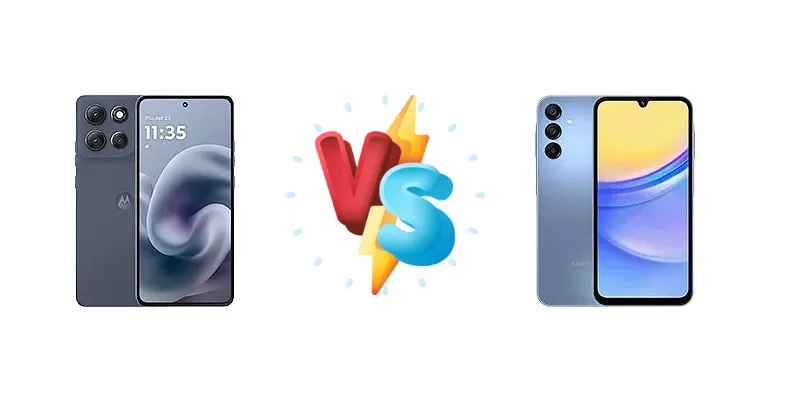
|
🏆 Quick Verdict
For users prioritizing longevity and sustained performance, the Motorola Moto G86 Power is the clear winner. Its significantly superior battery endurance (67:39h vs 14:31h) and more powerful chipset (Dimensity 7300/7400) outweigh the Galaxy A15 5G’s brighter screen. However, the A15 5G remains a viable option for those who heavily prioritize display visibility.
| PHONES | ||
|---|---|---|
| Phone Names | Motorola Moto G86 Power | Samsung Galaxy A15 5G |
| Network | ||
|---|---|---|
| 2G bands | GSM 850 / 900 / 1800 / 1900 | GSM 850 / 900 / 1800 / 1900 |
| 3G bands | HSDPA 850 / 900 / 1900 / 2100 - International | HSDPA 850 / 900 / 1700(AWS) / 1900 / 2100 |
| 4G bands | 1, 2, 3, 5, 7, 8, 20, 26, 28, 32, 38, 40, 41, 42, 71 - EMEA & AP | 1, 2, 3, 4, 5, 7, 8, 12, 17, 20, 26, 28, 38, 40, 41, 66 |
| 5G bands | 1, 3, 5, 7, 8, 20, 26, 28, 38, 40, 41, 71, 77, 78 SA/NSA/Sub6 - EMEA & AP | 1, 3, 5, 7, 8, 26, 28, 40, 41, 66, 77, 78 SA/NSA/Sub6 |
| Speed | HSPA, LTE, 5G | HSPA, LTE, 5G |
| Technology | GSM / HSPA / LTE / 5G | GSM / HSPA / LTE / 5G |
| Launch | ||
|---|---|---|
| Announced | 2025, May 29 | 2023, December 11 |
| Status | Available. Released 2025, July 30 | Available. Released 2023, December 16 |
| Body | ||
|---|---|---|
| Build | Glass front (Gorilla Glass 7i), plastic frame, silicone polymer (eco leather) back | Glass front, plastic back, plastic frame |
| Dimensions | 161.2 x 74.7 x 8.7 mm (6.35 x 2.94 x 0.34 in) | 160.1 x 76.8 x 8.4 mm (6.30 x 3.02 x 0.33 in) |
| SIM | · Nano-SIM + eSIM· Nano-SIM + Nano-SIM | · Nano-SIM· Nano-SIM + Nano-SIM |
| Weight | 195 or 198 g (6.98 oz) | 200 g (7.05 oz) |
| Display | ||
|---|---|---|
| Protection | Corning Gorilla Glass 7i, Mohs level 4 | - |
| Resolution | 1220 x 2712 pixels, 20:9 ratio (~446 ppi density) | 1080 x 2340 pixels, 19.5:9 ratio (~396 ppi density) |
| Size | 6.67 inches, 107.4 cm2 (~89.2% screen-to-body ratio) | 6.5 inches, 103.7 cm2 (~84.3% screen-to-body ratio) |
| Type | P-OLED, 1B colors, 120Hz, HDR10+, 4500 nits peak | Super AMOLED, 90Hz, 800 nits (HBM) |
| Platform | ||
|---|---|---|
| CPU | Octa-core (4x2.5 GHz Cortex-A78 & 4x2.0 GHz Cortex-A55) - GlobalOcta-core (4x2.6 GHz Cortex-A78 & 4x2.0 GHz Cortex-A55) - India | Octa-core (2x2.2 GHz Cortex-A76 & 6x2.0 GHz Cortex-A55) |
| Chipset | Mediatek Dimensity 7300 (4 nm) - GlobalMediatek Dimensity 7400 (4 nm) - India | Mediatek Dimensity 6100+ (6 nm) |
| GPU | Mali-G615 MC2 | Mali-G57 MC2 |
| OS | Android 15, up to 2 major Android upgrades | Android 14, upgradable to Android 16, One UI 8, up to 4 major Android upgrades |
| Memory | ||
|---|---|---|
| Card slot | microSDXC (dedicated slot) | microSDXC (uses shared SIM slot) |
| Internal | 128GB 8GB RAM, 256GB 8GB RAM, 256GB 12GB RAM, 512GB 8GB RAM, 512GB 12GB RAM | 64GB 4GB RAM, 128GB 4GB RAM, 128GB 6GB RAM, 128GB 8GB RAM, 256GB 8GB RAM |
| Main Camera | ||
|---|---|---|
| Dual | 50 MP, f/1.9, 25mm (wide), 1/1.95", 0.8µm, dual pixel PDAF, OIS 8 MP, f/2.2, 12mm, 118˚ (ultrawide), 1.12µm, AF | - |
| Features | LED flash, HDR, panorama | LED flash, panorama, HDR |
| Triple | - | 50 MP, f/1.8, (wide), AF 5 MP, f/2.2, (ultrawide) 2 MP (macro) |
| Video | 4K@30/60fps, 1080p@30/60/120fps, gyro-EIS | 1080p@30fps, gyro-EIS |
| Selfie camera | ||
|---|---|---|
| Features | HDR | - |
| Single | 32 MP, f/2.2, (wide), 0.7µm | 13 MP, f/2.0, (wide) |
| Video | 4K@30fps, 1080p@30fps, gyro-EIS | 1080p@30fps |
| Sound | ||
|---|---|---|
| 35mm jack | No | Yes |
| Loudspeaker | Yes, with stereo speakers (with Dolby Atmos) | Yes |
| Comms | ||
|---|---|---|
| Bluetooth | 5.4, A2DP, LE | 5.3, A2DP, LE |
| NFC | Yes | Yes (market/region dependent) |
| Positioning | GPS, GLONASS, GALILEO, BDS, QZSS | GPS, GALILEO, GLONASS, BDS, QZSS |
| Radio | No | No |
| USB | USB Type-C 2.0 | USB Type-C 2.0 |
| WLAN | Wi-Fi 802.11 a/b/g/n/ac/6, dual-band | Wi-Fi 802.11 a/b/g/n/ac, dual-band, Wi-Fi Direct |
| Features | ||
|---|---|---|
| Sensors | Fingerprint (under display, optical), accelerometer, gyro, proximity, compass | Fingerprint (side-mounted), accelerometer, gyro, compass |
| Battery | ||
|---|---|---|
| Charging | 30W wired | 25W wired |
| Type | 6720 mAh | 5000 mAh |
| Misc | ||
|---|---|---|
| Colors | Pantone: Spellbound, Golden Cypress, Cosmic Sky, Chrysanthemum | Brave Black, Personality Yellow, Magical Blue, Optimistic Blue |
| Models | XT2527-7 | SM-A156B, SM-A156B/DS, SM-A156P, SM-A156P/DS, SM-A156U, SM-A156U1, SM-A156U1/DS, SM-A156W, SM-A156P/N, SM-A156P/DSN, SM-S156VL, SM-A156M, SM-A156E, SM-A156E/DSN |
| Price | $ 472.00 / € 269.90 / ₹ 17,000 | € 167.00 / $ 79.97 / ₹ 17,490 |
| SAR EU | - | 0.80 W/kg (head) 1.46 W/kg (body) |
| EU LABEL | ||
|---|---|---|
| Battery | 67:39h endurance, 1000 cycles | - |
| Energy | Class A | - |
| Free fall | Class B (180 falls) | - |
| Repairability | Class B | - |
Motorola Moto G86 Power
- Exceptional battery life (67:39h endurance)
- More powerful processor (Dimensity 7300/7400)
- Long-lasting battery health (1000 cycles)
- Display brightness likely lower than A15 5G
- Camera specs largely unknown
Samsung Galaxy A15 5G
- Bright display (786 nits)
- Samsung’s brand recognition
- Respectable 25W charging
- Significantly shorter battery life (14:31h)
- Less powerful processor (Dimensity 6100+)
- 6nm process may lead to more heat
Display Comparison
The Samsung Galaxy A15 5G boasts a notably brighter display, reaching a measured 786 nits of peak brightness. This is a significant advantage for outdoor use, where the G86 Power’s display brightness is not specified but likely falls short. While the A15 5G’s panel technology isn’t specified, the high brightness suggests an LCD panel. The G86 Power’s display details are missing, but the A15 5G’s brightness is a clear win for users who frequently use their phones outdoors. Color accuracy and viewing angles are unknown for both devices, requiring further testing.
Camera Comparison
Camera details beyond the chipsets are limited. Both phones likely feature multi-camera setups, but the specifics are unknown. Given the market segment, it’s reasonable to assume both will include a primary sensor, an ultrawide, and potentially a macro lens. However, without sensor size or aperture information, a direct comparison is difficult. The A15 5G’s image processing is likely tuned for Samsung’s signature vibrant colors, while Motorola typically aims for a more natural look. The absence of detailed camera specs makes it difficult to declare a clear winner.
Performance
The Motorola Moto G86 Power, depending on the region, utilizes either the Mediatek Dimensity 7300 (4nm) or the Dimensity 7400 (4nm) – both representing a substantial performance advantage over the Samsung Galaxy A15 5G’s Dimensity 6100+ (6nm). The Dimensity 7300/7400 feature a more powerful CPU configuration (Octa-core with 4x2.5/2.6 GHz Cortex-A78 cores) compared to the A15 5G’s (Octa-core with 2x2.2 GHz Cortex-A76 cores). The 4nm process node of the Dimensity 7300/7400 also contributes to improved thermal efficiency, potentially leading to less throttling during sustained workloads. This translates to smoother multitasking, faster app loading times, and a better gaming experience for the G86 Power.
Battery Life
The Motorola Moto G86 Power dominates in battery endurance, achieving an impressive 67:39 hours in testing. This is a massive leap over the Samsung Galaxy A15 5G’s 14:31 hours of active use. While the A15 5G’s 25W charging is respectable, the G86 Power’s 30W charging offers a slightly faster top-up speed. Crucially, the G86 Power’s battery is also rated for 1000 cycles, suggesting long-term battery health will be superior. The G86 Power’s endurance is a game-changer for users who prioritize minimizing charging frequency.
Buying Guide
Buy the Motorola Moto G86 Power if you need a phone that can reliably last through two full days of moderate use, or if you frequently engage in demanding tasks like gaming or video streaming. Buy the Samsung Galaxy A15 5G if you prefer a brighter display for outdoor visibility and consume a lot of media in direct sunlight, and are willing to compromise on battery life and raw processing power.