
Moto G86 Power vs. Google Pixel 7a: A Deep Dive into Battery, Performance, and Camera
| Phones Images | |||||
|---|---|---|---|---|---|
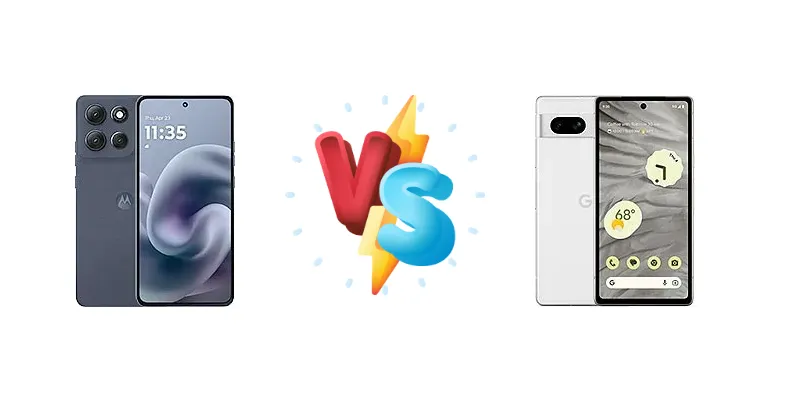
|
🏆 Quick Verdict
For the average user, the Google Pixel 7a emerges as the stronger all-rounder. Its Tensor G2 chipset provides a smoother, more responsive experience, and its camera system is demonstrably superior. However, if battery life is your absolute top priority, the Moto G86 Power’s exceptional endurance is unmatched.
| PHONES | ||
|---|---|---|
| Phone Names | Motorola Moto G86 Power | Google Pixel 7a |
| Network | ||
|---|---|---|
| 2G bands | GSM 850 / 900 / 1800 / 1900 | GSM 850 / 900 / 1800 / 1900 |
| 3G bands | HSDPA 850 / 900 / 1900 / 2100 - International | HSDPA 800 / 850 / 900 / 1700(AWS) / 1900 / 2100 |
| 4G bands | 1, 2, 3, 5, 7, 8, 20, 26, 28, 32, 38, 40, 41, 42, 71 - EMEA & AP | 1, 2, 3, 4, 5, 7, 8, 12, 13, 14, 17, 20, 25, 26, 28, 29, 30, 38, 40, 41, 48, 66, 71 - GWKK3, G0DZQ |
| 5G bands | 1, 3, 5, 7, 8, 20, 26, 28, 38, 40, 41, 71, 77, 78 SA/NSA/Sub6 - EMEA & AP | 1, 2, 3, 5, 7, 8, 12, 14, 20, 25, 28, 30, 38, 41, 48, 66, 71, 77, 78 SA/NSA/Sub6 - GWKK3 |
| Speed | HSPA, LTE, 5G | HSPA, LTE, 5G |
| Technology | GSM / HSPA / LTE / 5G | GSM / HSPA / LTE / 5G |
| - | 1, 2, 3, 5, 7, 8, 12, 20, 25, 28, 38, 40, 41, 66, 75, 76, 77, 78, 79 SA/NSA/Sub6 - GHL1X, G82U8 | |
| Launch | ||
|---|---|---|
| Announced | 2025, May 29 | 2023, May 10 |
| Status | Available. Released 2025, July 30 | Available. Released 2023, May 10 |
| Body | ||
|---|---|---|
| Build | Glass front (Gorilla Glass 7i), plastic frame, silicone polymer (eco leather) back | Glass front (Gorilla Glass 3), aluminum frame, plastic back |
| Dimensions | 161.2 x 74.7 x 8.7 mm (6.35 x 2.94 x 0.34 in) | 152 x 72.9 x 9 mm (5.98 x 2.87 x 0.35 in) |
| SIM | · Nano-SIM + eSIM· Nano-SIM + Nano-SIM | Nano-SIM + eSIM |
| Weight | 195 or 198 g (6.98 oz) | 193.5 g (6.84 oz) |
| - | IP67 dust/water resistant (up to 1m for 30 min) | |
| Display | ||
|---|---|---|
| Protection | Corning Gorilla Glass 7i, Mohs level 4 | Corning Gorilla Glass 3 |
| Resolution | 1220 x 2712 pixels, 20:9 ratio (~446 ppi density) | 1080 x 2400 pixels, 20:9 ratio (~429 ppi density) |
| Size | 6.67 inches, 107.4 cm2 (~89.2% screen-to-body ratio) | 6.1 inches, 90.7 cm2 (~81.8% screen-to-body ratio) |
| Type | P-OLED, 1B colors, 120Hz, HDR10+, 4500 nits peak | OLED, HDR, 90Hz |
| - | Always-on display | |
| Platform | ||
|---|---|---|
| CPU | Octa-core (4x2.5 GHz Cortex-A78 & 4x2.0 GHz Cortex-A55) - GlobalOcta-core (4x2.6 GHz Cortex-A78 & 4x2.0 GHz Cortex-A55) - India | Octa-core (2x2.85 GHz Cortex-X1 & 2x2.35 GHz Cortex-A78 & 4x1.80 GHz Cortex-A55) |
| Chipset | Mediatek Dimensity 7300 (4 nm) - GlobalMediatek Dimensity 7400 (4 nm) - India | Google Tensor G2 (5 nm) |
| GPU | Mali-G615 MC2 | Mali-G710 MP7 |
| OS | Android 15, up to 2 major Android upgrades | Android 13, upgradable to Android 15, up to 5 major Android upgrades |
| Memory | ||
|---|---|---|
| Card slot | microSDXC (dedicated slot) | No |
| Internal | 128GB 8GB RAM, 256GB 8GB RAM, 256GB 12GB RAM, 512GB 8GB RAM, 512GB 12GB RAM | 128GB 8GB RAM |
| - | UFS 3.1 | |
| Main Camera | ||
|---|---|---|
| Dual | 50 MP, f/1.9, 25mm (wide), 1/1.95", 0.8µm, dual pixel PDAF, OIS 8 MP, f/2.2, 12mm, 118˚ (ultrawide), 1.12µm, AF | 64 MP, f/1.9, 26mm (wide), 1/1.73", 0.8µm, dual pixel PDAF, OIS 13 MP, f/2.2, 120˚ (ultrawide), 1.12µm |
| Features | LED flash, HDR, panorama | Dual-LED flash, Pixel Shift, Auto-HDR, panorama |
| Video | 4K@30/60fps, 1080p@30/60/120fps, gyro-EIS | 4K@30/60fps, 1080p@30/60/120/240fps, OIS |
| Selfie camera | ||
|---|---|---|
| Features | HDR | HDR, panorama |
| Single | 32 MP, f/2.2, (wide), 0.7µm | 13 MP, f/2.2, 20mm (ultrawide), 1.12µm |
| Video | 4K@30fps, 1080p@30fps, gyro-EIS | 4K@30fps, 1080p@30fps |
| Sound | ||
|---|---|---|
| 3.5mm jack | - | No |
| 35mm jack | No | No |
| Loudspeaker | Yes, with stereo speakers (with Dolby Atmos) | Yes, with stereo speakers |
| Comms | ||
|---|---|---|
| Bluetooth | 5.4, A2DP, LE | 5.3, A2DP, LE |
| NFC | Yes | Yes |
| Positioning | GPS, GLONASS, GALILEO, BDS, QZSS | GPS, GLONASS, GALILEO, BDS, QZSS, NavIC |
| Radio | No | No |
| USB | USB Type-C 2.0 | USB Type-C 3.2 |
| WLAN | Wi-Fi 802.11 a/b/g/n/ac/6, dual-band | Wi-Fi 802.11 a/b/g/n/ac/6e, tri-band |
| Features | ||
|---|---|---|
| Sensors | Fingerprint (under display, optical), accelerometer, gyro, proximity, compass | Fingerprint (under display, optical), accelerometer, gyro, proximity, compass, barometer |
| Battery | ||
|---|---|---|
| Charging | 30W wired | 18W wired, PD3.0 7.5W wireless |
| Type | 6720 mAh | Li-Po 4385 mAh |
| Misc | ||
|---|---|---|
| Colors | Pantone: Spellbound, Golden Cypress, Cosmic Sky, Chrysanthemum | Charcoal, Snow, Sea, Coral |
| Models | XT2527-7 | GWKK3, GHL1X, G0DZQ, G82U8 |
| Price | $ 472.00 / € 269.90 / ₹ 17,000 | € 179.90 / $ 150.00 / £ 170.00 / ₹ 25,980 |
| EU LABEL | ||
|---|---|---|
| Battery | 67:39h endurance, 1000 cycles | - |
| Energy | Class A | - |
| Free fall | Class B (180 falls) | - |
| Repairability | Class B | - |
Motorola Moto G86 Power
- Exceptional battery life (67:39h endurance)
- Faster 30W wired charging
- Potentially more affordable price point
- Less powerful processor than the Pixel 7a
- Inferior camera system
- No wireless charging
Google Pixel 7a
- Superior performance with Google Tensor G2
- Excellent camera quality and image processing
- Wireless charging support
- Shorter battery life compared to the G86 Power
- Slower 18W wired charging
- Generally higher price
Display Comparison
The Pixel 7a boasts a brighter display, peaking at 1070 nits, offering superior visibility in direct sunlight compared to the Moto G86 Power (brightness data unavailable). While the G86 Power’s panel specifics are unknown, the Pixel 7a’s OLED panel delivers vibrant colors and deep blacks. The Pixel 7a’s 90Hz refresh rate, though not specified for the G86 Power, likely provides a smoother scrolling experience. The Pixel 7a’s smaller bezels contribute to a more modern aesthetic.
Camera Comparison
The Pixel 7a’s camera system is a clear standout. While specific sensor details are missing for the G86 Power, the Pixel 7a’s image processing, powered by the Tensor G2, delivers exceptional dynamic range and detail in both photos and videos. Google’s computational photography algorithms excel in low-light conditions. The Pixel 7a’s video capabilities are also superior, offering features like Cinematic Blur. The G86 Power likely relies more on hardware for image quality, potentially struggling in challenging lighting scenarios. Ignoring any potential 2MP macro lenses on either device, the Pixel 7a’s main sensor and image processing pipeline are the key differentiators.
Performance
The Google Pixel 7a’s Tensor G2 (5nm) chipset, featuring a Cortex-X1 prime core, offers a significant performance advantage over the Motorola Moto G86 Power’s Mediatek Dimensity 7300 (4nm) or 7400 (4nm). The Tensor G2’s architecture, with its focus on AI and machine learning, translates to faster image processing and improved voice assistant capabilities. While the Dimensity chips are efficient, the Tensor G2’s more powerful GPU will deliver a better gaming experience. The G86 Power’s Cortex-A78 cores are capable, but the Pixel 7a’s X1 core provides a noticeable boost in single-core performance. The Pixel 7a also benefits from faster LPDDR5x RAM, further enhancing responsiveness.
Battery Life
The Motorola Moto G86 Power truly shines in battery endurance, achieving a remarkable 67:39h rating. This is significantly longer than the Pixel 7a’s 76h (older rating, likely lower with current software). However, the Pixel 7a offers the convenience of 7.5W wireless charging, a feature absent on the G86 Power. The G86 Power’s 30W wired charging is faster than the Pixel 7a’s 18W wired charging with PD3.0, allowing for quicker top-ups, but the G86 Power’s longevity means you’ll need to charge it less frequently.
Buying Guide
Buy the Motorola Moto G86 Power if you need a phone that can reliably last two days on a single charge, frequently travel without easy access to power outlets, or prioritize value above all else. Buy the Google Pixel 7a if you prefer a more polished software experience, a significantly better camera for photos and videos, and a faster, more capable processor for demanding apps and games.