
Motorola Moto G85 vs Xiaomi Redmi Note 13 Pro+: A Detailed Comparison
| Phones Images | |||||
|---|---|---|---|---|---|
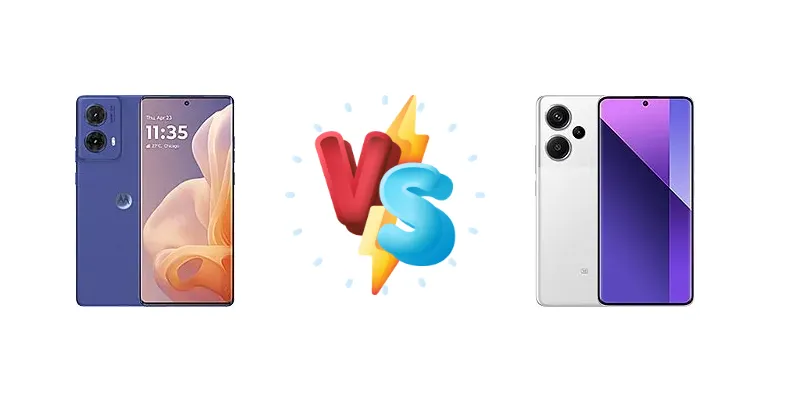
|
🏆 Quick Verdict
For the average user prioritizing speed and convenience, the Xiaomi Redmi Note 13 Pro+ is the clear winner. Its significantly faster 120W charging and more powerful Dimensity 7200 Ultra chipset outweigh the Moto G85’s efficiency gains. However, the G85 remains a strong contender for those on a tighter budget.
| PHONES | ||
|---|---|---|
| Phone Names | Motorola Moto G85 | Xiaomi Redmi Note 13 Pro+ |
| Network | ||
|---|---|---|
| 2G bands | GSM 850 / 900 / 1800 / 1900 | GSM 850 / 900 / 1800 / 1900 |
| 3G bands | HSDPA 850 / 900 / 1900 / 2100 | HSDPA 800 / 850 / 900 / 1700(AWS) / 1900 / 2100 - International |
| 4G bands | 1, 2, 3, 5, 7, 8, 18, 19, 20, 26, 28, 32, 38, 40, 41, 42 | 1, 2, 3, 4, 5, 7, 8, 12, 13, 17, 18, 19, 20, 26, 28, 32, 38, 40, 41, 66 - International |
| 5G bands | 1, 3, 5, 7, 8, 20, 26, 28, 38, 40, 41, 77, 78 SA/NSA/Sub6 | 1, 3, 5, 7, 8, 20, 28, 38, 40, 41, 66, 77, 78 SA/NSA- International |
| Speed | HSPA, LTE, 5G | HSPA, LTE, 5G |
| Technology | GSM / HSPA / LTE / 5G | GSM / CDMA / HSPA / EVDO / LTE / 5G |
| Launch | ||
|---|---|---|
| Announced | 2024, June 25 | 2023, September 21 |
| Status | Available. Released 2024, June 25 | Available. Released 2023, September 21 |
| Body | ||
|---|---|---|
| Build | Glass front (Gorilla Glass 5), plastic frame, plastic back or silicone polymer (eco leather) back | Glass front (Gorilla Glass Victus), glass back or silicone polymer back (eco leather) |
| Dimensions | 161.9 x 73.1 x 7.6 mm (6.37 x 2.88 x 0.30 in) | 161.4 x 74.2 x 8.9 mm (6.35 x 2.92 x 0.35 in) |
| SIM | Nano-SIM + eSIM | · Nano-SIM + eSIM· Nano-SIM + Nano-SIM |
| Weight | 171 g or 173 g (6.03 oz) | 199 g or 204.5 g (7.02 oz) |
| Display | ||
|---|---|---|
| Protection | Corning Gorilla Glass 5 | Corning Gorilla Glass Victus |
| Resolution | 1080 x 2400 pixels, 20:9 ratio (~395 ppi density) | 1220 x 2712 pixels, 20:9 ratio (~446 ppi density) |
| Size | 6.67 inches, 107.4 cm2 (~90.8% screen-to-body ratio) | 6.67 inches, 107.4 cm2 (~89.7% screen-to-body ratio) |
| Type | P-OLED, 1B colors, 120Hz, 1600 nits (peak) | AMOLED, 68B colors, 120Hz, 1920Hz PWM, Dolby Vision, HDR10+, 1800 nits (peak) |
| Platform | ||
|---|---|---|
| CPU | Octa-core (2x2.3 GHz Cortex-A78 & 6x2.0 GHz Cortex-A55) | Octa-core (2x2.8 GHz Cortex-A715 & 6x2.0 GHz Cortex-A510) |
| Chipset | Qualcomm SM6375 Snapdragon 6s Gen 3 (6 nm) | Mediatek Dimensity 7200 Ultra (4 nm) |
| GPU | Adreno 619 | Mali-G610 MC4 |
| OS | Android 14 | Android 13, up to 3 major Android upgrades, HyperOS |
| Memory | ||
|---|---|---|
| Card slot | microSDXC | No |
| Internal | 128GB 8GB RAM, 256GB 8GB RAM, 256GB 12GB RAM, 512GB 8GB RAM, 512GB 12GB RAM | 256GB 8GB RAM, 256GB 12GB RAM, 512GB 8GB RAM, 512GB 12GB RAM, 512GB 16GB RAM |
| Main Camera | ||
|---|---|---|
| Dual | 50 MP, f/1.8 (wide), 1/1.95", 0.8µm, PDAF, OIS 8 MP, f/2.2, 118˚ (ultrawide), 1.12µm, AF | - |
| Features | LED flash, HDR, panorama | Dual-LED dual-tone flash, HDR, panorama |
| Triple | - | 200 MP, f/1.7, 23mm (wide), 1/1.4", 0.56µm, multi-directional PDAF, OIS 8 MP, f/2.2, 16mm, 120˚ (ultrawide), 1/4.0", 1.12µm 2 MP (macro) |
| Video | 1080p@30/60fps | 4K@24/30fps, 1080p@30/60/120fps, gyro-EIS |
| Selfie camera | ||
|---|---|---|
| Features | - | HDR, panorama |
| Single | 32 MP, f/2.4, (wide), 0.7µm | 16 MP, f/2.4, (wide) |
| Video | 1080p@30fps | 1080p@30/60fps |
| Sound | ||
|---|---|---|
| 35mm jack | No | No |
| Loudspeaker | Yes, with stereo speakers | Yes, with stereo speakers |
| Comms | ||
|---|---|---|
| Bluetooth | 5.1, A2DP, LE | 5.3, A2DP, LE |
| Infrared port | - | Yes |
| NFC | Yes (market/region dependent) | Yes (market/region dependent) |
| Positioning | GPS, GALILEO, GLONASS, BDS, QZSS | GPS, GLONASS, BDS, GALILEO, QZSS |
| Radio | Unspecified | No |
| USB | USB Type-C 2.0 | USB Type-C 2.0, OTG |
| WLAN | Wi-Fi 802.11 a/b/g/n/ac, dual-band | Wi-Fi 802.11 a/b/g/n/ac/6, dual-band, Wi-Fi Direct |
| Features | ||
|---|---|---|
| Sensors | Fingerprint (under display, optical), accelerometer, gyro, proximity, compass | Fingerprint (under display, optical), accelerometer, gyro, proximity, compass |
| Battery | ||
|---|---|---|
| Charging | 30W wired - International 33W wired - India | 120W wired, PD3.0, 100% in 19 min |
| Type | 5000 mAh | Li-Po 5000 mAh |
| Misc | ||
|---|---|---|
| Colors | Olive Green, Cobalt Blue, Urban Grey, Magenta | Midnight Black (Fushion Black), Moonlight White (Fushion White), Aurora Purple, Fushion Purple, Camo Green |
| Models | XT2427-3 | 23090RA98C, 23090RA98G, 23090RA98I |
| Price | $ 289.99 / C$ 287.10 / £ 214.58 / € 194.79 | $ 299.98 / £ 299.00 / € 208.98 / ₹ 24,999 |
| SAR | - | 1.09 W/kg (head) 0.85 W/kg (body) |
| SAR EU | - | 0.98 W/kg (head) 1.00 W/kg (body) |
Motorola Moto G85
- Potentially better battery efficiency due to the Snapdragon 6s Gen 3.
- Likely cleaner software experience with Motorola’s near-stock Android.
- More affordable price point (expected).
- Significantly slower charging speed (30W/33W).
- Less powerful processor compared to the Dimensity 7200 Ultra.
Xiaomi Redmi Note 13 Pro+
- Ultra-fast 120W charging (0-100% in 19 minutes).
- More powerful Dimensity 7200 Ultra processor.
- Brighter display for better outdoor visibility.
- Potentially less battery efficiency than the Moto G85.
- Xiaomi’s MIUI software can be more resource-intensive.
Display Comparison
The Redmi Note 13 Pro+ boasts a significantly brighter display, reaching a measured 1283 nits, compared to an unstated value for the Moto G85. This higher peak brightness translates to better visibility outdoors under direct sunlight. While both likely utilize AMOLED panels, the Redmi’s brightness advantage is a key differentiator. The Redmi Note 13 Pro+’s panel is also likely to have a higher refresh rate, though this is not specified in the provided data. The G85’s display quality is likely adequate, but will fall short of the Redmi in terms of vibrancy and outdoor usability.
Camera Comparison
Without detailed camera specifications for the Moto G85, a direct comparison is limited. However, the Redmi Note 13 Pro+ is expected to feature a more sophisticated camera system, potentially including a higher resolution main sensor and more advanced image processing capabilities. The Redmi’s image processing will likely focus on vibrant colors and strong dynamic range, while Motorola typically aims for a more natural look. The absence of information regarding OIS on the G85 suggests the Redmi Note 13 Pro+ will offer superior low-light performance and video stabilization.
Performance
The Xiaomi Redmi Note 13 Pro+ leverages the Mediatek Dimensity 7200 Ultra, fabricated on a 4nm process, offering a clear advantage in performance and efficiency over the Motorola Moto G85’s Qualcomm Snapdragon 6s Gen 3 (6nm). The Dimensity 7200 Ultra’s Cortex-A715 cores, clocked at 2.8 GHz, are architecturally superior to the G85’s Cortex-A78 cores at 2.3 GHz, resulting in faster application loading and smoother multitasking. The 4nm process also contributes to better thermal management, potentially reducing throttling during sustained workloads. While both phones feature octa-core CPUs, the Redmi Note 13 Pro+ is demonstrably more powerful.
Battery Life
The Redmi Note 13 Pro+’s 120W wired charging is a game-changer, achieving a full charge in just 19 minutes. This is a massive advantage over the Moto G85’s 30W (International) or 33W (India) charging. While the Redmi Note 13 Pro+’s battery capacity isn’t specified, its active use score of 10:38h indicates excellent battery life. The Moto G85 will likely offer comparable or slightly better battery endurance due to the more efficient Snapdragon 6s Gen 3, but the convenience of the Redmi’s ultra-fast charging is a significant benefit.
Buying Guide
Buy the Motorola Moto G85 if you need a reliable, efficient smartphone for everyday tasks and value a clean software experience. It’s ideal for users who prioritize battery life over peak performance and aren’t heavy gamers. Buy the Xiaomi Redmi Note 13 Pro+ if you prefer a faster, more capable device with a stunning display and incredibly rapid charging. This phone is geared towards users who consume a lot of media, game frequently, and demand a premium experience.