
Motorola Moto G85 vs Nothing Phone (2a) Plus: A Detailed Comparison
| Phones Images | |||||
|---|---|---|---|---|---|
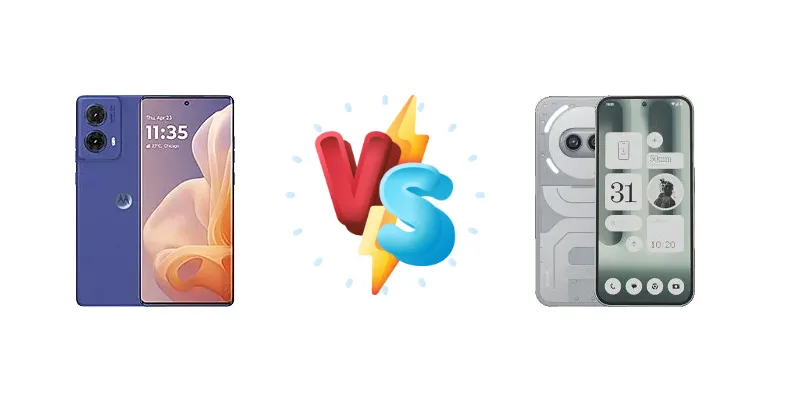
|
🏆 Quick Verdict
For the average user prioritizing a brighter display and significantly faster charging, the Nothing Phone (2a) Plus is the clear winner. Its Mediatek Dimensity 7350 Pro chipset also offers a performance edge. However, the Moto G85 remains a compelling option for those on a tighter budget who value efficiency.
| PHONES | ||
|---|---|---|
| Phone Names | Motorola Moto G85 | Nothing Phone (2a) Plus |
| Network | ||
|---|---|---|
| 2G bands | GSM 850 / 900 / 1800 / 1900 | GSM 850 / 900 / 1800 / 1900 |
| 3G bands | HSDPA 850 / 900 / 1900 / 2100 | HSDPA 800 / 850 / 900 / 1700(AWS) / 1900 / 2100 |
| 4G bands | 1, 2, 3, 5, 7, 8, 18, 19, 20, 26, 28, 32, 38, 40, 41, 42 | 1, 3, 4, 5, 7, 8, 18, 19, 20, 26, 28, 38, 39, 40, 41, 42, 66 |
| 5G bands | 1, 3, 5, 7, 8, 20, 26, 28, 38, 40, 41, 77, 78 SA/NSA/Sub6 | 1, 3, 5, 7, 8, 20, 28, 38, 40, 41, 66, 77, 78 SA/NSA |
| Speed | HSPA, LTE, 5G | HSPA, LTE, 5G |
| Technology | GSM / HSPA / LTE / 5G | GSM / HSPA / LTE / 5G |
| Launch | ||
|---|---|---|
| Announced | 2024, June 25 | 2024, July 31 |
| Status | Available. Released 2024, June 25 | Available. Released 2024, August 03 |
| Body | ||
|---|---|---|
| Build | Glass front (Gorilla Glass 5), plastic frame, plastic back or silicone polymer (eco leather) back | Glass front (Gorilla Glass 5), plastic frame, plastic back |
| Dimensions | 161.9 x 73.1 x 7.6 mm (6.37 x 2.88 x 0.30 in) | 161.7 x 76.3 x 8.5 mm (6.37 x 3.00 x 0.33 in) |
| SIM | Nano-SIM + eSIM | Nano-SIM + Nano-SIM |
| Weight | 171 g or 173 g (6.03 oz) | 190 g (6.70 oz) |
| Display | ||
|---|---|---|
| Protection | Corning Gorilla Glass 5 | Corning Gorilla Glass 5 |
| Resolution | 1080 x 2400 pixels, 20:9 ratio (~395 ppi density) | 1080 x 2412 pixels, 20:9 ratio (~395 ppi density) |
| Size | 6.67 inches, 107.4 cm2 (~90.8% screen-to-body ratio) | 6.7 inches, 107.5 cm2 (~87.1% screen-to-body ratio) |
| Type | P-OLED, 1B colors, 120Hz, 1600 nits (peak) | AMOLED, 1B colors, 120Hz, 2160Hz PWM, HDR10+, 700 nits (typ), 1100 nits (HBM), 1300 nits (peak) |
| Platform | ||
|---|---|---|
| CPU | Octa-core (2x2.3 GHz Cortex-A78 & 6x2.0 GHz Cortex-A55) | Octa-core (2x3.0 GHz Cortex-A715 & 6x 2.0 GHz Cortex-A510) |
| Chipset | Qualcomm SM6375 Snapdragon 6s Gen 3 (6 nm) | Mediatek Dimensity 7350 Pro (4 nm) |
| GPU | Adreno 619 | Mali-G610 MC4 |
| OS | Android 14 | Android 14, up to 3 major Android upgrades, Nothing OS 3.0 |
| Memory | ||
|---|---|---|
| Card slot | microSDXC | No |
| Internal | 128GB 8GB RAM, 256GB 8GB RAM, 256GB 12GB RAM, 512GB 8GB RAM, 512GB 12GB RAM | 256GB 8GB RAM, 256GB 12GB RAM |
| Main Camera | ||
|---|---|---|
| Dual | 50 MP, f/1.8 (wide), 1/1.95", 0.8µm, PDAF, OIS 8 MP, f/2.2, 118˚ (ultrawide), 1.12µm, AF | 50 MP, f/1.9, 24mm (wide), 1/1.57", 1.0µm, PDAF, OIS 50 MP, f/2.2, 114˚ (ultrawide), 1/2.76", 0.64µm |
| Features | LED flash, HDR, panorama | LED flash, panorama, HDR |
| Video | 1080p@30/60fps | 4K@30fps, 1080p@60/120fps, gyro-EIS |
| Selfie camera | ||
|---|---|---|
| Features | - | HDR |
| Single | 32 MP, f/2.4, (wide), 0.7µm | 50 MP, f/2.2, (wide), 1/2.76" |
| Video | 1080p@30fps | 4K@30fps |
| Sound | ||
|---|---|---|
| 35mm jack | No | No |
| Loudspeaker | Yes, with stereo speakers | Yes, with stereo speakers |
| Comms | ||
|---|---|---|
| Bluetooth | 5.1, A2DP, LE | 5.3, A2DP, LE |
| NFC | Yes (market/region dependent) | Yes, 360˚ |
| Positioning | GPS, GALILEO, GLONASS, BDS, QZSS | GPS, GALILEO, GLONASS, BDS, QZSS |
| Radio | Unspecified | No |
| USB | USB Type-C 2.0 | USB Type-C 2.0, OTG |
| WLAN | Wi-Fi 802.11 a/b/g/n/ac, dual-band | Wi-Fi 802.11 a/b/g/n/ac/6, dual-band, Wi-Fi Direct |
| Features | ||
|---|---|---|
| Sensors | Fingerprint (under display, optical), accelerometer, gyro, proximity, compass | Fingerprint (under display, optical), accelerometer, gyro, proximity, compass |
| Battery | ||
|---|---|---|
| Charging | 30W wired - International 33W wired - India | 50W wired, 50% in 21 min, 100% in 56 min |
| Type | 5000 mAh | 5000 mAh |
| Misc | ||
|---|---|---|
| Colors | Olive Green, Cobalt Blue, Urban Grey, Magenta | Black, Grey |
| Models | XT2427-3 | A142P |
| Price | $ 289.99 / C$ 287.10 / £ 214.58 / € 194.79 | € 269.90 / ₹ 22,599 |
Motorola Moto G85
- Potentially more affordable price point
- Efficient Snapdragon 6s Gen 3 chipset
- Reliable Motorola software experience
- Slower charging speeds (30W/33W)
- Likely less powerful processor
- Display likely less bright than the competition
Nothing Phone (2a) Plus
- Significantly faster 50W charging
- Brighter and more vibrant display (1097 nits)
- More powerful Mediatek Dimensity 7350 Pro processor
- Potentially higher price
- Mediatek chipset may have less long-term software support
- Nothing OS may not appeal to all users
Display Comparison
The Nothing Phone (2a) Plus boasts a significantly brighter display, reaching a measured peak of 1097 nits. This is a substantial advantage over what we'd expect from the Moto G85, making it far more usable in direct sunlight. While the Moto G85’s panel specifications aren’t provided, the Nothing Phone (2a) Plus’s brightness level suggests a superior viewing experience. The Nothing Phone (2a) Plus’s display technology is likely to offer better color accuracy and contrast, enhancing media consumption. The lack of LTPO on either device means neither will dynamically adjust refresh rates for maximum efficiency.
Camera Comparison
Without detailed camera specifications for the Moto G85, a direct comparison is limited. However, the Nothing Phone (2a) Plus likely benefits from a more advanced image signal processor (ISP) integrated within the Dimensity 7350 Pro. The Nothing Phone (2a) Plus’s image processing will likely deliver more detailed and dynamic range in challenging lighting conditions. We can assume the Moto G85 will offer a competent camera experience for casual photography, but the Nothing Phone (2a) Plus is expected to provide a more refined and versatile camera system.
Performance
The Nothing Phone (2a) Plus’s Mediatek Dimensity 7350 Pro, built on a 4nm process, holds a clear advantage over the Motorola Moto G85’s Qualcomm Snapdragon 6s Gen 3 (6nm). The Dimensity 7350 Pro features newer Cortex-A715 cores clocked at 3.0 GHz, compared to the G85’s Cortex-A78 cores at 2.3 GHz. This translates to faster application loading times and smoother multitasking. While both utilize a 6-core Cortex-A510/A55 efficiency cluster, the 4nm node of the Dimensity 7350 Pro offers superior thermal efficiency, potentially reducing throttling during sustained workloads. The G85 will be adequate for everyday tasks, but the Nothing Phone (2a) Plus is the better choice for gamers and power users.
Battery Life
The Nothing Phone (2a) Plus shines in the charging department with its 50W wired charging, achieving 50% charge in just 21 minutes and a full charge in 56 minutes. The Moto G85 lags behind with 30W (International) or 33W (India) charging, resulting in a significantly longer charging time. While battery capacity isn’t specified for the Moto G85, the Nothing Phone (2a) Plus demonstrates excellent real-world battery life, achieving 16 hours and 34 minutes of active use. The faster charging of the Nothing Phone (2a) Plus mitigates any potential concerns about battery life, offering greater convenience for users who frequently need to top up their device.
Buying Guide
Buy the Motorola Moto G85 if you need a dependable daily driver with a focus on efficient power usage and are comfortable with slower charging speeds. Buy the Nothing Phone (2a) Plus if you prioritize a vibrant, bright display, rapid 50W charging, and a more powerful processor for demanding applications and gaming.