
Moto G85 vs Honor X9b: A Deep Dive into Mid-Range Chipsets and Charging
| Phones Images | |||||
|---|---|---|---|---|---|
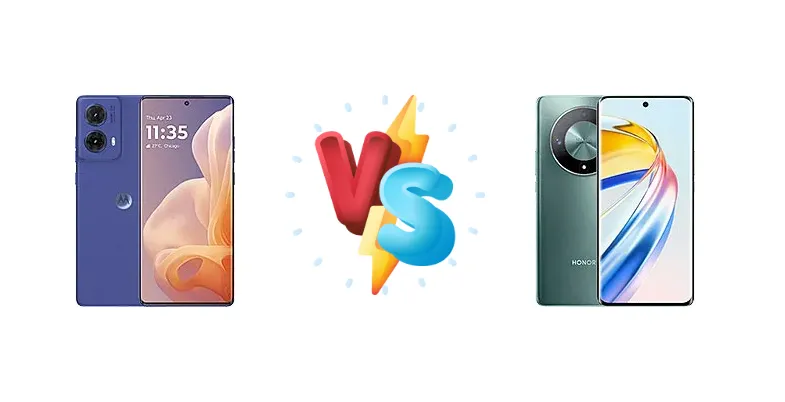
|
🏆 Quick Verdict
For the average user prioritizing sustained performance and potentially longer software support, the Honor X9b emerges as the better choice. Its Snapdragon 6 Gen 1, built on a more efficient 4nm process, offers a slight edge in processing power and thermal management, coupled with faster 35W charging. However, the Moto G85 remains a strong contender for those seeking a more affordable option.
| PHONES | ||
|---|---|---|
| Phone Names | Motorola Moto G85 | Honor X9b |
| Network | ||
|---|---|---|
| 2G bands | GSM 850 / 900 / 1800 / 1900 | GSM 850 / 900 / 1800 / 1900 |
| 3G bands | HSDPA 850 / 900 / 1900 / 2100 | HSDPA 850 / 900 / 1900 / 2100 |
| 4G bands | 1, 2, 3, 5, 7, 8, 18, 19, 20, 26, 28, 32, 38, 40, 41, 42 | 1, 2, 3, 4, 5, 7, 8, 20, 28, 32, 38, 40, 41 |
| 5G bands | 1, 3, 5, 7, 8, 20, 26, 28, 38, 40, 41, 77, 78 SA/NSA/Sub6 | 1, 3, 7, 8, 20, 28, 38, 40, 41, 77, 78 SA/NSA |
| Speed | HSPA, LTE, 5G | HSPA, LTE, 5G |
| Technology | GSM / HSPA / LTE / 5G | GSM / HSPA / LTE / 5G |
| Launch | ||
|---|---|---|
| Announced | 2024, June 25 | 2023, October 18 |
| Status | Available. Released 2024, June 25 | Available. Released 2023, October |
| Body | ||
|---|---|---|
| Build | Glass front (Gorilla Glass 5), plastic frame, plastic back or silicone polymer (eco leather) back | - |
| Dimensions | 161.9 x 73.1 x 7.6 mm (6.37 x 2.88 x 0.30 in) | 163.6 x 75.5 x 8 mm (6.44 x 2.97 x 0.31 in) |
| SIM | Nano-SIM + eSIM | Nano-SIM + Nano-SIM |
| Weight | 171 g or 173 g (6.03 oz) | 185 g (6.53 oz) |
| Display | ||
|---|---|---|
| Protection | Corning Gorilla Glass 5 | - |
| Resolution | 1080 x 2400 pixels, 20:9 ratio (~395 ppi density) | 1220 x 2652 pixels, 19.5:9 ratio (~431 ppi density) |
| Size | 6.67 inches, 107.4 cm2 (~90.8% screen-to-body ratio) | 6.78 inches, 112.6 cm2 (~91.2% screen-to-body ratio) |
| Type | P-OLED, 1B colors, 120Hz, 1600 nits (peak) | AMOLED, 1B colors, 120Hz, 1200 nits (peak) |
| Platform | ||
|---|---|---|
| CPU | Octa-core (2x2.3 GHz Cortex-A78 & 6x2.0 GHz Cortex-A55) | Octa-core (4x2.2 GHz Cortex-A78 & 4x1.8 GHz Cortex-A55) |
| Chipset | Qualcomm SM6375 Snapdragon 6s Gen 3 (6 nm) | Qualcomm SM6450 Snapdragon 6 Gen 1 (4 nm) |
| GPU | Adreno 619 | Adreno 710 |
| OS | Android 14 | Android 13, Magic OS 7.2 |
| Memory | ||
|---|---|---|
| Card slot | microSDXC | No |
| Internal | 128GB 8GB RAM, 256GB 8GB RAM, 256GB 12GB RAM, 512GB 8GB RAM, 512GB 12GB RAM | 256GB 8GB RAM, 256GB 12GB RAM, 512GB 8GB RAM, 512GB 12GB RAM |
| Main Camera | ||
|---|---|---|
| Dual | 50 MP, f/1.8 (wide), 1/1.95", 0.8µm, PDAF, OIS 8 MP, f/2.2, 118˚ (ultrawide), 1.12µm, AF | - |
| Features | LED flash, HDR, panorama | LED flash, panorama, HDR |
| Triple | - | 108 MP, f/1.8, (wide), 1/1.67", PDAF 5 MP, f/2.2, (ultrawide) 2 MP (macro) |
| Video | 1080p@30/60fps | 4K@30fps, 1080p@30fps |
| Selfie camera | ||
|---|---|---|
| Single | 32 MP, f/2.4, (wide), 0.7µm | 16 MP, f/2.5, (wide) |
| Video | 1080p@30fps | 1080p@30fps |
| Sound | ||
|---|---|---|
| 35mm jack | No | No |
| Loudspeaker | Yes, with stereo speakers | Yes |
| Comms | ||
|---|---|---|
| Bluetooth | 5.1, A2DP, LE | 5.1, A2DP, LE |
| Infrared port | - | Yes |
| NFC | Yes (market/region dependent) | Yes (market/region dependent) |
| Positioning | GPS, GALILEO, GLONASS, BDS, QZSS | GPS, GLONASS, GALILEO, BDS |
| Radio | Unspecified | No |
| USB | USB Type-C 2.0 | USB Type-C 2.0, OTG |
| WLAN | Wi-Fi 802.11 a/b/g/n/ac, dual-band | Wi-Fi 802.11 a/b/g/n/ac, dual-band, Wi-Fi Direct |
| Features | ||
|---|---|---|
| Sensors | Fingerprint (under display, optical), accelerometer, gyro, proximity, compass | Fingerprint (under display, optical), accelerometer, gyro, proximity, compass |
| Battery | ||
|---|---|---|
| Charging | 30W wired - International 33W wired - India | 35W wired Reverse wired |
| Type | 5000 mAh | Li-Po 5800 mAh |
| Misc | ||
|---|---|---|
| Colors | Olive Green, Cobalt Blue, Urban Grey, Magenta | Sunrise Orange, Midnight Black, Emerald Green |
| Models | XT2427-3 | ALI-NX1 |
| Price | $ 289.99 / C$ 287.10 / £ 214.58 / € 194.79 | About 970 EUR |
Motorola Moto G85
- Potentially lower price point
- Slightly higher CPU clock speeds on primary cores
- Clean Android experience (typically Motorola)
- Less efficient 6nm Snapdragon 6s Gen 3
- Slower 30W/33W charging
- No reverse wired charging
Honor X9b
- More efficient 4nm Snapdragon 6 Gen 1
- Faster 35W wired charging
- Reverse wired charging capability
- Potentially higher price
- Slightly lower CPU clock speeds on primary cores
- Honor's MagicOS may not appeal to all users
Display Comparison
Neither device boasts a standout display. While specific panel details (like OLED vs LCD) are missing, the focus here is on the chipset impact. Both will likely offer 1080p+ resolution displays common in this segment. The absence of high refresh rates or LTPO technology suggests neither prioritizes a premium visual experience. Bezels are expected to be similar, typical of mid-range devices.
Camera Comparison
Without detailed camera specs, a direct comparison is limited. Both phones will likely feature a multi-camera setup with a primary sensor, ultrawide, and potentially a macro lens. However, the image signal processor (ISP) within the Snapdragon 6 Gen 1 is likely more advanced, potentially leading to better image processing, especially in low-light conditions. The 4nm process also allows for more efficient processing of camera data. The Moto G85’s ISP, while capable, will be constrained by the 6nm process and potentially less advanced architecture. We anticipate similar video recording capabilities (1080p at 30/60fps).
Performance
The core difference lies in the chipsets. The Honor X9b’s Snapdragon 6 Gen 1 (4nm) benefits from a smaller fabrication process, translating to improved power efficiency and potentially less thermal throttling under sustained load. While the Moto G85’s Snapdragon 6s Gen 3 (6nm) features Cortex-A78 cores clocked slightly higher (2.3GHz vs 2.2GHz), the Gen 1’s architecture and process node give it an advantage. The Gen 1’s 4x A78 cores versus the G85’s 2x A78 cores also contribute to better multi-core performance. This means the X9b will likely handle multitasking and moderately demanding games more smoothly. RAM configurations are assumed to be similar (likely 8GB options), but the Snapdragon 6 Gen 1’s superior efficiency will be more noticeable.
Battery Life
The Honor X9b’s 35W wired charging is a clear advantage over the Moto G85’s 30W (International) / 33W (India) charging. This translates to faster top-up times, reducing downtime. While battery capacity isn’t specified, the Snapdragon 6 Gen 1’s 4nm efficiency should result in comparable or slightly better battery life despite potentially having a similar capacity to the Moto G85. The X9b also includes reverse wired charging, a feature absent on the G85, allowing it to charge other devices.
Buying Guide
Buy the Motorola Moto G85 if you need a highly affordable smartphone with a decent processor for everyday tasks and aren't heavily reliant on demanding applications. Buy the Honor X9b if you prefer a slightly more powerful and efficient chipset for smoother multitasking, light gaming, and faster charging, even if it comes at a modest price premium.