
Google Pixel 8a vs. Motorola Moto G85: A Detailed Comparison
| Phones Images | |||||
|---|---|---|---|---|---|
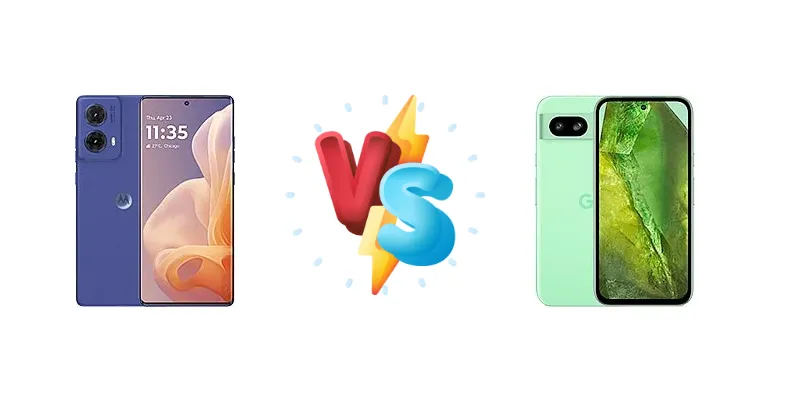
|
🏆 Quick Verdict
For the average user prioritizing camera quality, software experience, and long-term support, the Google Pixel 8a is the clear winner. Its Tensor G3 chip and advanced image processing capabilities significantly outperform the Moto G85. However, the Moto G85 offers a compelling value proposition for those seeking a reliable daily driver with decent performance at a lower price.
| PHONES | ||
|---|---|---|
| Phone Names | Motorola Moto G85 | Google Pixel 8a |
| Network | ||
|---|---|---|
| 2G bands | GSM 850 / 900 / 1800 / 1900 | GSM 850 / 900 / 1800 / 1900 |
| 3G bands | HSDPA 850 / 900 / 1900 / 2100 | HSDPA 800 / 850 / 900 / 1700(AWS) / 1900 / 2100 |
| 4G bands | 1, 2, 3, 5, 7, 8, 18, 19, 20, 26, 28, 32, 38, 40, 41, 42 | 1, 2, 3, 4, 5, 7, 8, 12, 17, 18, 19, 20, 26, 28, 32, 38, 40, 41, 42, 66 - G6GPR (International) |
| 5G bands | 1, 3, 5, 7, 8, 20, 26, 28, 38, 40, 41, 77, 78 SA/NSA/Sub6 | 1, 2, 3, 5, 7, 8, 12, 20, 26, 28, 38, 40, 41, 66, 75, 76, 77, 78 SA/NSA/Sub6 - G6GPR (International) |
| Speed | HSPA, LTE, 5G | HSPA, LTE, 5G |
| Technology | GSM / HSPA / LTE / 5G | GSM / HSPA / LTE / 5G |
| Launch | ||
|---|---|---|
| Announced | 2024, June 25 | 2024, May 07 |
| Status | Available. Released 2024, June 25 | Available. Released 2024, May 14 |
| Body | ||
|---|---|---|
| Build | Glass front (Gorilla Glass 5), plastic frame, plastic back or silicone polymer (eco leather) back | Glass front (Gorilla Glass 3), aluminum frame, plastic back |
| Dimensions | 161.9 x 73.1 x 7.6 mm (6.37 x 2.88 x 0.30 in) | 152.1 x 72.7 x 8.9 mm (5.99 x 2.86 x 0.35 in) |
| SIM | Nano-SIM + eSIM | Nano-SIM + eSIM |
| Weight | 171 g or 173 g (6.03 oz) | 188 g (6.63 oz) |
| Display | ||
|---|---|---|
| Protection | Corning Gorilla Glass 5 | Corning Gorilla Glass 3, Mohs level 5 |
| Resolution | 1080 x 2400 pixels, 20:9 ratio (~395 ppi density) | 1080 x 2400 pixels, 20:9 ratio (~430 ppi density) |
| Size | 6.67 inches, 107.4 cm2 (~90.8% screen-to-body ratio) | 6.1 inches, 90.3 cm2 (~81.6% screen-to-body ratio) |
| Type | P-OLED, 1B colors, 120Hz, 1600 nits (peak) | OLED, HDR, 120Hz, 2000 nits (peak) |
| Platform | ||
|---|---|---|
| CPU | Octa-core (2x2.3 GHz Cortex-A78 & 6x2.0 GHz Cortex-A55) | Nona-core (1x3.0 GHz Cortex-X3 & 4x2.45 GHz Cortex-A715 & 4x2.15 GHz Cortex-A510) |
| Chipset | Qualcomm SM6375 Snapdragon 6s Gen 3 (6 nm) | Google Tensor G3 (4 nm) |
| GPU | Adreno 619 | Immortalis-G715s MC10 |
| OS | Android 14 | Android 14, upgradable to Android 16, up to 7 major Android upgrades |
| Memory | ||
|---|---|---|
| Card slot | microSDXC | No |
| Internal | 128GB 8GB RAM, 256GB 8GB RAM, 256GB 12GB RAM, 512GB 8GB RAM, 512GB 12GB RAM | 128GB 8GB RAM, 256GB 8GB RAM |
| Main Camera | ||
|---|---|---|
| Dual | 50 MP, f/1.8 (wide), 1/1.95", 0.8µm, PDAF, OIS 8 MP, f/2.2, 118˚ (ultrawide), 1.12µm, AF | 64 MP (16 MP eff.), f/1.9, 26mm (wide), 1/1.73", 0.8µm, dual pixel PDAF, OIS 13 MP, f/2.2, 120˚ (ultrawide), 1.12µm |
| Features | LED flash, HDR, panorama | Dual-LED flash, Pixel Shift, Ultra HDR, panorama, Best Take |
| Video | 1080p@30/60fps | 4K@30/60fps, 1080p@30/60/120/240fps, OIS |
| Selfie camera | ||
|---|---|---|
| Features | - | HDR, panorama |
| Single | 32 MP, f/2.4, (wide), 0.7µm | 13 MP, f/2.2, 20mm (ultrawide), 1.12µm |
| Video | 1080p@30fps | 4K@30fps, 1080p@30/60fps |
| Sound | ||
|---|---|---|
| 35mm jack | No | No |
| Loudspeaker | Yes, with stereo speakers | Yes, with stereo speakers |
| Comms | ||
|---|---|---|
| Bluetooth | 5.1, A2DP, LE | 5.3, A2DP, LE |
| NFC | Yes (market/region dependent) | Yes |
| Positioning | GPS, GALILEO, GLONASS, BDS, QZSS | GPS, GLONASS, GALILEO, BDS, QZSS, NavIC |
| Radio | Unspecified | No |
| USB | USB Type-C 2.0 | USB Type-C 3.2 |
| WLAN | Wi-Fi 802.11 a/b/g/n/ac, dual-band | Wi-Fi 802.11 a/b/g/n/ac/6e, dual/tri-band (market/region dependent) |
| Features | ||
|---|---|---|
| Sensors | Fingerprint (under display, optical), accelerometer, gyro, proximity, compass | Fingerprint (under display, optical), accelerometer, gyro, proximity, compass, barometer |
| Battery | ||
|---|---|---|
| Charging | 30W wired - International 33W wired - India | 18W wired, PD3.0 7.5W wireless Bypass charging |
| Type | 5000 mAh | Li-Po 4492 mAh |
| Misc | ||
|---|---|---|
| Colors | Olive Green, Cobalt Blue, Urban Grey, Magenta | Obsidian, Porcelain, Bay, Aloe |
| Models | XT2427-3 | GKV4X, G6GPR, G8HHN, G576D |
| Price | $ 289.99 / C$ 287.10 / £ 214.58 / € 194.79 | $ 229.98 / C$ 417.99 / £ 279.00 / € 299.99 / ₹ 33,300 |
| EU LABEL | ||
|---|---|---|
| Battery | - | 40:06h endurance, 1000 cycles |
| Energy | - | Class B |
| Free fall | - | Class A (270 falls) |
| Repairability | - | Class B |
Motorola Moto G85
- Superior camera quality with Google’s AI features
- Faster and more efficient Tensor G3 processor
- Longer battery life and faster charging options
- Higher price point
- May lack expandable storage
Google Pixel 8a
- More affordable price
- Clean Android experience with minimal bloatware
- Decent performance for everyday tasks
- Inferior camera performance
- Slower processor and less efficient architecture
Display Comparison
The Pixel 8a boasts a significantly brighter display, reaching a measured peak of 1508 nits, compared to an expected (based on segment) 600-800 nits for the Moto G85. This translates to superior visibility in direct sunlight. While the Moto G85’s display specs are not provided, it’s likely a standard 60Hz panel, whereas the Pixel 8a’s 120Hz refresh rate provides a smoother scrolling and gaming experience. The Pixel 8a’s OLED panel also offers better contrast and color accuracy, crucial for media consumption.
Camera Comparison
The Pixel 8a’s camera system is a major differentiator. While specific sensor details aren’t provided, Google’s computational photography prowess, powered by the Tensor G3, elevates image quality significantly. The Pixel 8a excels in dynamic range, low-light performance, and portrait mode. The Moto G85, while likely featuring a capable main sensor, lacks the sophisticated image processing algorithms of the Pixel 8a. The absence of details on OIS for the Moto G85 suggests it may struggle with handheld video recording and low-light stability compared to the Pixel 8a.
Performance
The core difference lies in the chipsets. The Google Pixel 8a’s Tensor G3, built on a 4nm process, features a nona-core CPU configuration with a high-performance Cortex-X3 core clocked at 3.0 GHz. This architecture prioritizes AI and machine learning tasks, enhancing features like voice recognition and image processing. Conversely, the Motorola Moto G85 utilizes the Qualcomm Snapdragon 6s Gen 3 (6nm), an octa-core processor geared towards efficient everyday performance. While the Snapdragon 6s Gen 3 is capable, the Tensor G3’s more advanced architecture and process node provide a noticeable performance advantage, particularly in demanding applications and multitasking. The Pixel 8a’s likely LPDDR5x RAM further enhances responsiveness.
Battery Life
The Pixel 8a demonstrates impressive battery endurance, achieving 40:06 hours of total usage and 11:25 hours of active use. This suggests a highly optimized power management system. While the Moto G85’s battery capacity isn’t specified, its 30W (International) or 33W (India) charging is slower than the Pixel 8a’s 18W charging with PD3.0 and 7.5W wireless charging. The Pixel 8a also benefits from 'bypass charging' which reduces battery degradation during prolonged charging. The Pixel 8a’s endurance rating of 83h (old data) further reinforces its superior battery performance.
Buying Guide
Buy the Motorola Moto G85 if you need a dependable smartphone for everyday tasks, prioritize a clean Android experience without excessive bloatware, and are on a strict budget. Buy the Google Pixel 8a if you prefer a superior camera system with Google’s AI enhancements, value a smooth and feature-rich software experience with guaranteed updates, and are willing to spend a bit more for premium features.