
Motorola Moto G82 vs Xiaomi Redmi Note 11 Pro 5G: Which Mid-Range 5G Phone Wins?
| Phones Images | |||||
|---|---|---|---|---|---|
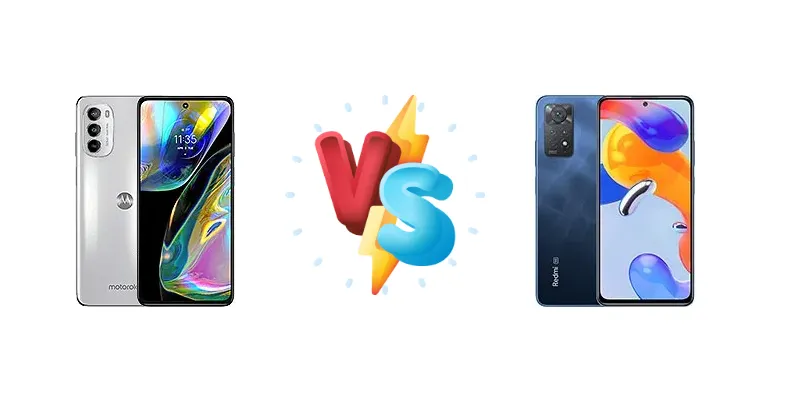
|
🏆 Quick Verdict
For most users, the Xiaomi Redmi Note 11 Pro 5G is the better buy. Its significantly faster 67W charging, achieving a full charge in just 42 minutes, addresses a common pain point. While the Moto G82 offers respectable endurance, the Redmi Note 11 Pro 5G’s convenience outweighs its slightly smaller battery capacity.
| PHONES | ||
|---|---|---|
| Phone Names | Motorola Moto G82 | Xiaomi Redmi Note 11 Pro 5G |
| Network | ||
|---|---|---|
| 2G bands | GSM 850 / 900 / 1800 / 1900 | GSM 850 / 900 / 1800 / 1900 |
| 3G bands | HSDPA 850 / 900 / 1700(AWS) / 1900 / 2100 | HSDPA 800 / 850 / 900 / 1900 / 2100 |
| 4G bands | 1, 2, 3, 4, 5, 7, 8, 12, 13, 17, 18, 19, 20, 26, 28, 32, 38, 39, 40, 41, 42, 43, 66 | 1, 2, 3, 4, 5, 7, 8, 12, 13, 17, 18, 19, 20, 26, 28, 32, 38, 40, 41, 66 |
| 5G bands | 1, 2, 3, 5, 7, 8, 20, 28, 38, 40, 41, 66, 77, 78, 78 SA/NSA | 1, 3, 5, 7, 8, 20, 28, 38, 40, 41, 66, 77, 78 SA/NSA |
| Speed | HSPA, LTE, 5G | HSPA, LTE, 5G |
| Technology | GSM / HSPA / LTE / 5G | GSM / HSPA / LTE / 5G |
| Launch | ||
|---|---|---|
| Announced | 2022, May 12 | 2022, January 26 |
| Status | Available. Released 2022, June 07 | Available. Released 2022, February 18 |
| Body | ||
|---|---|---|
| Build | Glass front, plastic frame, plastic back | Glass front (Gorilla Glass 5), glass back, plastic frame |
| Dimensions | 160.9 x 74.5 x 8 mm (6.33 x 2.93 x 0.31 in) | 164.2 x 76.1 x 8.1 mm (6.46 x 3.00 x 0.32 in) |
| SIM | Nano-SIM + Nano-SIM | Nano-SIM + Nano-SIM |
| Weight | 173 g (6.10 oz) | 202 g (7.13 oz) |
| Water-repellent design | IP53, dust and splash resistant | |
| Display | ||
|---|---|---|
| Protection | - | Corning Gorilla Glass 5 |
| Resolution | 1080 x 2400 pixels, 20:9 ratio (~402 ppi density) | 1080 x 2400 pixels, 20:9 ratio (~395 ppi density) |
| Size | 6.6 inches, 103.6 cm2 (~86.4% screen-to-body ratio) | 6.67 inches, 107.4 cm2 (~86.0% screen-to-body ratio) |
| Type | AMOLED, 120Hz | Super AMOLED, 120Hz, 700 nits, 1200 nits (peak) |
| Platform | ||
|---|---|---|
| CPU | Octa-core (2x2.2 GHz Kryo 660 Gold & 6x1.7 GHz Kryo 660 Silver) | Octa-core (2x2.2 GHz Kryo 660 Gold & 6x1.7 GHz Kryo 660 Silver) |
| Chipset | Qualcomm SM6375 Snapdragon 695 5G (6 nm) | Qualcomm SM6375 Snapdragon 695 5G (6 nm) |
| GPU | Adreno 619 | Adreno 619 |
| OS | Android 12, upgradable to Android 13 | Android 11, MIUI 13 |
| Memory | ||
|---|---|---|
| Card slot | microSDXC (uses shared SIM slot) | microSDXC (uses shared SIM slot) |
| Internal | 128GB 6GB RAM, 128GB 8GB RAM | 64GB 6GB RAM, 128GB 4GB RAM, 128GB 6GB RAM, 128GB 8GB RAM |
| UFS | UFS 2.2 | |
| Main Camera | ||
|---|---|---|
| Features | LED flash, HDR, panorama | LED flash, HDR, panorama |
| Single | - | 16 MP, f/2.5, (wide), 1/3.06" 1.0µm |
| Triple | 50 MP, f/1.8 (wide), 1/2.76", 0.64µm, PDAF, OIS 8 MP, f/2.2, 118˚ (ultrawide), 1/4.0", 1.12µm 2 MP (macro) | 108 MP, f/1.9, 26mm (wide), 1/1.52", 0.7µm, PDAF 8 MP, f/2.2, 118˚ (ultrawide) 2 MP (macro) |
| Video | 1080p@30/60fps | 1080p@30fps |
| Selfie camera | ||
|---|---|---|
| Single | 16 MP, f/2.2, (wide), 1.0µm | 16 MP, f/2.5, (wide), 1/3.06" 1.0µm |
| Video | 1080p@30fps | 1080p@30fps |
| Sound | ||
|---|---|---|
| 3.5mm jack | Yes | Yes |
| 35mm jack | Yes | Yes |
| Loudspeaker | Yes, with stereo speakers | Yes, with stereo speakers |
| - | 24-bit/192kHz audio | |
| Comms | ||
|---|---|---|
| Bluetooth | 5.1, A2DP, LE | 5.1, A2DP, LE |
| Infrared port | - | Yes |
| NFC | Yes (market/region dependent) | Yes (market/region dependent) |
| Positioning | GPS, GLONASS, GALILEO | GPS, GLONASS, BDS, GALILEO |
| Radio | FM radio (market/region dependent) | Unspecified |
| USB | USB Type-C 2.0 | USB Type-C 2.0, OTG |
| WLAN | Wi-Fi 802.11 a/b/g/n/ac, dual-band, Wi-Fi Direct | Wi-Fi 802.11 a/b/g/n/ac, dual-band, Wi-Fi Direct |
| Features | ||
|---|---|---|
| Sensors | Fingerprint (side-mounted), accelerometer, gyro, proximity, compass | Fingerprint (side-mounted), accelerometer, gyro, compass |
| - | Virtual proximity sensing | |
| Battery | ||
|---|---|---|
| Charging | 30W wired | 67W wired, PD3.0, QC3, 50% in 15 min, 100% in 42 min |
| Type | Li-Po 5000 mAh | Li-Po 5000 mAh |
| Misc | ||
|---|---|---|
| Colors | Meteorite Gray, White Lily | Graphite Gray, Polar White, Atlantic Blue |
| Models | XT2225-1 | 21091116I, 2201116SG |
| Price | About 290 EUR | € 120.33 / $ 230.00 / £ 319.00 |
| SAR | - | 1.05 W/kg (head) 1.09 W/kg (body) |
| SAR EU | - | 0.60 W/kg (head) 0.96 W/kg (body) |
| Tests | ||
|---|---|---|
| Battery life | Endurance rating 130h | Endurance rating 115h |
| Camera | Photo / Video | Photo / Video |
| Display | Contrast ratio: Infinite (nominal) | Contrast ratio: Infinite (nominal) |
| Loudspeaker | -26.4 LUFS (Good) | -25.8 LUFS (Very good) |
| Performance | AnTuTu: 380812 (v9) GeekBench: 1977 (v5.1) GFXBench: 16fps (ES 3.1 onscreen) | AnTuTu: 288914 (v8), 382902 (v9) GeekBench: 2063 (v5.1) GFXBench: 17fps (ES 3.1 onscreen) |
Motorola Moto G82
- Slightly longer battery endurance rating.
- Clean Motorola software experience (potentially).
- Potentially more affordable (depending on region).
- Significantly slower 30W charging.
- Lower peak display brightness.
- Limited camera details available.
Xiaomi Redmi Note 11 Pro 5G
- Much faster 67W charging with PD3.0 and QC3 support.
- Brighter display for better outdoor visibility.
- Convenient fast charging for busy users.
- Slightly lower battery endurance rating.
- Xiaomi’s MIUI software can be polarizing.
- Potentially higher price point.
Display Comparison
The Xiaomi Redmi Note 11 Pro 5G boasts a brighter display, reaching a measured 746 nits compared to the Moto G82’s 690 nits. This translates to better visibility outdoors under direct sunlight. Both displays share an 'Infinite' (nominal) contrast ratio, suggesting typical IPS LCD characteristics. While neither utilizes advanced panel technology like LTPO, the Redmi Note 11 Pro 5G’s higher peak brightness provides a more comfortable viewing experience in bright environments.
Camera Comparison
Both phones feature 'Photo / Video' capabilities, but detailed sensor information is lacking. Without specifics on sensor size, aperture, or image stabilization (OIS), a direct comparison is challenging. It’s reasonable to assume both employ standard camera setups for their respective price brackets. The absence of details suggests neither phone is a standout performer in photography, focusing instead on all-around functionality. Ignoring the likely inclusion of low-resolution 2MP macro lenses on both devices, the primary camera sensor quality will be the deciding factor, but that remains unknown.
Performance
Both devices are powered by the Qualcomm SM6375 Snapdragon 695 5G (6 nm) chipset, featuring an octa-core CPU configuration with 2x2.2 GHz Kryo 660 Gold and 6x1.7 GHz Kryo 660 Silver cores. Performance will be virtually identical for everyday tasks and moderate gaming. The absence of information regarding RAM speed (LPDDR4x vs LPDDR5) makes it difficult to assess potential differences in multitasking responsiveness, but given the price point, LPDDR4x is likely present in both.
Battery Life
The Motorola Moto G82 offers an endurance rating of 130 hours, while the Xiaomi Redmi Note 11 Pro 5G achieves 115 hours. However, this difference is largely offset by the Redmi Note 11 Pro 5G’s significantly faster 67W wired charging, capable of reaching 50% charge in 15 minutes and 100% in 42 minutes. The Moto G82’s 30W charging is considerably slower. This means the Redmi Note 11 Pro 5G can quickly top up its battery, mitigating the impact of its slightly lower endurance rating.
Buying Guide
Buy the Motorola Moto G82 if you prioritize a slightly longer endurance rating and are less concerned with rapid charging. It’s a solid choice for users who charge their phones overnight and don’t mind a slower top-up. Buy the Xiaomi Redmi Note 11 Pro 5G if you value convenience and need to quickly replenish battery life throughout the day. The 67W charging is a game-changer for those with busy schedules or who frequently use power-intensive apps.