
Moto G82 vs Poco X4 Pro 5G: Which 5G Phone Delivers the Best Value?
| Phones Images | |||||
|---|---|---|---|---|---|
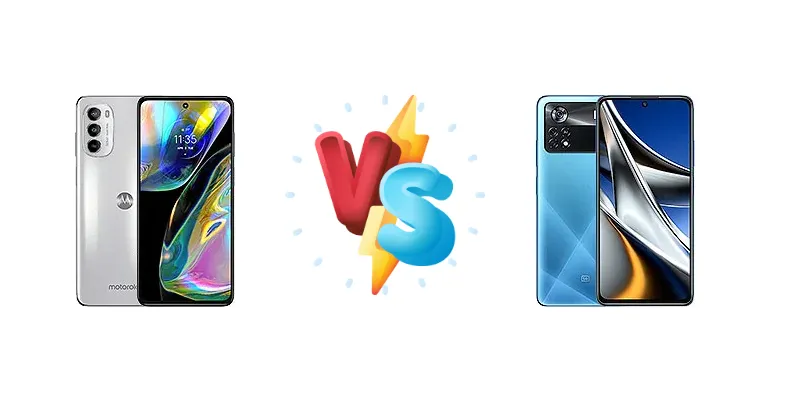
|
🏆 Quick Verdict
For most users, the Xiaomi Poco X4 Pro 5G emerges as the stronger choice. Its 67W charging capability, achieving a full charge in just 41 minutes, is a game-changer compared to the Moto G82’s 30W charging. While both phones share the same chipset, the Poco’s faster refueling makes it ideal for power users.
| PHONES | ||
|---|---|---|
| Phone Names | Motorola Moto G82 | Xiaomi Poco X4 Pro 5G |
| Network | ||
|---|---|---|
| 2G bands | GSM 850 / 900 / 1800 / 1900 | GSM 850 / 900 / 1800 / 1900 |
| 3G bands | HSDPA 850 / 900 / 1700(AWS) / 1900 / 2100 | HSDPA 800 / 850 / 900 / 1700(AWS) / 1900 / 2100 - Global |
| 4G bands | 1, 2, 3, 4, 5, 7, 8, 12, 13, 17, 18, 19, 20, 26, 28, 32, 38, 39, 40, 41, 42, 43, 66 | 1, 2, 3, 4, 5, 7, 8, 12, 17, 18, 19, 20, 26, 28, 38, 40, 41 - Global |
| 5G bands | 1, 2, 3, 5, 7, 8, 20, 28, 38, 40, 41, 66, 77, 78, 78 SA/NSA | 1, 3, 5, 7, 8, 20, 28, 38, 40, 41, 77, 78 SA/NSA - Global |
| Speed | HSPA, LTE, 5G | HSPA, LTE, 5G |
| Technology | GSM / HSPA / LTE / 5G | GSM / HSPA / LTE / 5G |
| - | 1, 3, 5, 8, 28, 40, 78 SA/NSA - India | |
| Launch | ||
|---|---|---|
| Announced | 2022, May 12 | 2022, February 28 |
| Status | Available. Released 2022, June 07 | Available. Released 2022, March 23 |
| Body | ||
|---|---|---|
| Build | Glass front, plastic frame, plastic back | Glass front (Gorilla Glass 5), glass back, plastic frame |
| Dimensions | 160.9 x 74.5 x 8 mm (6.33 x 2.93 x 0.31 in) | 164.2 x 76.1 x 8.1 mm (6.46 x 3.00 x 0.32 in) |
| SIM | Nano-SIM + Nano-SIM | Nano-SIM + Nano-SIM |
| Weight | 173 g (6.10 oz) | 205 g (7.23 oz) |
| Water-repellent design | IP53, dust and splash resistant | |
| Display | ||
|---|---|---|
| Protection | - | Corning Gorilla Glass 5 |
| Resolution | 1080 x 2400 pixels, 20:9 ratio (~402 ppi density) | 1080 x 2400 pixels, 20:9 ratio (~395 ppi density) |
| Size | 6.6 inches, 103.6 cm2 (~86.4% screen-to-body ratio) | 6.67 inches, 107.4 cm2 (~86.0% screen-to-body ratio) |
| Type | AMOLED, 120Hz | Super AMOLED, 120Hz, 700 nits, 1200 nits (peak) |
| Platform | ||
|---|---|---|
| CPU | Octa-core (2x2.2 GHz Kryo 660 Gold & 6x1.7 GHz Kryo 660 Silver) | Octa-core (2x2.2 GHz Kryo 660 Gold & 6x1.7 GHz Kryo 660 Silver) |
| Chipset | Qualcomm SM6375 Snapdragon 695 5G (6 nm) | Qualcomm SM6375 Snapdragon 695 5G (6 nm) |
| GPU | Adreno 619 | Adreno 619 |
| OS | Android 12, upgradable to Android 13 | Android 11, MIUI 13 for POCO |
| Memory | ||
|---|---|---|
| Card slot | microSDXC (uses shared SIM slot) | microSDXC (uses shared SIM slot) |
| Internal | 128GB 6GB RAM, 128GB 8GB RAM | 64GB 6GB RAM, 128GB 6GB RAM, 128GB 8GB RAM, 256GB 6GB RAM, 256GB 8GB RAM |
| UFS | UFS 2.2 | |
| Main Camera | ||
|---|---|---|
| Features | LED flash, HDR, panorama | LED flash, HDR, panorama |
| Single | - | 16 MP, f/2.5, (wide), 1/3.06" 1.0µm |
| Triple | 50 MP, f/1.8 (wide), 1/2.76", 0.64µm, PDAF, OIS 8 MP, f/2.2, 118˚ (ultrawide), 1/4.0", 1.12µm 2 MP (macro) | 108 MP, f/1.9, 26mm (wide), 1/1.52", 0.7µm, PDAF - Global version 64 MP, f/1.8, 26mm (wide), 0.7µm, PDAF - India version 8 MP, f/2.2, 118˚ (ultrawide), 1/4.0", 1.12µm 2 MP (macro) |
| Video | 1080p@30/60fps | 1080p@30fps |
| Selfie camera | ||
|---|---|---|
| Features | - | HDR, panorama |
| Single | 16 MP, f/2.2, (wide), 1.0µm | 16 MP, f/2.5, (wide), 1/3.06" 1.0µm |
| Video | 1080p@30fps | 1080p@30fps |
| Sound | ||
|---|---|---|
| 3.5mm jack | Yes | Yes |
| 35mm jack | Yes | Yes |
| Loudspeaker | Yes, with stereo speakers | Yes, with stereo speakers |
| - | 24-bit/192kHz audio | |
| Comms | ||
|---|---|---|
| Bluetooth | 5.1, A2DP, LE | 5.1, A2DP, LE |
| Infrared port | - | Yes |
| NFC | Yes (market/region dependent) | Yes (market/region dependent) |
| Positioning | GPS, GLONASS, GALILEO | GPS, GLONASS, BDS, GALILEO |
| Radio | FM radio (market/region dependent) | FM radio |
| USB | USB Type-C 2.0 | USB Type-C 2.0, OTG |
| WLAN | Wi-Fi 802.11 a/b/g/n/ac, dual-band, Wi-Fi Direct | Wi-Fi 802.11 a/b/g/n/ac, dual-band, Wi-Fi Direct |
| Features | ||
|---|---|---|
| Sensors | Fingerprint (side-mounted), accelerometer, gyro, proximity, compass | Fingerprint (side-mounted), accelerometer, gyro, proximity, compass |
| Battery | ||
|---|---|---|
| Charging | 30W wired | 67W wired, PD3.0, QC3, 70% in 22 min, 100% in 41 min |
| Type | Li-Po 5000 mAh | Li-Po 5000 mAh |
| Misc | ||
|---|---|---|
| Colors | Meteorite Gray, White Lily | Laser Black, Laser Blue, Poco Yellow |
| Models | XT2225-1 | 2201116PG |
| Price | About 290 EUR | € 160.40 / $ 419.99 / £ 255.00 / ₹ 12,940 |
| SAR | - | 1.06 W/kg (head) 1.09 W/kg (body) |
| SAR EU | - | 0.60 W/kg (head) 0.96 W/kg (body) |
| Tests | ||
|---|---|---|
| Battery life | Endurance rating 130h | Endurance rating 119h |
| Camera | Photo / Video | Photo / Video |
| Display | Contrast ratio: Infinite (nominal) | Contrast ratio: Infinite (nominal) |
| Loudspeaker | -26.4 LUFS (Good) | -26.8 LUFS (Good) |
| Performance | AnTuTu: 380812 (v9) GeekBench: 1977 (v5.1) GFXBench: 16fps (ES 3.1 onscreen) | AnTuTu: 335353 (v8), 384646 (v9) GeekBench: 2063 (v5.1) GFXBench: 17fps (ES 3.1 onscreen) |
Motorola Moto G82
- Slightly brighter display for better outdoor visibility.
- Potentially longer battery life based on endurance rating.
- Motorola’s cleaner Android software experience.
- Significantly slower 30W charging.
- Limited camera details make performance uncertain.
Xiaomi Poco X4 Pro 5G
- 67W fast charging – a major time saver.
- Faster charging offsets slightly lower endurance rating.
- Competitive price point within the mid-range segment.
- MIUI software can be resource-intensive and feature bloat.
- Display brightness is lower than the Moto G82.
Display Comparison
Both the Moto G82 and Poco X4 Pro 5G feature displays with an 'Infinite' (nominal) contrast ratio, suggesting deep blacks. However, the Moto G82 boasts a measured peak brightness of 690 nits, offering better visibility in direct sunlight. While both likely utilize AMOLED panels (implied by the contrast ratio), the G82’s higher brightness is a tangible advantage for outdoor use. Details regarding refresh rates and panel technology (LTPO, PWM dimming) are missing, but the G82’s brightness is a clear differentiator.
Camera Comparison
Both phones list 'Photo / Video' capabilities, but lack specific details regarding sensor size, aperture, or optical image stabilization (OIS). This makes a direct comparison difficult. The presence of a 2MP macro camera on both devices is likely a marketing feature with limited real-world utility. Without further information, it’s safe to assume camera performance will be similar, leaning towards adequate for social media sharing but not excelling in low-light conditions.
Performance
Both devices are powered by the Qualcomm Snapdragon 695 5G (6nm), featuring an octa-core CPU configuration with 2x2.2 GHz Kryo 660 Gold and 6x1.7 GHz Kryo 660 Silver cores. This means performance will be largely identical for everyday tasks and moderate gaming. The absence of information regarding RAM type (LPDDR4x vs LPDDR5) and storage speed (UFS 2.2 vs UFS 3.1) prevents a deeper analysis, but the shared chipset ensures comparable processing power. Thermal management will likely be similar, given the 6nm process node.
Battery Life
The Moto G82 offers an endurance rating of 130 hours, while the Poco X4 Pro 5G achieves 119 hours. This suggests the G82 has slightly better battery optimization or a marginally larger battery capacity (specific mAh figures are missing). However, this advantage is overshadowed by the Poco X4 Pro 5G’s significantly faster 67W charging. The Poco X4 Pro can reach 70% charge in 22 minutes and 100% in 41 minutes, a substantial improvement over the G82’s 30W charging. This faster charging mitigates any potential battery life disadvantage.
Buying Guide
Buy the Motorola Moto G82 if you prioritize a slightly brighter display (690 nits) and prefer Motorola’s near-stock Android experience. Buy the Xiaomi Poco X4 Pro 5G if you value significantly faster charging speeds, minimizing downtime and maximizing usability throughout the day, and don't mind Xiaomi's MIUI software.