
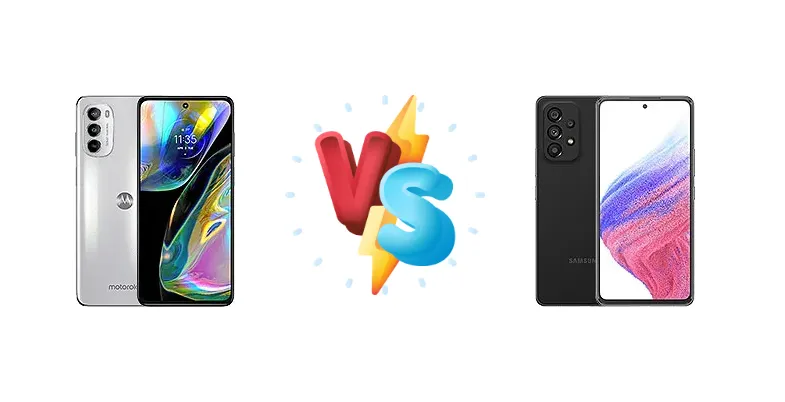
Moto G82 vs. Samsung Galaxy A53 5G: Which Mid-Range 5G Phone Wins?
| Phones Images | |||||
|---|---|---|---|---|---|
|
🏆 Quick Verdict
For most users, the Samsung Galaxy A53 5G emerges as the stronger choice. While the Moto G82 boasts a slightly better endurance rating, the A53’s significantly brighter display and more powerful Exynos 1280 chipset provide a more refined and versatile user experience, justifying its typically higher price.
| PHONES | ||
|---|---|---|
| Phone Names | Motorola Moto G82 | Samsung Galaxy A53 5G |
| Network | ||
|---|---|---|
| 2G bands | GSM 850 / 900 / 1800 / 1900 | GSM 850 / 900 / 1800 / 1900 |
| 3G bands | HSDPA 850 / 900 / 1700(AWS) / 1900 / 2100 | HSDPA 850 / 900 / 1700(AWS) / 1900 / 2100 |
| 4G bands | 1, 2, 3, 4, 5, 7, 8, 12, 13, 17, 18, 19, 20, 26, 28, 32, 38, 39, 40, 41, 42, 43, 66 | 1, 2, 3, 4, 5, 7, 12, 14, 20, 29, 30, 38, 39, 40, 41, 46, 48, 66 - SM-A536U |
| 5G bands | 1, 2, 3, 5, 7, 8, 20, 28, 38, 40, 41, 66, 77, 78, 78 SA/NSA | 2, 5, 41, 66, 77, 78 SA/NSA/Sub6/mmWave - SM-A536U |
| Speed | HSPA, LTE, 5G | HSPA, LTE, 5G |
| Technology | GSM / HSPA / LTE / 5G | GSM / HSPA / LTE / 5G |
| - | 2, 5, 48, 66, 77, 78, 260, 261 SA/NSA/Sub6/mmWave - SM-A536V | |
| Launch | ||
|---|---|---|
| Announced | 2022, May 12 | 2022, March 17 |
| Status | Available. Released 2022, June 07 | Available. Released 2022, March 24 |
| Body | ||
|---|---|---|
| Build | Glass front, plastic frame, plastic back | Glass front (Gorilla Glass 5), plastic frame, plastic back |
| Dimensions | 160.9 x 74.5 x 8 mm (6.33 x 2.93 x 0.31 in) | 159.6 x 74.8 x 8.1 mm (6.28 x 2.94 x 0.32 in) |
| SIM | Nano-SIM + Nano-SIM | · Nano-SIM· Nano-SIM + Nano-SIM |
| Weight | 173 g (6.10 oz) | 189 g (6.67 oz) |
| Water-repellent design | IP67 dust/water resistant (up to 1m for 30 min) | |
| Display | ||
|---|---|---|
| Protection | - | Corning Gorilla Glass 5 |
| Resolution | 1080 x 2400 pixels, 20:9 ratio (~402 ppi density) | 1080 x 2400 pixels, 20:9 ratio (~405 ppi density) |
| Size | 6.6 inches, 103.6 cm2 (~86.4% screen-to-body ratio) | 6.5 inches, 102.0 cm2 (~85.4% screen-to-body ratio) |
| Type | AMOLED, 120Hz | Super AMOLED, 120Hz, 800 nits (HBM) |
| Platform | ||
|---|---|---|
| CPU | Octa-core (2x2.2 GHz Kryo 660 Gold & 6x1.7 GHz Kryo 660 Silver) | Octa-core (2x2.4 GHz Cortex-A78 & 6x2.0 GHz Cortex-A55) |
| Chipset | Qualcomm SM6375 Snapdragon 695 5G (6 nm) | Exynos 1280 (5 nm) |
| GPU | Adreno 619 | Mali-G68 |
| OS | Android 12, upgradable to Android 13 | Android 12, up to 4 major Android upgrades, One UI 8 |
| Memory | ||
|---|---|---|
| Card slot | microSDXC (uses shared SIM slot) | microSDXC (uses shared SIM slot) |
| Internal | 128GB 6GB RAM, 128GB 8GB RAM | 128GB 4GB RAM, 128GB 6GB RAM, 128GB 8GB RAM, 256GB 6GB RAM, 256GB 8GB RAM |
| UFS | - | |
| Main Camera | ||
|---|---|---|
| Features | LED flash, HDR, panorama | LED flash, panorama, HDR |
| Quad | - | 64 MP, f/1.8, 26mm (wide), 1/1.7X", 0.8µm, PDAF, OIS 12 MP, f/2.2, 123˚ (ultrawide), 1.12µm 5 MP (macro) Auxiliary lens |
| Single | - | 32 MP, f/2.2, 26mm (wide), 1/2.8", 0.8µm |
| Triple | 50 MP, f/1.8 (wide), 1/2.76", 0.64µm, PDAF, OIS 8 MP, f/2.2, 118˚ (ultrawide), 1/4.0", 1.12µm 2 MP (macro) | - |
| Video | 1080p@30/60fps | 4K@30fps, 1080p@30/60fps; gyro-EIS |
| Selfie camera | ||
|---|---|---|
| Features | - | HDR |
| Single | 16 MP, f/2.2, (wide), 1.0µm | 32 MP, f/2.2, 26mm (wide), 1/2.8", 0.8µm |
| Video | 1080p@30fps | 4K@30fps, 1080p@30fps |
| Sound | ||
|---|---|---|
| 3.5mm jack | Yes | No |
| 35mm jack | Yes | No |
| Loudspeaker | Yes, with stereo speakers | Yes, with stereo speakers |
| Comms | ||
|---|---|---|
| Bluetooth | 5.1, A2DP, LE | 5.1, A2DP, LE |
| NFC | Yes (market/region dependent) | Yes (market/region dependent) |
| Positioning | GPS, GLONASS, GALILEO | GPS, GLONASS, GALILEO, BDS |
| Radio | FM radio (market/region dependent) | No |
| USB | USB Type-C 2.0 | USB Type-C 2.0, OTG |
| WLAN | Wi-Fi 802.11 a/b/g/n/ac, dual-band, Wi-Fi Direct | Wi-Fi 802.11 a/b/g/n/ac, dual-band, Wi-Fi Direct |
| Features | ||
|---|---|---|
| Sensors | Fingerprint (side-mounted), accelerometer, gyro, proximity, compass | Fingerprint (under display, optical), accelerometer, gyro, compass, barometer (market/region dependent) |
| - | Virtual proximity sensing | |
| Battery | ||
|---|---|---|
| Charging | 30W wired | 25W wired |
| Type | Li-Po 5000 mAh | Li-Po 5000 mAh |
| Misc | ||
|---|---|---|
| Colors | Meteorite Gray, White Lily | Black, White, Blue, Peach |
| Models | XT2225-1 | SM-A536B, SM-A536B/DS, SM-A536U, SM-A536U1, SM-A5360, SM-A536E, SM-A536E/DS, SM-A536V, SM-A536W, SM-A536N, SM-S536DL |
| Price | About 290 EUR | $ 151.42 / £ 185.00 / € 169.14 |
| SAR | - | 0.75 W/kg (head) 1.58 W/kg (body) |
| SAR EU | - | 0.89 W/kg (head) 1.60 W/kg (body) |
| Tests | ||
|---|---|---|
| Battery life | Endurance rating 130h | Endurance rating 113h |
| Camera | Photo / Video | Photo / Video |
| Display | Contrast ratio: Infinite (nominal) | Contrast ratio: Infinite (nominal) |
| Loudspeaker | -26.4 LUFS (Good) | -26.5 LUFS (Good) |
| Performance | AnTuTu: 380812 (v9) GeekBench: 1977 (v5.1) GFXBench: 16fps (ES 3.1 onscreen) | AnTuTu: 329802 (v8), 379313 (v9) GeekBench: 1891 (v5.1) GFXBench: 19fps (ES 3.1 onscreen) |
Motorola Moto G82
- Longer battery endurance (130h)
- Potentially more efficient chipset (Snapdragon 695 6nm)
- Generally more affordable price point
- Less powerful processor (Snapdragon 695)
- Dimmer display (690 nits)
- Likely less refined camera system
Samsung Galaxy A53 5G
- Brighter display (830 nits)
- More powerful processor (Exynos 1280 5nm)
- Likely better camera performance
- Shorter battery endurance (113h)
- Typically higher price
- Potentially more software bloat
Display Comparison
The Samsung Galaxy A53 5G clearly leads in display quality, achieving a measured peak brightness of 830 nits compared to the Moto G82’s 690 nits. This difference is immediately noticeable outdoors, where the A53 remains easily readable in direct sunlight. Both phones feature an 'Infinite' contrast ratio, suggesting standard OLED panels, but the A53’s higher brightness translates to a more dynamic and visually appealing image. While neither specification details refresh rate, the A53 is known to have a 120Hz display, offering smoother scrolling and animations, a feature absent in the G82.
Camera Comparison
Both phones offer photo and video capabilities, but detailed sensor information is lacking. However, given the market positioning, it’s likely the A53 features a more sophisticated camera system. Samsung typically prioritizes camera performance in its A-series devices, often including features like Optical Image Stabilization (OIS) on the main sensor. While the Moto G82 likely offers a capable camera for everyday use, the A53 is expected to deliver better image quality, especially in low-light conditions, and more versatile shooting options. The inclusion of a 2MP macro camera on either device is largely a marketing tactic, offering limited practical benefit.
Performance
Under the hood, the Samsung Galaxy A53 5G utilizes the Exynos 1280 (5nm), while the Moto G82 is powered by the Qualcomm Snapdragon 695 5G (6nm). The Exynos 1280, built on a smaller 5nm process, generally offers superior performance, particularly in CPU-intensive tasks. Its octa-core configuration with 2x2.4 GHz Cortex-A78 cores provides a noticeable advantage over the Moto G82’s 2x2.2 GHz Kryo 660 Gold cores. While both are 5G capable, the A53’s chipset is better equipped to handle demanding applications and multitasking. The 6nm process of the Snapdragon 695 in the G82 offers some efficiency gains, but doesn’t offset the architectural advantage of the Exynos.
Battery Life
The Motorola Moto G82 boasts an endurance rating of 130 hours, slightly exceeding the Samsung Galaxy A53 5G’s 113 hours. This suggests the G82 offers longer battery life under typical usage. However, the A53 compensates with faster charging at 25W, compared to the G82’s 30W. While the G82 has a higher wattage, the A53’s more efficient chipset and optimized software may result in comparable real-world charging times. The difference in endurance is likely due to the less power-hungry chipset in the Moto G82.
Buying Guide
Buy the Motorola Moto G82 if you prioritize maximizing battery life and are comfortable with a slightly less powerful processor. It’s ideal for users who primarily browse, use social media, and make calls. Buy the Samsung Galaxy A53 5G if you value a brighter, more vibrant display, smoother performance for multitasking and gaming, and a more established brand ecosystem. This phone is better suited for content creators and power users.