
Google Pixel 6a vs. Motorola Moto G82: A Detailed Comparison
| Phones Images | |||||
|---|---|---|---|---|---|
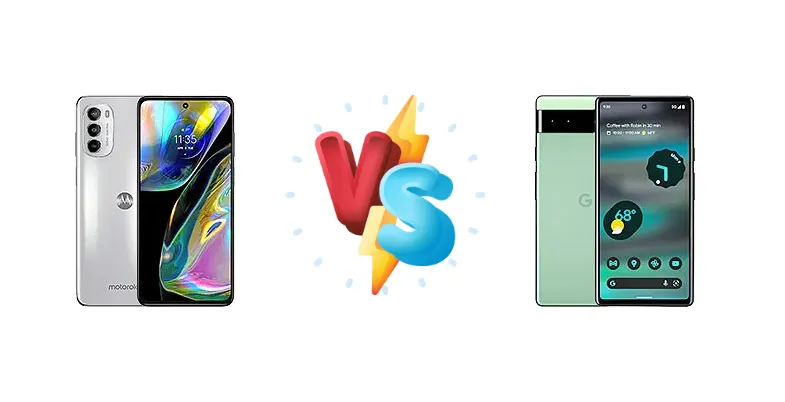
|
🏆 Quick Verdict
For most users, the Google Pixel 6a is the superior choice. While the Moto G82 boasts impressive battery endurance, the Pixel 6a’s significantly more powerful Tensor chip and superior camera capabilities justify the price difference, offering a smoother and more versatile experience.
| PHONES | ||
|---|---|---|
| Phone Names | Motorola Moto G82 | Google Pixel 6a |
| Network | ||
|---|---|---|
| 2G bands | GSM 850 / 900 / 1800 / 1900 | GSM 850 / 900 / 1800 / 1900 |
| 3G bands | HSDPA 850 / 900 / 1700(AWS) / 1900 / 2100 | HSDPA 800 / 850 / 900 / 1700(AWS) / 1900 / 2100 |
| 4G bands | 1, 2, 3, 4, 5, 7, 8, 12, 13, 17, 18, 19, 20, 26, 28, 32, 38, 39, 40, 41, 42, 43, 66 | 1, 2, 3, 4, 5, 7, 8, 12, 13, 14, 17, 18, 19, 20, 25, 26, 28, 29, 30, 38, 39, 40, 41, 42, 48, 66, 71 - GX7AS, GB62Z (USA/Canada) |
| 5G bands | 1, 2, 3, 5, 7, 8, 20, 28, 38, 40, 41, 66, 77, 78, 78 SA/NSA | 1, 2, 3, 5, 7, 8, 12, 20, 25, 28, 30, 38, 40, 41, 48, 66, 71, 77, 78 SA/NSA/Sub6 - GX7AS (USA/Canada) |
| Speed | HSPA, LTE, 5G | HSPA, LTE, 5G |
| Technology | GSM / HSPA / LTE / 5G | GSM / HSPA / LTE / 5G |
| - | 1, 2, 3, 5, 7, 8, 12, 20, 25, 28, 30, 40, 48, 66, 71, 77, 78 SA/NSA/Sub6 - G1AZG (International) | |
| Launch | ||
|---|---|---|
| Announced | 2022, May 12 | 2022, May 11 |
| Status | Available. Released 2022, June 07 | Available. Released 2022, July 21 |
| Body | ||
|---|---|---|
| Build | Glass front, plastic frame, plastic back | Glass front (Gorilla Glass 3), aluminum frame, plastic back |
| Dimensions | 160.9 x 74.5 x 8 mm (6.33 x 2.93 x 0.31 in) | 152.2 x 71.8 x 8.9 mm (5.99 x 2.83 x 0.35 in) |
| SIM | Nano-SIM + Nano-SIM | Nano-SIM + eSIM |
| Weight | 173 g (6.10 oz) | 178 g (6.28 oz) |
| Water-repellent design | IP67 dust/water resistant (up to 1m for 30 min) | |
| Display | ||
|---|---|---|
| Protection | - | Corning Gorilla Glass 3 |
| Resolution | 1080 x 2400 pixels, 20:9 ratio (~402 ppi density) | 1080 x 2400 pixels, 20:9 ratio (~429 ppi density) |
| Size | 6.6 inches, 103.6 cm2 (~86.4% screen-to-body ratio) | 6.1 inches, 90.7 cm2 (~83.0% screen-to-body ratio) |
| Type | AMOLED, 120Hz | OLED, HDR |
| - | Always-on display | |
| Platform | ||
|---|---|---|
| CPU | Octa-core (2x2.2 GHz Kryo 660 Gold & 6x1.7 GHz Kryo 660 Silver) | Octa-core (2x2.80 GHz Cortex-X1 & 2x2.25 GHz Cortex-A76 & 4x1.80 GHz Cortex-A55) |
| Chipset | Qualcomm SM6375 Snapdragon 695 5G (6 nm) | Google Tensor (5 nm) |
| GPU | Adreno 619 | Mali-G78 MP20 |
| OS | Android 12, upgradable to Android 13 | Android 12, upgradable to Android 15, up to 5 major Android upgrades |
| Memory | ||
|---|---|---|
| Card slot | microSDXC (uses shared SIM slot) | No |
| Internal | 128GB 6GB RAM, 128GB 8GB RAM | 128GB 6GB RAM |
| UFS | UFS 3.1 | |
| Main Camera | ||
|---|---|---|
| Dual | - | 12.2 MP, f/1.7, 27mm, (wide), 1/2.55", 1.4µm, dual pixel PDAF, OIS 12 MP, f/2.2, 17mm, 114˚ (ultrawide), 1.25µm |
| Features | LED flash, HDR, panorama | Dual-LED flash, Pixel Shift, Auto-HDR, panorama |
| Single | - | 8 MP, f/2.0, 24mm (wide), 1.12µm |
| Triple | 50 MP, f/1.8 (wide), 1/2.76", 0.64µm, PDAF, OIS 8 MP, f/2.2, 118˚ (ultrawide), 1/4.0", 1.12µm 2 MP (macro) | - |
| Video | 1080p@30/60fps | 4K@30/60fps, 1080p@30/60/120/240fps; gyro-EIS, OIS |
| Selfie camera | ||
|---|---|---|
| Features | - | HDR, panorama |
| Single | 16 MP, f/2.2, (wide), 1.0µm | 8 MP, f/2.0, 24mm (wide), 1.12µm |
| Video | 1080p@30fps | 1080p@30fps |
| Sound | ||
|---|---|---|
| 3.5mm jack | Yes | No |
| 35mm jack | Yes | No |
| Loudspeaker | Yes, with stereo speakers | Yes, with stereo speakers |
| Comms | ||
|---|---|---|
| Bluetooth | 5.1, A2DP, LE | 5.2, A2DP, LE |
| NFC | Yes (market/region dependent) | Yes |
| Positioning | GPS, GLONASS, GALILEO | GPS, GLONASS, GALILEO, QZSS |
| Radio | FM radio (market/region dependent) | No |
| USB | USB Type-C 2.0 | USB Type-C 3.1 |
| WLAN | Wi-Fi 802.11 a/b/g/n/ac, dual-band, Wi-Fi Direct | Wi-Fi 802.11 a/b/g/n/ac/6e, dual-band, Wi-Fi Direct |
| Features | ||
|---|---|---|
| Sensors | Fingerprint (side-mounted), accelerometer, gyro, proximity, compass | Fingerprint (under display, optical), accelerometer, gyro, proximity, compass, barometer |
| Battery | ||
|---|---|---|
| Charging | 30W wired | 18W wired, PD3.0 |
| Type | Li-Po 5000 mAh | Li-Po 4410 mAh |
| Misc | ||
|---|---|---|
| Colors | Meteorite Gray, White Lily | Chalk, Charcoal, Sage |
| Models | XT2225-1 | GX7AS, GB62Z, G1AZG, GB17L |
| Price | About 290 EUR | $ 138.99 / C$ 228.74 / ₹ 23,999 |
| Tests | ||
|---|---|---|
| Battery life | Endurance rating 130h | Endurance rating 94h |
| Camera | Photo / Video | - |
| Display | Contrast ratio: Infinite (nominal) | Contrast ratio: Infinite (nominal) |
| Loudspeaker | -26.4 LUFS (Good) | - |
| Performance | AnTuTu: 380812 (v9) GeekBench: 1977 (v5.1) GFXBench: 16fps (ES 3.1 onscreen) | - |
Motorola Moto G82
- Superior performance with Google Tensor chip
- Exceptional camera quality and image processing
- Guaranteed software updates and features
- Shorter battery life compared to Moto G82
- Slower charging speed than some competitors
Google Pixel 6a
- Excellent battery endurance (130h rating)
- Very bright display (690 nits)
- More affordable price point
- Less powerful processor (Snapdragon 695)
- Inferior camera performance compared to Pixel 6a
Display Comparison
The Pixel 6a’s display significantly outshines the Moto G82 in terms of brightness, reaching 876 nits compared to the G82’s 690 nits. This makes the Pixel 6a much more usable in direct sunlight. Both phones feature an 'Infinite' (nominal) contrast ratio, typical of OLED panels, but the Pixel 6a’s higher peak brightness translates to a more vibrant and punchy image. While neither phone boasts a high refresh rate, the Pixel 6a’s superior color accuracy and brightness provide a better viewing experience overall.
Camera Comparison
While both phones offer photo and video capabilities, the Pixel 6a holds a clear advantage. Google’s computational photography prowess, combined with the Tensor chip’s image signal processor (ISP), delivers consistently excellent image quality, particularly in challenging lighting conditions. The Moto G82’s camera system, while capable, lacks the sophisticated processing algorithms found in the Pixel 6a. Details regarding sensor sizes are missing, but the Pixel 6a’s image processing is known to excel at dynamic range and noise reduction. The Moto G82 likely relies more on hardware, and will show its limitations more quickly.
Performance
The core difference lies in the chipsets. The Google Pixel 6a is powered by Google’s in-house Tensor chip (5nm), while the Moto G82 utilizes the Qualcomm Snapdragon 695 5G (6nm). The Tensor chip’s octa-core configuration, featuring 2x2.80 GHz Cortex-X1 cores, delivers substantially higher performance than the Snapdragon 695’s 2x2.2 GHz Kryo 660 Gold cores. This translates to faster app loading times, smoother multitasking, and a more responsive overall experience on the Pixel 6a. The 5nm process node of the Tensor chip also contributes to better thermal efficiency, potentially reducing throttling during sustained workloads. The Snapdragon 695 is adequate for everyday tasks, but will struggle with demanding games and applications.
Battery Life
The Moto G82 boasts an endurance rating of 130 hours, significantly exceeding the Pixel 6a’s 94 hours. This suggests the Moto G82 will last considerably longer on a single charge, especially for users with moderate usage patterns. However, the Pixel 6a supports faster charging with PD3.0, while the Moto G82 is limited to 30W wired charging. While the Pixel 6a’s battery life isn’t poor, the Moto G82 is the clear winner for users who prioritize longevity and infrequent charging.
Buying Guide
Buy the Motorola Moto G82 if you prioritize all-day battery life and a very bright display for outdoor use, and are willing to compromise on processing power and camera quality. Buy the Google Pixel 6a if you value a fast and responsive user experience, exceptional camera performance, and guaranteed software updates, even if it means more frequent charging.