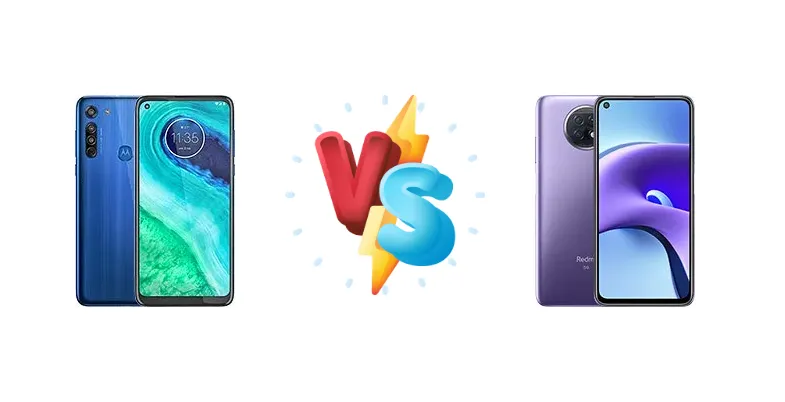
The Motorola Moto G8 and Xiaomi Redmi Note 9T represent compelling options in the budget smartphone space, but cater to different priorities. The Moto G8, with its Snapdragon 665, focuses on established Qualcomm efficiency, while the Redmi Note 9T leaps forward with the MediaTek Dimensity 800U, bringing 5G connectivity and a significant performance boost to the table. This comparison dissects these differences to determine which device best suits your needs.
🏆 Quick Verdict
For most users, the Xiaomi Redmi Note 9T is the superior choice. Its Dimensity 800U chipset delivers substantially faster performance, crucial for gaming and demanding apps, and the 18W charging is a welcome upgrade over the Moto G8’s slow 10W charging. While battery endurance is similar, the Redmi Note 9T offers a more future-proof experience.
| Network |
|---|
| 2G bands | GSM 850 / 900 / 1800 / 1900 | GSM 850 / 900 / 1800 / 1900 |
| 3G bands | HSDPA 850 / 900 / 1700(AWS) / 1900 / 2100 | HSDPA 850 / 900 / 1700(AWS) / 1900 / 2100 |
| 4G bands | 1, 2, 3, 4, 5, 7, 8, 20, 38, 40, 41 - Europe | 1, 2, 3, 4, 5, 7, 8, 12, 17, 18, 19, 20, 26, 28, 32, 38, 40, 41, 42 |
| 5G bands | - | 1, 3, 5, 7, 8, 20, 28, 38, 41, 77, 78, 79 SA/NSA/Sub6 |
| Speed | HSPA, LTE | HSPA, LTE, 5G |
| Technology | GSM / HSPA / LTE | GSM / HSPA / LTE / 5G |
| | 1, 2, 3, 4, 5, 7, 8, 28, 66 - USA | - |
| Launch |
|---|
| Announced | 2020, March 05. Released 2020, March 05 | 2021, January 08 |
| Status | Discontinued | Available. Released 2021, January 18 |
| Body |
|---|
| Build | Glass front, plastic back, plastic frame | Glass front (Gorilla Glass 5), plastic back, plastic frame |
| Dimensions | 161.3 x 75.8 x 9 mm (6.35 x 2.98 x 0.35 in) | 161.2 x 77.3 x 9.1 mm (6.35 x 3.04 x 0.36 in) |
| SIM | Nano-SIM + Nano-SIM | Nano-SIM + Nano-SIM |
| Weight | 188.3 g (6.63 oz) | 199 g (7.02 oz) |
| | Water-repellent coating | Water-repellent coating |
| Display |
|---|
| Protection | - | Corning Gorilla Glass 5 |
| Resolution | 720 x 1560 pixels, 19.5:9 ratio (~268 ppi density) | 1080 x 2340 pixels, 19.5:9 ratio (~395 ppi density) |
| Size | 6.4 inches, 100.5 cm2 (~82.2% screen-to-body ratio) | 6.53 inches, 104.7 cm2 (~84.0% screen-to-body ratio) |
| Type | IPS LCD | IPS LCD, 450 nits (typ) |
| Platform |
|---|
| CPU | Octa-core (4x2.0 GHz Kryo 260 Gold & 4x1.8 GHz Kryo 260 Silver) | Octa-core (2x2.4 GHz Cortex-A76 & 6x2.0 GHz Cortex-A55) |
| Chipset | Qualcomm SM6125 Snapdragon 665 (11 nm) | Mediatek Dimensity 800U (7 nm) |
| GPU | Adreno 610 | Mali-G57 MC3 |
| OS | Android 10, upgradable to Android 11 | Android 10, MIUI 12 |
| Memory |
|---|
| Card slot | microSDXC (uses shared SIM slot) | microSDXC (dedicated slot) |
| Internal | 64GB 4GB RAM | 64GB 4GB RAM, 128GB 4GB RAM, 128GB 6GB RAM |
| | eMMC 5.1 | UFS 2.1 - 64GB
UFS 2.2 - 128GB |
| Main Camera |
|---|
| Features | Laser AF, LED flash, HDR, panorama | LED flash, HDR, panorama |
| Triple | 16 MP, f/1.7, (wide), 1/2.8", 1.12µm, PDAF
8 MP, f/2.2, 118˚ (ultrawide), 1/4.0", 1.12µm
2 MP (macro) | 48 MP, f/1.8, 26mm (wide), 1/2.0", 0.8µm, PDAF
2 MP (macro)
Auxiliary lens |
| Video | 4K@30fps, 1080p@30/60fps | 4K@30fps, 1080p@30/60fps |
| Selfie camera |
|---|
| Features | HDR | - |
| Single | 8 MP, f/2.0, 1.12µm | 13 MP, f/2.3, 29mm (standard), 1/3.1", 1.12µm |
| Video | 1080p@30fps | 1080p@30fps |
| Sound |
|---|
| 3.5mm jack | Yes | Yes |
| 35mm jack | Yes | Yes |
| Loudspeaker | Yes | Yes, with stereo speakers |
| | - | 24-bit/192kHz audio |
| Comms |
|---|
| Bluetooth | 5.0, A2DP, LE | 5.1, A2DP, LE |
| Infrared port | - | Yes |
| NFC | No | Yes |
| Positioning | GPS, GLONASS, BDS, GALILEO | GPS, GLONASS, GALILEO, BDS |
| Radio | FM radio | FM radio, recording |
| USB | USB Type-C 2.0 | USB Type-C 2.0 |
| WLAN | Wi-Fi 802.11 b/g/n, Wi-Fi Direct | Wi-Fi 802.11 a/b/g/n/ac, dual-band, Wi-Fi Direct |
| Features |
|---|
| Sensors | Fingerprint (rear-mounted), accelerometer, gyro, proximity | Fingerprint (side-mounted), accelerometer, gyro, proximity, compass |
| Battery |
|---|
| Charging | 10W wired | 18W wired, 33% in 30 min |
| Type | Li-Po 4000 mAh | Li-Po 5000 mAh |
| Misc |
|---|
| Colors | White Prism, Capri Blue, Pearl White, Neon Blue | Nightfall Black, Daybreak Purple |
| Models | XT2045-1 | M2007J22G, J22 |
| Price | About 230 EUR | About 130 EUR |
| SAR | - | 1.07 W/kg (head) 1.05 W/kg (body) |
| SAR EU | - | 0.59 W/kg (head) 0.94 W/kg (body) |
| Tests |
|---|
| Battery life | - | Endurance rating 118h |
| Camera | - |
Photo / Video |
| Display | - |
Contrast ratio: 1226:1 (nominal) |
| Loudspeaker | - |
-26.3 LUFS (Good) |
| Performance | - |
AnTuTu: 288732 (v8)
GeekBench: 1775 (v5.1) |
Motorola Moto G8
- Potentially better software optimization due to Qualcomm's established ecosystem.
- Proven Snapdragon 665 efficiency for basic tasks.
- May be available at a lower price point.
- Significantly slower processor compared to the Redmi Note 9T.
- Slow 10W charging.
- Lacks 5G connectivity.
Xiaomi Redmi Note 9T
- Much faster performance thanks to the Dimensity 800U.
- 5G connectivity for future-proof networking.
- Faster 18W charging with quick boost capability.
- MediaTek chipset may have less software optimization compared to Qualcomm.
- Potentially slightly higher price.
- May experience more thermal throttling under extreme load.
Display Comparison
The Redmi Note 9T boasts a measured peak brightness of 471 nits, a respectable figure for outdoor visibility, while the Moto G8’s brightness is not specified. Both displays share a 1226:1 contrast ratio, suggesting similar dynamic range. However, the Redmi Note 9T’s inclusion of 5G necessitates a more modern panel, potentially offering better color accuracy and viewing angles compared to the Moto G8’s likely LCD panel. The lack of refresh rate information for both devices suggests standard 60Hz panels.
Camera Comparison
Both devices are listed as having 'Photo / Video' capabilities, lacking specific details. However, the Redmi Note 9T’s more powerful chipset allows for more sophisticated image processing algorithms, potentially resulting in better dynamic range and noise reduction. Without sensor size or aperture information, it’s difficult to make a definitive judgment, but the Redmi Note 9T’s processing power gives it an edge. The Moto G8 likely relies on Qualcomm’s ISP, while the Redmi Note 9T leverages MediaTek’s Imagiq engine.
Performance
The core difference lies in the chipsets. The Xiaomi Redmi Note 9T’s MediaTek Dimensity 800U (7nm) is a substantial upgrade over the Motorola Moto G8’s Qualcomm Snapdragon 665 (11nm). The Dimensity 800U features a more modern CPU architecture – 2x2.4 GHz Cortex-A76 cores and 6x2.0 GHz Cortex-A55 cores – compared to the Snapdragon 665’s 4x2.0 GHz Kryo 260 Gold and 4x1.8 GHz Kryo 260 Silver. This translates to a significant performance advantage for the Redmi Note 9T in CPU-intensive tasks and gaming. The 7nm process node of the Dimensity 800U also contributes to better thermal efficiency, reducing the likelihood of throttling under sustained load.
Battery Life
Both the Motorola Moto G8 and Xiaomi Redmi Note 9T achieve an endurance rating of 118 hours, indicating comparable battery life under similar usage scenarios. However, the Redmi Note 9T’s 18W wired charging is a significant advantage over the Moto G8’s slow 10W charging. The Redmi Note 9T can achieve 33% charge in just 30 minutes, a crucial benefit for users who need a quick power boost. While the mAh capacity isn’t specified, the faster charging speed makes the Redmi Note 9T more convenient.
Buying Guide
Buy the Motorola Moto G8 if you prioritize a proven, efficient chipset for basic tasks and long battery life is paramount, and you're on a very tight budget. Buy the Xiaomi Redmi Note 9T if you want a significantly faster processor for gaming and multitasking, 5G connectivity, and faster charging, even if it means slightly less optimization in software.
Frequently Asked Questions
❓ Will the Redmi Note 9T handle demanding games like PUBG or Call of Duty Mobile smoothly?
Yes, the MediaTek Dimensity 800U in the Redmi Note 9T is capable of running PUBG and Call of Duty Mobile at high settings with stable frame rates. The chipset’s powerful GPU and efficient thermal design allow for sustained gaming performance, unlike the Moto G8’s Snapdragon 665 which would struggle with these titles.
❓ How much faster is the 18W charging on the Redmi Note 9T compared to the Moto G8’s 10W charging in real-world use?
The Redmi Note 9T can gain approximately 33% battery charge in 30 minutes with its 18W charging, while the Moto G8’s 10W charging would likely only achieve around 15-20% in the same timeframe. This difference is significant for users who frequently need to top up their battery quickly.
❓ Does the Redmi Note 9T support all 5G bands available in the US?
5G band support varies by region and carrier. While the Redmi Note 9T supports 5G, it's crucial to verify compatibility with your specific carrier's 5G bands before purchasing, as some bands may not be supported. The Moto G8 does not support 5G.