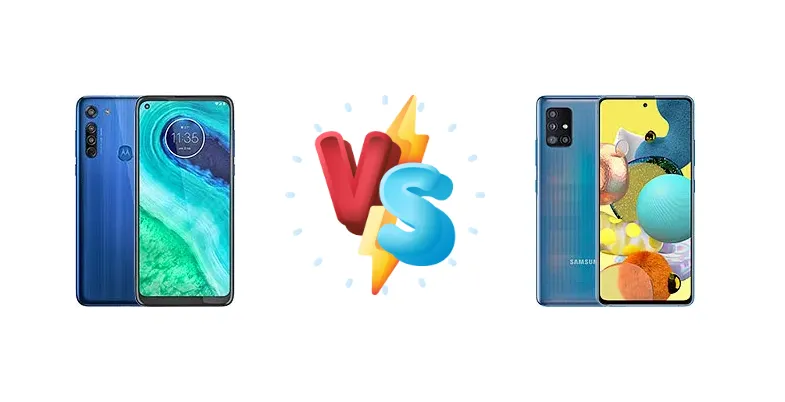
The Motorola Moto G8 and Samsung Galaxy A51 5G UW represent different approaches to the mid-range smartphone market. The Moto G8 prioritizes affordability, while the A51 5G UW aims to deliver 5G connectivity and a more robust processing experience. This comparison dissects their key differences to determine which device offers the best value for your needs.
🏆 Quick Verdict
For the average user prioritizing performance and future-proofing with 5G, the Samsung Galaxy A51 5G UW is the clear winner. Its Snapdragon 765G chipset provides a noticeable performance uplift over the Moto G8’s Snapdragon 665, justifying the price difference for demanding tasks and smoother multitasking.
| Network |
|---|
| 2G bands | GSM 850 / 900 / 1800 / 1900 | GSM 850 / 900 / 1800 / 1900 |
| 3G bands | HSDPA 850 / 900 / 1700(AWS) / 1900 / 2100 | HSDPA 850 / 900 / 1900 / 2100 |
| 4G bands | 1, 2, 3, 4, 5, 7, 8, 20, 38, 40, 41 - Europe | 2, 4, 5, 13, 66 |
| 5G bands | - | 260, 261 mmWave |
| Speed | HSPA, LTE | HSPA, LTE, 5G |
| Technology | GSM / HSPA / LTE | GSM / HSPA / LTE / 5G |
| | 1, 2, 3, 4, 5, 7, 8, 28, 66 - USA | - |
| Launch |
|---|
| Announced | 2020, March 05. Released 2020, March 05 | 2020, August 14 |
| Status | Discontinued | Available. Released 2020, August 14 |
| Body |
|---|
| Build | Glass front, plastic back, plastic frame | Glass front (Gorilla Glass 3), plastic back, aluminum frame |
| Dimensions | 161.3 x 75.8 x 9 mm (6.35 x 2.98 x 0.35 in) | 158.8 x 73.4 x 8.6 mm (6.25 x 2.89 x 0.34 in) |
| SIM | Nano-SIM + Nano-SIM | Nano-SIM (pre-installed) |
| Weight | 188.3 g (6.63 oz) | 188.8 g (6.67 oz) |
| | Water-repellent coating | - |
| Display |
|---|
| Protection | - | Corning Gorilla Glass 3 |
| Resolution | 720 x 1560 pixels, 19.5:9 ratio (~268 ppi density) | 1080 x 2400 pixels, 20:9 ratio (~405 ppi density) |
| Size | 6.4 inches, 100.5 cm2 (~82.2% screen-to-body ratio) | 6.5 inches, 102.0 cm2 (~87.5% screen-to-body ratio) |
| Type | IPS LCD | Super AMOLED |
| Platform |
|---|
| CPU | Octa-core (4x2.0 GHz Kryo 260 Gold & 4x1.8 GHz Kryo 260 Silver) | Octa-core (1x2.4 GHz Kryo 475 Prime & 1x2.2 GHz Kryo 475 Gold & 6x1.8 GHz Kryo 475 Silver) |
| Chipset | Qualcomm SM6125 Snapdragon 665 (11 nm) | Qualcomm SM7250 Snapdragon 765G 5G (7 nm) |
| GPU | Adreno 610 | Adreno 620 |
| OS | Android 10, upgradable to Android 11 | Android 10, One UI 2 |
| Memory |
|---|
| Card slot | microSDXC (uses shared SIM slot) | microSDXC (uses shared SIM slot) |
| Internal | 64GB 4GB RAM | 128GB 6GB RAM |
| | eMMC 5.1 | UFS 2.1 |
| Main Camera |
|---|
| Features | Laser AF, LED flash, HDR, panorama | LED flash, panorama, HDR |
| Quad | - | 48 MP, f/2.0, 26mm (wide), 1/2.0", 0.8µm, PDAF
12 MP, f/2.2, 123˚ (ultrawide)
5 MP (macro)
Auxiliary lens |
| Single | - | 5 MP, AF |
| Triple | 16 MP, f/1.7, (wide), 1/2.8", 1.12µm, PDAF
8 MP, f/2.2, 118˚ (ultrawide), 1/4.0", 1.12µm
2 MP (macro) | - |
| Video | 4K@30fps, 1080p@30/60fps | 4K@30fps, 1080p@30/120fps; gyro-EIS |
| Selfie camera |
|---|
| Features | HDR | HDR |
| Single | 8 MP, f/2.0, 1.12µm | 32 MP, f/2.2, 26mm (wide), 1/2.8", 0.8µm |
| Video | 1080p@30fps | 4K@30fps, 1080p@30fps |
| Sound |
|---|
| 3.5mm jack | Yes | Yes |
| 35mm jack | Yes | Yes |
| Loudspeaker | Yes | Yes |
| Comms |
|---|
| Bluetooth | 5.0, A2DP, LE | 5.0, A2DP, LE |
| NFC | No | Yes |
| Positioning | GPS, GLONASS, BDS, GALILEO | GPS, GLONASS, GALILEO, BDS |
| Radio | FM radio | FM radio, RDS, recording |
| USB | USB Type-C 2.0 | USB Type-C 2.0, OTG |
| WLAN | Wi-Fi 802.11 b/g/n, Wi-Fi Direct | Wi-Fi 802.11 a/b/g/n/ac, dual-band, Wi-Fi Direct |
| Features |
|---|
| Sensors | Fingerprint (rear-mounted), accelerometer, gyro, proximity | Fingerprint (under display, optical), accelerometer, gyro, proximity, compass |
| | - | ANT+ |
| Battery |
|---|
| Charging | 10W wired | 15W wired |
| Stand-by | - | Up to 672 h |
| Talk time | - | Up to 5 h |
| Type | Li-Po 4000 mAh | Li-Po 4500 mAh |
| Misc |
|---|
| Colors | White Prism, Capri Blue, Pearl White, Neon Blue | Prism Bricks Blue |
| Models | XT2045-1 | SM-A516V |
| Price | About 230 EUR | About 470 EUR |
| SAR | - | 0.70 W/kg (head) 1.25 W/kg (body) |
| SAR EU | - | 0.59 W/kg (head) 1.32 W/kg (body) |
Motorola Moto G8
- More affordable price point
- Simple and straightforward user experience
- Potentially longer battery life due to less demanding chipset (depending on battery capacity)
- Significantly slower performance
- Lacks 5G connectivity
- Slower charging speeds
Samsung Galaxy A51 5G UW
- Faster and more responsive performance
- 5G connectivity for faster data speeds
- Faster charging speeds
- Higher price point
- Potentially shorter battery life under heavy load
- More complex software experience (Samsung One UI)
Display Comparison
While display specifications aren't provided, both phones likely feature LCD panels common in this price bracket. However, the A51 5G UW’s chipset allows for potentially more sophisticated image processing, leading to slightly better color accuracy and dynamic range. The Moto G8, being an older model, may exhibit wider bezels. The lack of high refresh rate panels on either device is typical for this segment.
Camera Comparison
Without detailed camera specs, it’s difficult to make a definitive judgment. However, the A51 5G UW’s more powerful ISP (Image Signal Processor) within the Snapdragon 765G chipset will likely result in better image processing, particularly in low-light conditions. The Moto G8 likely relies on more basic computational photography techniques. The presence of 5G on the A51 5G UW also facilitates faster cloud-based photo backups and sharing.
Performance
The core difference lies in the chipsets. The Samsung Galaxy A51 5G UW’s Qualcomm SM7250 Snapdragon 765G (7nm) is a significant upgrade over the Motorola Moto G8’s SM6125 Snapdragon 665 (11nm). The 7nm process node allows for greater transistor density and improved power efficiency, translating to better sustained performance and less thermal throttling. The 765G’s CPU configuration – 1x2.4 GHz Kryo 475 Prime, 1x2.2 GHz Kryo 475 Gold, and 6x1.8 GHz Kryo 475 Silver – offers a more balanced and powerful architecture compared to the Moto G8’s 4x2.0 GHz Kryo 260 Gold & 4x1.8 GHz Kryo 260 Silver. This means faster app loading times, smoother multitasking, and a more responsive user experience on the A51 5G UW.
Battery Life
Battery capacity isn't specified, but the A51 5G UW’s 15W charging is a step up from the Moto G8’s 10W charging. While neither is particularly fast by modern standards, the 15W charging will reduce the time to fully charge the A51 5G UW. The more efficient Snapdragon 765G also contributes to better battery life, offsetting any potential capacity differences.
Buying Guide
Buy the Motorola Moto G8 if you need a highly affordable smartphone for basic tasks like calling, texting, and light social media use, and 5G connectivity isn't a priority. Buy the Samsung Galaxy A51 5G UW if you want a more capable device for gaming, streaming, and utilizing 5G networks, and are willing to spend a bit more for a smoother, faster experience.
Frequently Asked Questions
❓ Will the Snapdragon 765G in the A51 5G UW handle demanding games like PUBG or Call of Duty Mobile smoothly?
Yes, the Snapdragon 765G is capable of running PUBG and Call of Duty Mobile at medium to high settings with playable frame rates. While it won't match the performance of flagship chipsets, it provides a significantly better gaming experience than the Snapdragon 665 in the Moto G8.
❓ Does the 5G connectivity on the A51 5G UW actually make a noticeable difference in everyday use?
The benefit of 5G depends on your location and carrier coverage. If you live in an area with robust 5G infrastructure, you'll experience significantly faster download and upload speeds, especially for streaming, gaming, and large file transfers. However, if 5G coverage is limited, you'll primarily connect to 4G LTE, diminishing the advantage.
❓ Is the 10W charging on the Moto G8 painfully slow in 2024?
Yes, 10W charging is quite slow by today's standards. Expect it to take several hours to fully charge the Moto G8 from 0%. The A51 5G UW’s 15W charging is an improvement, but still not considered fast charging.