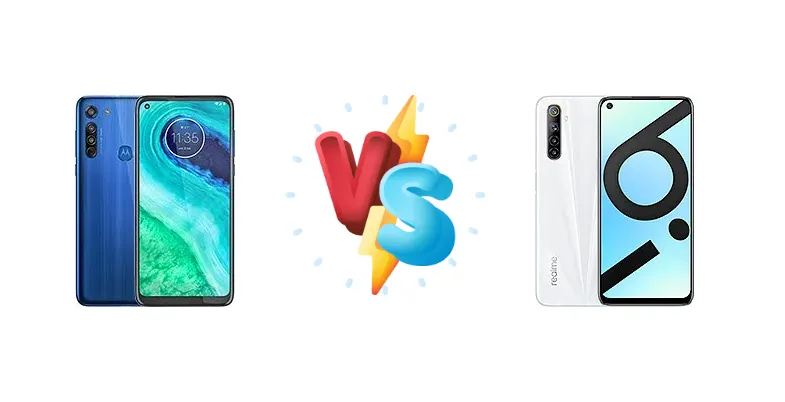
The Motorola Moto G8 and Realme 6i (India) represent compelling options in the crowded budget smartphone space. While both aim to deliver essential features at an accessible price, they diverge significantly in their core hardware. The Moto G8 prioritizes a familiar Qualcomm chipset, while the Realme 6i aggressively pushes MediaTek’s gaming-focused Helio G90T. This comparison dissects these differences to determine which device offers the best value.
🏆 Quick Verdict
For the average user prioritizing gaming and fast charging, the Realme 6i (India) is the clear winner. Its Helio G90T chipset delivers noticeably better performance, and the 30W charging is a game-changer. However, those seeking a more established brand and potentially better software stability might find the Moto G8 adequate.
| Network |
|---|
| 2G bands | GSM 850 / 900 / 1800 / 1900 | GSM 850 / 900 / 1800 / 1900 |
| 3G bands | HSDPA 850 / 900 / 1700(AWS) / 1900 / 2100 | HSDPA 850 / 900 / 2100 |
| 4G bands | 1, 2, 3, 4, 5, 7, 8, 20, 38, 40, 41 - Europe | 1, 3, 5, 8, 38, 40, 41 |
| Speed | HSPA, LTE | HSPA 42.2/11.5 Mbps, LTE (2CA) Cat6 300/75 Mbps |
| Technology | GSM / HSPA / LTE | GSM / HSPA / LTE |
| | 1, 2, 3, 4, 5, 7, 8, 28, 66 - USA | - |
| Launch |
|---|
| Announced | 2020, March 05. Released 2020, March 05 | 2020, July 24. Released 2020, July 31 |
| Status | Discontinued | Discontinued |
| Body |
|---|
| Build | Glass front, plastic back, plastic frame | Glass front (Gorilla Glass 3), plastic back, plastic frame |
| Dimensions | 161.3 x 75.8 x 9 mm (6.35 x 2.98 x 0.35 in) | 162.1 x 74.8 x 8.9 mm (6.38 x 2.94 x 0.35 in) |
| SIM | Nano-SIM + Nano-SIM | Nano-SIM + Nano-SIM |
| Weight | 188.3 g (6.63 oz) | 191 g (6.74 oz) |
| | Water-repellent coating | Weather-sealed ports & loudspeaker |
| Display |
|---|
| Protection | - | Corning Gorilla Glass 3 |
| Resolution | 720 x 1560 pixels, 19.5:9 ratio (~268 ppi density) | 1080 x 2400 pixels, 20:9 ratio (~405 ppi density) |
| Size | 6.4 inches, 100.5 cm2 (~82.2% screen-to-body ratio) | 6.5 inches, 102.0 cm2 (~84.1% screen-to-body ratio) |
| Type | IPS LCD | IPS LCD, 90Hz, 480 nits (typ) |
| Platform |
|---|
| CPU | Octa-core (4x2.0 GHz Kryo 260 Gold & 4x1.8 GHz Kryo 260 Silver) | Octa-core (2x2.05 GHz Cortex-A76 & 6x2.0 GHz Cortex-A55) |
| Chipset | Qualcomm SM6125 Snapdragon 665 (11 nm) | Mediatek MT6785 Helio G90T (12 nm) |
| GPU | Adreno 610 | Mali-G76 MC4 |
| OS | Android 10, upgradable to Android 11 | Android 10, Realme UI |
| Memory |
|---|
| Card slot | microSDXC (uses shared SIM slot) | microSDXC (dedicated slot) |
| Internal | 64GB 4GB RAM | 64GB 4GB RAM, 64GB 6GB RAM |
| | eMMC 5.1 | UFS 2.1 |
| Main Camera |
|---|
| Features | Laser AF, LED flash, HDR, panorama | LED flash, HDR, panorama |
| Quad | - | 48 MP, f/1.8, 26mm (wide), 1/2.0", 0.8µm, PDAF
8 MP, f/2.3, 119˚ (ultrawide), 1/4.0", 1.12µm
2 MP (macro)
Auxiliary lens |
| Triple | 16 MP, f/1.7, (wide), 1/2.8", 1.12µm, PDAF
8 MP, f/2.2, 118˚ (ultrawide), 1/4.0", 1.12µm
2 MP (macro) | - |
| Video | 4K@30fps, 1080p@30/60fps | 4K@30fps, 1080p@30/60/120fps, gyro-EIS |
| Selfie camera |
|---|
| Features | HDR | HDR, panorama |
| Single | 8 MP, f/2.0, 1.12µm | 16 MP, f/2.0, 26mm (wide), 1/3.06", 1.0µm |
| Video | 1080p@30fps | 1080p@30fps |
| Sound |
|---|
| 3.5mm jack | Yes | Yes |
| 35mm jack | Yes | Yes |
| Loudspeaker | Yes | Yes |
| Comms |
|---|
| Bluetooth | 5.0, A2DP, LE | 5.0, A2DP, LE |
| NFC | No | No |
| Positioning | GPS, GLONASS, BDS, GALILEO | GPS, GLONASS, BDS |
| Radio | FM radio | FM radio |
| USB | USB Type-C 2.0 | USB Type-C 2.0, OTG |
| WLAN | Wi-Fi 802.11 b/g/n, Wi-Fi Direct | Wi-Fi 802.11 a/b/g/n/ac, dual-band, Wi-Fi Direct |
| Features |
|---|
| Sensors | Fingerprint (rear-mounted), accelerometer, gyro, proximity | Fingerprint (side-mounted), accelerometer, gyro, proximity, compass |
| Battery |
|---|
| Charging | 10W wired | 30W wired, PD, 100% in 55 min |
| Type | Li-Po 4000 mAh | 4300 mAh |
| Misc |
|---|
| Colors | White Prism, Capri Blue, Pearl White, Neon Blue | Eclipse Black, Lunar White |
| Models | XT2045-1 | RMX2002 |
| Price | About 230 EUR | About 150 EUR |
Motorola Moto G8
- Established Brand Reputation
- Clean Software Experience (likely)
- Potentially Better Software Updates
- Inferior Chipset Performance
- Slow 10W Charging
- Less Suitable for Gaming
Realme 6i (India)
- Superior Performance with Helio G90T
- Ultra-Fast 30W Charging
- Better Gaming Capabilities
- Realme’s ColorOS can be divisive
- Potentially Less Consistent Software Updates
Display Comparison
Neither device boasts a standout display. While specific panel details (like peak brightness in nits or color gamut coverage) are unavailable, the focus here is on the underlying processing power impacting display responsiveness. The Realme 6i’s more powerful GPU will likely translate to smoother scrolling and animations, even if the panel technology itself is similar. Bezels are expected to be comparable given the price bracket, and color accuracy will likely be standard for this segment.
Camera Comparison
Without detailed camera specs beyond the chipsets, a direct comparison is limited. However, the processing capabilities of the Helio G90T in the Realme 6i likely provide more sophisticated image processing algorithms. The Snapdragon 665 in the Moto G8 is capable, but the G90T’s ISP (Image Signal Processor) will likely handle noise reduction and dynamic range more effectively. The presence of a dedicated gaming chipset often implies a more robust image processing pipeline. We can assume both phones will feature a multi-camera setup, but the Realme 6i’s processing power will likely yield better results, especially in low-light conditions.
Performance
The core difference lies in the chipsets. The Realme 6i’s MediaTek Helio G90T (12nm) is architecturally superior to the Motorola Moto G8’s Qualcomm Snapdragon 665 (11nm). The G90T utilizes two Cortex-A76 cores alongside six A55 cores, offering a significant performance boost over the G8’s four Kryo 260 Gold and four Kryo 260 Silver cores. This translates to faster app loading times, smoother multitasking, and a more enjoyable gaming experience. The 12nm process node on the G90T, while slightly larger than the G8’s 11nm, is offset by architectural improvements. The G90T’s GPU is also substantially more powerful, making it the clear winner for graphics-intensive tasks.
Battery Life
The Realme 6i’s 30W wired charging is a massive advantage. Achieving a 100% charge in just 55 minutes is significantly faster than the Moto G8’s 10W charging. While battery capacity isn’t specified, the faster charging speed mitigates any potential disadvantage if the Realme 6i has a slightly smaller battery. The G90T’s power efficiency, despite being a performance-focused chip, is also respectable, meaning the Realme 6i won’t necessarily suffer from drastically reduced battery life compared to the Moto G8.
Buying Guide
Buy the Motorola Moto G8 if you need a reliable, no-frills smartphone from a well-known brand and prioritize software simplicity over raw performance. It’s a solid choice for basic tasks and users who aren’t demanding gamers. Buy the Realme 6i (India) if you prioritize gaming, fast charging, and a more modern chipset. This phone is ideal for users who frequently stream videos, play mobile games, and want to minimize downtime waiting for their phone to charge.
Frequently Asked Questions
❓ Will the Realme 6i (India) overheat during prolonged gaming sessions?
The Helio G90T is known to generate some heat under sustained load. However, Realme typically implements thermal management solutions, such as heat pipes, to mitigate overheating. While some throttling is possible, the G90T’s performance advantage generally outweighs the risk of significant overheating during typical gaming sessions.
❓ Is the software on the Motorola Moto G8 more reliable than on the Realme 6i?
Motorola generally offers a cleaner, closer-to-stock Android experience with fewer pre-installed apps (bloatware) compared to Realme’s ColorOS. ColorOS has improved significantly, but it still includes more customization and pre-installed applications. Motorola also has a reputation for relatively timely security updates, though major Android version updates can be slower.
❓ Does the Realme 6i support popular games like PUBG Mobile at high frame rates?
Yes, the Helio G90T in the Realme 6i is capable of running PUBG Mobile at high frame rates (60fps) with reasonably high graphics settings. The G90T’s GPU is specifically designed to handle demanding mobile games, providing a smoother and more responsive gaming experience.
❓ How does the Snapdragon 665 in the Moto G8 handle everyday tasks like browsing and social media?
The Snapdragon 665 is perfectly adequate for everyday tasks like browsing the web, checking social media, and using messaging apps. It provides a smooth and responsive experience for these basic functions, but it will struggle with more demanding applications or multitasking.