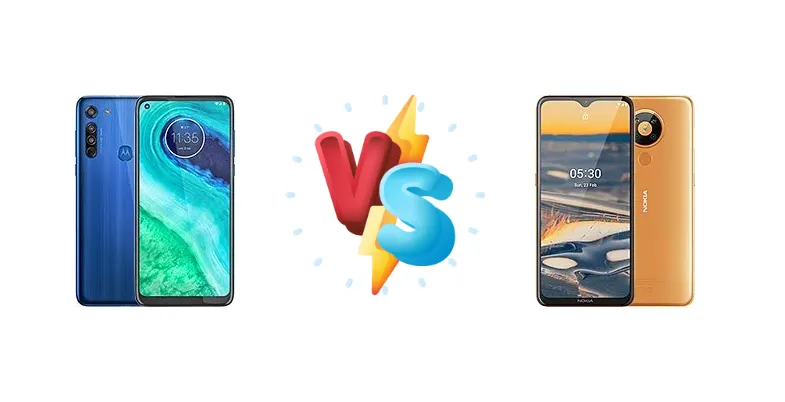
The Motorola Moto G8 and Nokia 5.3 occupy a fiercely competitive segment: the sub-$200 smartphone market. Both devices leverage the Qualcomm Snapdragon 665 chipset, making a direct performance comparison crucial. This analysis goes beyond raw specs to determine which phone offers the better overall user experience, considering factors like software optimization and potential long-term value.
🏆 Quick Verdict
For the average user prioritizing a clean Android experience and potential for longer software support, the Nokia 5.3 edges out the Motorola Moto G8. While performance is virtually identical due to the shared Snapdragon 665, Nokia’s commitment to updates and generally cleaner software provides a slight advantage.
| Network |
|---|
| 2G bands | GSM 850 / 900 / 1800 / 1900 | GSM 850 / 900 / 1800 / 1900 |
| 3G bands | HSDPA 850 / 900 / 1700(AWS) / 1900 / 2100 | HSDPA 850 / 900 / 1900 / 2100 - Global |
| 4G bands | 1, 2, 3, 4, 5, 7, 8, 20, 38, 40, 41 - Europe | 1, 3, 5, 7, 8, 20, 28, 38, 40, 41 - Global |
| Speed | HSPA, LTE | HSPA 42.2/5.76 Mbps, LTE Cat4 150/50 Mbps |
| Technology | GSM / HSPA / LTE | GSM / HSPA / LTE |
| | 1, 2, 3, 4, 5, 7, 8, 28, 66 - USA | 1, 3, 5, 8, 40, 41 - India |
| Launch |
|---|
| Announced | 2020, March 05. Released 2020, March 05 | 2020, March 19. Released 2020, April 02 |
| Status | Discontinued | Discontinued |
| Body |
|---|
| Build | Glass front, plastic back, plastic frame | Glass front (Gorilla Glass 3), plastic back, plastic frame |
| Dimensions | 161.3 x 75.8 x 9 mm (6.35 x 2.98 x 0.35 in) | 164.3 x 76.6 x 8.5 mm (6.47 x 3.02 x 0.33 in) |
| SIM | Nano-SIM + Nano-SIM | · Nano-SIM· Nano-SIM + Nano-SIM |
| Weight | 188.3 g (6.63 oz) | 185 g (6.53 oz) |
| | Water-repellent coating | - |
| Display |
|---|
| Protection | - | Corning Gorilla Glass 3 |
| Resolution | 720 x 1560 pixels, 19.5:9 ratio (~268 ppi density) | 720 x 1600 pixels, 20:9 ratio (~268 ppi density) |
| Size | 6.4 inches, 100.5 cm2 (~82.2% screen-to-body ratio) | 6.55 inches, 103.6 cm2 (~82.3% screen-to-body ratio) |
| Type | IPS LCD | IPS LCD, 450 nits (typ) |
| Platform |
|---|
| CPU | Octa-core (4x2.0 GHz Kryo 260 Gold & 4x1.8 GHz Kryo 260 Silver) | Octa-core (4x2.0 GHz Kryo 260 Gold & 4x1.8 GHz Kryo 260 Silver) |
| Chipset | Qualcomm SM6125 Snapdragon 665 (11 nm) | Qualcomm SM6125 Snapdragon 665 (11 nm) |
| GPU | Adreno 610 | Adreno 610 |
| OS | Android 10, upgradable to Android 11 | Android 10, upgradable to Android 11, Android One |
| Memory |
|---|
| Card slot | microSDXC (uses shared SIM slot) | microSDXC (dedicated slot) |
| Internal | 64GB 4GB RAM | 64GB 3GB RAM, 64GB 4GB RAM, 64GB 6GB RAM, 128GB 4GB RAM |
| | eMMC 5.1 | eMMC 5.1 |
| Main Camera |
|---|
| Features | Laser AF, LED flash, HDR, panorama | LED flash, HDR, panorama |
| Quad | - | 13 MP, f/1.8, (wide), PDAF
5 MP, 13mm (ultrawide)
2 MP (macro)
Auxiliary lens |
| Triple | 16 MP, f/1.7, (wide), 1/2.8", 1.12µm, PDAF
8 MP, f/2.2, 118˚ (ultrawide), 1/4.0", 1.12µm
2 MP (macro) | - |
| Video | 4K@30fps, 1080p@30/60fps | 4K@30fps, 1080p@30fps |
| Selfie camera |
|---|
| Features | HDR | - |
| Single | 8 MP, f/2.0, 1.12µm | 8 MP, f/2.0, (wide) |
| Video | 1080p@30fps | 1080p@30fps |
| Sound |
|---|
| 3.5mm jack | Yes | Yes |
| 35mm jack | Yes | Yes |
| Loudspeaker | Yes | Yes |
| Comms |
|---|
| Bluetooth | 5.0, A2DP, LE | 4.2, A2DP, LE, aptX |
| NFC | No | Yes |
| Positioning | GPS, GLONASS, BDS, GALILEO | GPS, GLONASS, BDS |
| Radio | FM radio | FM radio |
| USB | USB Type-C 2.0 | USB Type-C 2.0, OTG |
| WLAN | Wi-Fi 802.11 b/g/n, Wi-Fi Direct | Wi-Fi 802.11 b/g/n/ac, Wi-Fi Direct |
| Features |
|---|
| Sensors | Fingerprint (rear-mounted), accelerometer, gyro, proximity | Fingerprint (rear-mounted), accelerometer, proximity |
| Battery |
|---|
| Charging | 10W wired | 10W wired |
| Type | Li-Po 4000 mAh | Li-Po 4000 mAh |
| Misc |
|---|
| Colors | White Prism, Capri Blue, Pearl White, Neon Blue | Cyan, Sand, Charcoal |
| Models | XT2045-1 | TA-1234, TA-1223, TA-1227, TA-1229 |
| Price | About 230 EUR | About 290 EUR |
| SAR | - | 1.03 W/kg (head) 0.95 W/kg (body) |
| SAR EU | - | 0.70 W/kg (head) 1.39 W/kg (body) |
Motorola Moto G8
- Readily available and often discounted.
- Simple and straightforward Android experience.
- Reliable performance for basic tasks.
- Limited software update commitment.
- Slow 10W charging.
- Potentially less refined camera image processing.
Nokia 5.3
- Cleaner Android One software experience.
- Potential for longer software support.
- Generally more natural camera color reproduction.
- Slow 10W charging.
- May be slightly more expensive than the Moto G8.
- Availability can vary by region.
Display Comparison
Both the Moto G8 and Nokia 5.3 lack detailed display specifications in the provided data. However, given their price point, it’s safe to assume both utilize LCD panels. The absence of high refresh rates or advanced features like HDR is expected. The user experience will likely hinge on color calibration and viewing angles, areas where Nokia historically performs slightly better with its color science. Bezels are likely comparable, reflecting the budget nature of both devices.
Camera Comparison
Without detailed camera specifications, a direct comparison is limited. Both phones likely feature a multi-camera setup, but the quality will depend heavily on sensor size, lens aperture, and image processing algorithms. Given the market segment, expect a primary sensor accompanied by depth or macro lenses. The usefulness of a 2MP macro lens is questionable, offering limited detail. Nokia’s image processing tends towards more natural colors, while Motorola often boosts saturation. The quality of the primary sensor will be the deciding factor for most users.
Performance
The core of both devices is the Qualcomm SM6125 Snapdragon 665 (11 nm) paired with an Octa-core CPU configuration (4x2.0 GHz Kryo 260 Gold & 4x1.8 GHz Kryo 260 Silver). This means CPU performance will be nearly indistinguishable between the two. The Snapdragon 665 is capable of handling everyday tasks like browsing, social media, and light gaming without significant issues. However, demanding games will require reduced graphics settings. Thermal management will be crucial; the 11nm process node is relatively efficient, but sustained loads could lead to throttling. Software optimization will play a key role in maximizing performance.
Battery Life
Both the Moto G8 and Nokia 5.3 feature 10W wired charging. This is a significant limitation in today’s market, resulting in relatively slow charging times. A full 0-100% charge will likely take over two hours. Battery life will depend on usage patterns, but the Snapdragon 665’s efficiency should provide all-day battery life for moderate users. The actual mAh capacity of the batteries isn't specified, but it's likely in the 4000-5000 mAh range, typical for this price point. The slow charging speed is a major drawback for both devices.
Buying Guide
Buy the Motorola Moto G8 if you need a readily available, affordable device with a focus on immediate usability and aren't overly concerned with long-term software updates. Buy the Nokia 5.3 if you prefer a cleaner Android experience, value potential software updates, and appreciate Nokia’s design aesthetic. Both are excellent choices for first-time smartphone buyers or those seeking a reliable secondary device.
Frequently Asked Questions
❓ Will the Snapdragon 665 in either phone struggle with popular games like PUBG Mobile or Call of Duty Mobile?
The Snapdragon 665 can run PUBG Mobile and Call of Duty Mobile, but you'll likely need to use low or medium graphics settings to maintain a stable frame rate. Expect some occasional stuttering during intense action sequences. Neither phone is designed for high-end gaming.
❓ How long can I realistically expect software updates to be supported on the Nokia 5.3?
The Nokia 5.3, being part of the Android One program, is guaranteed at least two years of Android version updates and three years of security patches. This is a significant advantage over the Motorola Moto G8, which typically receives fewer updates.
❓ Is the 10W charging speed a dealbreaker in 2024?
Yes, the 10W charging is a significant drawback. It will take over two hours to fully charge the phone, which is slow compared to modern smartphones offering 18W, 33W, or even faster charging speeds. This is a compromise you make for the lower price point.