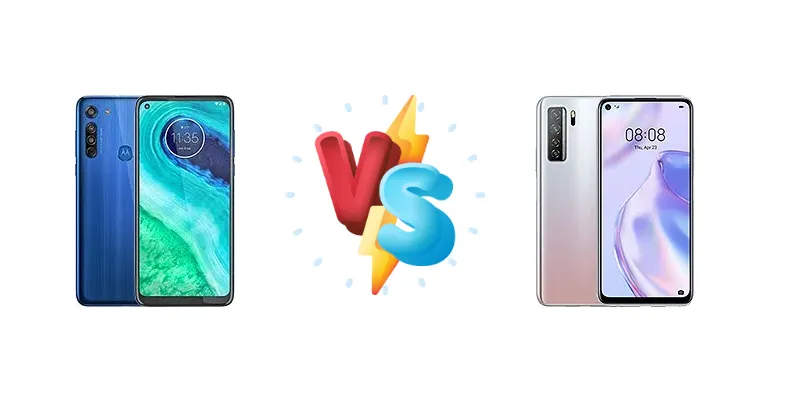
The Motorola Moto G8 and Huawei P40 lite 5G represent distinct approaches to the budget 5G smartphone market. The Moto G8, leveraging Qualcomm’s Snapdragon 665, aims for affordability and efficiency. Conversely, the P40 lite 5G, powered by Huawei’s Kirin 820 5G, prioritizes performance and faster charging, positioning itself as a more ambitious contender.
🏆 Quick Verdict
For the average user prioritizing performance and future-proofing with 5G, the Huawei P40 lite 5G is the clear winner. Its Kirin 820 5G chipset offers a substantial performance leap over the Moto G8’s Snapdragon 665, coupled with significantly faster 40W charging. However, the Moto G8 remains a viable option for those on a tighter budget who prioritize simplicity.
| Network |
|---|
| 2G bands | GSM 850 / 900 / 1800 / 1900 | GSM 850 / 900 / 1800 / 1900 |
| 3G bands | HSDPA 850 / 900 / 1700(AWS) / 1900 / 2100 | HSDPA 800 / 850 / 900 / 1700(AWS) / 1900 / 2100 |
| 4G bands | 1, 2, 3, 4, 5, 7, 8, 20, 38, 40, 41 - Europe | 1, 2, 3, 4, 5, 6, 7, 8, 12, 17, 18, 19, 20, 26, 28, 34, 38, 39, 40, 41, 66 |
| 5G bands | - | 1, 3, 28, 38, 41, 77, 78, 79 SA/NSA |
| Speed | HSPA, LTE | HSPA, LTE, 5G |
| Technology | GSM / HSPA / LTE | GSM / HSPA / LTE / 5G |
| | 1, 2, 3, 4, 5, 7, 8, 28, 66 - USA | - |
| Launch |
|---|
| Announced | 2020, March 05. Released 2020, March 05 | 2020, May 15. Released 2020, May 28 |
| Status | Discontinued | Discontinued |
| Body |
|---|
| Build | Glass front, plastic back, plastic frame | - |
| Dimensions | 161.3 x 75.8 x 9 mm (6.35 x 2.98 x 0.35 in) | 162.3 x 75 x 8.6 mm (6.39 x 2.95 x 0.34 in) |
| SIM | Nano-SIM + Nano-SIM | Nano-SIM + Nano-SIM |
| Weight | 188.3 g (6.63 oz) | 189 g (6.67 oz) |
| | Water-repellent coating | - |
| Display |
|---|
| Resolution | 720 x 1560 pixels, 19.5:9 ratio (~268 ppi density) | 1080 x 2400 pixels, 20:9 ratio (~405 ppi density) |
| Size | 6.4 inches, 100.5 cm2 (~82.2% screen-to-body ratio) | 6.5 inches, 102.0 cm2 (~83.8% screen-to-body ratio) |
| Type | IPS LCD | IPS LCD, HDR10 |
| Platform |
|---|
| CPU | Octa-core (4x2.0 GHz Kryo 260 Gold & 4x1.8 GHz Kryo 260 Silver) | Octa-core (1x2.36 GHz Cortex-A76 & 3x2.22 GHz Cortex-A76 & 4x1.84 GHz Cortex-A55) |
| Chipset | Qualcomm SM6125 Snapdragon 665 (11 nm) | Kirin 820 5G (7 nm) |
| GPU | Adreno 610 | Mali-G57 (6-core) |
| OS | Android 10, upgradable to Android 11 | Android 10, EMUI 10.1, no Google Play Services |
| Memory |
|---|
| Card slot | microSDXC (uses shared SIM slot) | Nano Memory (uses shared SIM slot) |
| Internal | 64GB 4GB RAM | 128GB 6GB RAM, 128GB 8GB RAM |
| | eMMC 5.1 | - |
| Main Camera |
|---|
| Features | Laser AF, LED flash, HDR, panorama | LED flash, Panorama, HDR |
| Quad | - | 64 MP, f/1.8, 26mm (wide), PDAF
8 MP, f/2.4, 17mm (ultrawide)
2 MP (macro)
Auxiliary lens |
| Triple | 16 MP, f/1.7, (wide), 1/2.8", 1.12µm, PDAF
8 MP, f/2.2, 118˚ (ultrawide), 1/4.0", 1.12µm
2 MP (macro) | - |
| Video | 4K@30fps, 1080p@30/60fps | 4K@30fps, 1080p@30fps |
| Selfie camera |
|---|
| Features | HDR | HDR |
| Single | 8 MP, f/2.0, 1.12µm | 16 MP, f/2.0, (wide) |
| Video | 1080p@30fps | 1080p@30fps |
| Sound |
|---|
| 3.5mm jack | Yes | Yes |
| 35mm jack | Yes | Yes |
| Loudspeaker | Yes | Yes |
| Comms |
|---|
| Bluetooth | 5.0, A2DP, LE | 5.1, A2DP, LE |
| NFC | No | Yes |
| Positioning | GPS, GLONASS, BDS, GALILEO | GPS, GLONASS, GALILEO, BDS |
| Radio | FM radio | No |
| USB | USB Type-C 2.0 | USB Type-C 2.0, OTG |
| WLAN | Wi-Fi 802.11 b/g/n, Wi-Fi Direct | Wi-Fi 802.11 a/b/g/n/ac, dual-band, Wi-Fi Direct |
| Features |
|---|
| Sensors | Fingerprint (rear-mounted), accelerometer, gyro, proximity | Fingerprint (side-mounted), accelerometer, gyro, proximity, compass |
| Battery |
|---|
| Charging | 10W wired | 40W wired, 70% in 30 min
5W reverse wired |
| Type | Li-Po 4000 mAh | Li-Po 4000 mAh |
| Misc |
|---|
| Colors | White Prism, Capri Blue, Pearl White, Neon Blue | Crush Green, Space Silver, Midnight Black |
| Models | XT2045-1 | CDY-NX9A |
| Price | About 230 EUR | About 190 EUR |
Motorola Moto G8
- Lower price point makes it accessible.
- Simple and straightforward user experience.
- Potentially longer battery life due to efficient chipset (though charging is slow).
- Significantly slower performance compared to the P40 lite 5G.
- Slow 10W charging.
- Limited 5G capabilities (if any).
Huawei P40 lite 5G
- Much faster performance thanks to the Kirin 820 5G.
- Ultra-fast 40W charging.
- 5G connectivity for future-proofed data speeds.
- Higher price compared to the Moto G8.
- Potentially more complex software experience (Huawei's EMUI).
- May experience more thermal throttling under extreme load.
Display Comparison
While display specifications aren't provided, the Moto G8 likely features a standard LCD panel common in its price bracket. The P40 lite 5G, benefiting from a more recent release, may incorporate a higher-quality panel with improved color accuracy and brightness. The absence of high refresh rate information suggests both devices target standard 60Hz operation. Bezels are likely larger on the Moto G8 due to its older design.
Camera Comparison
Without detailed camera specs, it’s difficult to make a definitive judgment. However, Huawei generally prioritizes camera performance, even in its budget offerings. The P40 lite 5G likely benefits from more sophisticated image processing algorithms and potentially a larger primary sensor. The Moto G8, while capable, likely relies on software optimization to compensate for potentially less advanced hardware. The presence of a 2MP macro camera on either device is unlikely to significantly impact image quality, serving primarily as a marketing feature.
Performance
The core difference lies in the chipsets. The Huawei P40 lite 5G’s Kirin 820 5G, built on a 7nm process, demonstrably outperforms the Motorola Moto G8’s Snapdragon 665 (11nm). The Kirin 820’s CPU configuration – a 1x2.36 GHz Cortex-A76, 3x2.22 GHz Cortex-A76, and 4x1.84 GHz Cortex-A55 – provides a significant advantage in multi-core performance compared to the Snapdragon 665’s 4x2.0 GHz Kryo 260 Gold & 4x1.8 GHz Kryo 260 Silver. This translates to faster app loading times, smoother multitasking, and a more enjoyable gaming experience on the P40 lite 5G. The 7nm process also contributes to better thermal efficiency, reducing the likelihood of throttling under sustained load.
Battery Life
Battery capacity isn't specified, but the charging capabilities are a major differentiator. The P40 lite 5G’s 40W wired charging, capable of reaching 70% charge in just 30 minutes, is a game-changer. This drastically reduces downtime compared to the Moto G8’s slow 10W charging. While the Moto G8 might have a slightly larger battery capacity, the P40 lite 5G’s faster charging effectively mitigates any potential battery life disadvantage. The P40 lite 5G also offers 5W reverse wired charging, a feature absent on the Moto G8.
Buying Guide
Buy the Motorola Moto G8 if you need a reliable, basic smartphone for everyday tasks like calling, texting, and light social media use, and value a lower price point above all else. Buy the Huawei P40 lite 5G if you prefer a smoother, more responsive experience for gaming and multitasking, and want the benefit of 5G connectivity and incredibly fast charging, even if it comes at a slightly higher cost.
Frequently Asked Questions
❓ Does the Kirin 820 5G in the P40 lite 5G get noticeably hot during extended gaming sessions?
While the 7nm process helps with thermal efficiency, the Kirin 820 5G is a powerful chip. Expect some heat buildup during prolonged gaming, but it's unlikely to reach critical levels. Huawei's software likely includes thermal management features to mitigate throttling, but performance may still decrease slightly over time.
❓ Is the 5G connectivity on the P40 lite 5G actually useful, or is it just a marketing gimmick?
The usefulness of 5G depends on your location and carrier coverage. If you live in an area with robust 5G infrastructure, you'll experience significantly faster download and upload speeds. However, if 5G coverage is limited, the phone will fall back to 4G, making the 5G capability less impactful. It's a future-proofing feature that will become increasingly valuable as 5G networks expand.
❓ How does the Snapdragon 665 in the Moto G8 handle basic multitasking and social media apps?
The Snapdragon 665 is perfectly adequate for everyday tasks like browsing the web, checking email, and using social media apps. You shouldn't experience significant lag or slowdowns with these activities. However, it will struggle with more demanding applications or heavy multitasking.