
Moto G8 vs Pixel 4a 5G: Which Budget 5G Phone Reigns Supreme?
| Phones Images | |||||
|---|---|---|---|---|---|
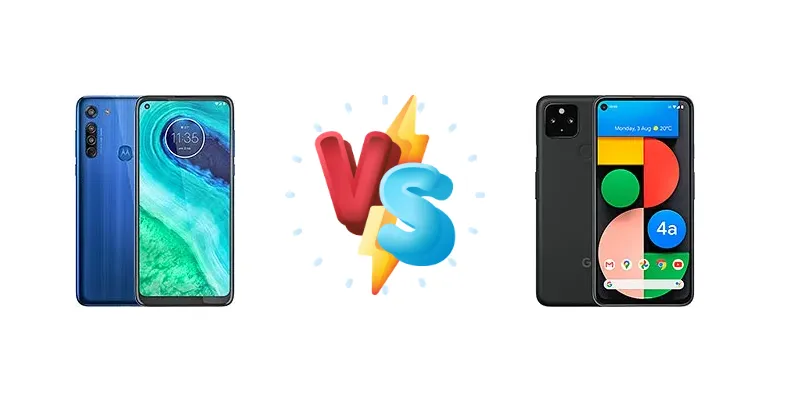
|
🏆 Quick Verdict
For most users, the Google Pixel 4a 5G is the superior choice. Its Snapdragon 765G chipset provides a significantly faster and more responsive experience, complemented by Google’s excellent camera software and guaranteed updates. While the Moto G8 is cheaper, the performance trade-offs are substantial.
| PHONES | ||
|---|---|---|
| Phone Names | Motorola Moto G8 | Google Pixel 4a 5G |
| Network | ||
|---|---|---|
| 2G bands | GSM 850 / 900 / 1800 / 1900 | GSM 850 / 900 / 1800 / 1900 |
| 3G bands | HSDPA 850 / 900 / 1700(AWS) / 1900 / 2100 | HSDPA 850 / 900 / 1700(AWS) / 1900 / 2100 |
| 4G bands | 1, 2, 3, 4, 5, 7, 8, 20, 38, 40, 41 - Europe | 1, 2, 3, 4, 5, 7, 8, 12, 13, 14, 17, 18, 19, 20, 25, 26, 28, 29, 30, 32, 38, 39, 40, 41, 42, 46, 48, 66, 71 |
| 5G bands | - | 1, 2, 3, 5, 7, 8, 12, 28, 41, 66, 71, 77, 78 Sub6, mmWave (market dependant) |
| Speed | HSPA, LTE | HSPA, LTE, 5G |
| Technology | GSM / HSPA / LTE | GSM / HSPA / LTE / 5G |
| 1, 2, 3, 4, 5, 7, 8, 28, 66 - USA | - | |
| Launch | ||
|---|---|---|
| Announced | 2020, March 05. Released 2020, March 05 | 2020, September 30 |
| Status | Discontinued | Available. Released 2020, November 05 |
| Body | ||
|---|---|---|
| Build | Glass front, plastic back, plastic frame | Glass front (Gorilla Glass 3), plastic back, plastic frame |
| Dimensions | 161.3 x 75.8 x 9 mm (6.35 x 2.98 x 0.35 in) | 153.9 x 74 x 8.2 mm (Sub-6) or 8.5 mm (Sub-6 and mmWave) |
| SIM | Nano-SIM + Nano-SIM | Nano-SIM + eSIM |
| Weight | 188.3 g (6.63 oz) | 168 g (5G Sub-6); 171 g ( 5G Sub-6 and mmWave) (5.93 oz) |
| Water-repellent coating | - | |
| Display | ||
|---|---|---|
| Protection | - | Corning Gorilla Glass 3 |
| Resolution | 720 x 1560 pixels, 19.5:9 ratio (~268 ppi density) | 1080 x 2340 pixels, 19.5:9 ratio (~413 ppi density) |
| Size | 6.4 inches, 100.5 cm2 (~82.2% screen-to-body ratio) | 6.2 inches, 95.7 cm2 (~84.1% screen-to-body ratio) |
| Type | IPS LCD | OLED, HDR |
| - | Always-on display | |
| Platform | ||
|---|---|---|
| CPU | Octa-core (4x2.0 GHz Kryo 260 Gold & 4x1.8 GHz Kryo 260 Silver) | Octa-core (1x2.4 GHz Kryo 475 Prime & 1x2.2 GHz Kryo 475 Gold & 6x1.8 GHz Kryo 475 Silver) |
| Chipset | Qualcomm SM6125 Snapdragon 665 (11 nm) | Qualcomm SM7250 Snapdragon 765G 5G (7 nm) |
| GPU | Adreno 610 | Adreno 620 |
| OS | Android 10, upgradable to Android 11 | Android 11, upgradable to Android 14 |
| Memory | ||
|---|---|---|
| Card slot | microSDXC (uses shared SIM slot) | No |
| Internal | 64GB 4GB RAM | 128GB 6GB RAM |
| eMMC 5.1 | UFS 2.1 | |
| Main Camera | ||
|---|---|---|
| Dual | - | 12.2 MP, f/1.7, 27mm (wide), 1/2.55", 1.4µm, dual pixel PDAF, OIS 16 MP, f/2.2, 107˚ (ultrawide), 1.0µm |
| Features | Laser AF, LED flash, HDR, panorama | LED flash, Pixel Shift, Auto-HDR, panorama |
| Triple | 16 MP, f/1.7, (wide), 1/2.8", 1.12µm, PDAF 8 MP, f/2.2, 118˚ (ultrawide), 1/4.0", 1.12µm 2 MP (macro) | - |
| Video | 4K@30fps, 1080p@30/60fps | 4K@30/60fps, 1080p@30/60/120/240fps; gyro-EIS |
| Selfie camera | ||
|---|---|---|
| Features | HDR | HDR |
| Single | 8 MP, f/2.0, 1.12µm | 8 MP, f/2.0, 24mm (wide), 1/4.0", 1.12µm |
| Video | 1080p@30fps | 1080p@30fps |
| Sound | ||
|---|---|---|
| 3.5mm jack | Yes | Yes |
| 35mm jack | Yes | Yes |
| Loudspeaker | Yes | Yes, with stereo speakers |
| Comms | ||
|---|---|---|
| Bluetooth | 5.0, A2DP, LE | 5.0, A2DP, LE, aptX HD |
| NFC | No | Yes |
| Positioning | GPS, GLONASS, BDS, GALILEO | GPS, GLONASS, GALILEO, QZSS, BDS |
| Radio | FM radio | No |
| USB | USB Type-C 2.0 | USB Type-C 3.1 |
| WLAN | Wi-Fi 802.11 b/g/n, Wi-Fi Direct | Wi-Fi 802.11 a/b/g/n/ac, dual-band, Wi-Fi Direct |
| Features | ||
|---|---|---|
| Sensors | Fingerprint (rear-mounted), accelerometer, gyro, proximity | Fingerprint (rear-mounted), accelerometer, gyro, proximity, compass, barometer |
| Battery | ||
|---|---|---|
| Charging | 10W wired | 18W wired, PD2.0 |
| Type | Li-Po 4000 mAh | Li-Po 3885 mAh |
| Misc | ||
|---|---|---|
| Colors | White Prism, Capri Blue, Pearl White, Neon Blue | Just Black, Clearly White |
| Models | XT2045-1 | GD1YQ, G025I, G025E, G025H, G6QU3 |
| Price | About 230 EUR | About 140 EUR |
Motorola Moto G8
- Lowest possible price point
- Functional for basic smartphone tasks
- Potentially larger display size (6.4 inches)
- Significantly slower performance
- Outdated Snapdragon 665 chipset
- Slow 10W charging
Google Pixel 4a 5G
- Faster Snapdragon 765G 5G chipset
- Superior camera quality with Google’s software
- 18W fast charging with PD2.0
- Higher price than the Moto G8
- May not have expandable storage
- Potentially less battery capacity than some competitors
Display Comparison
Neither device boasts a standout display. Both likely utilize LCD panels, a common choice in this price bracket. However, the Pixel 4a 5G’s larger 6.2-inch screen (vs. the Moto G8’s 6.4-inch) and potentially higher peak brightness, stemming from its more modern chipset’s display engine, will offer a more vibrant viewing experience. While specific nit ratings aren't provided, the Pixel's processing power allows for more sophisticated image processing, potentially improving color accuracy and contrast.
Camera Comparison
While megapixel counts aren't the sole determinant of camera quality, the Pixel 4a 5G benefits from Google’s renowned computational photography. Although sensor sizes aren't specified, the Pixel’s image processing algorithms are capable of extracting significantly more detail and dynamic range from its sensor. The Snapdragon 765G’s image signal processor (ISP) is far more advanced than the 665’s, enabling features like Night Sight and improved HDR processing. The Moto G8 likely relies more heavily on hardware limitations, resulting in less impressive low-light performance and a narrower dynamic range.
Performance
The performance gap is the most significant differentiator. The Google Pixel 4a 5G’s Qualcomm SM7250 Snapdragon 765G (7nm) is a substantial upgrade over the Motorola Moto G8’s Snapdragon 665 (11nm). The 7nm process node allows for greater transistor density and improved power efficiency, translating to faster processing speeds and reduced thermal throttling. The Pixel 4a 5G’s CPU configuration – a 1x2.4 GHz Kryo 475 Prime core, 1x2.2 GHz Kryo 475 Gold, and 6x1.8 GHz Kryo 475 Silver – offers a more balanced and powerful architecture than the Moto G8’s 4x2.0 GHz Kryo 260 Gold & 4x1.8 GHz Kryo 260 Silver. This difference will be most noticeable in demanding tasks like gaming and multitasking.
Battery Life
The Moto G8’s battery capacity isn’t specified, but its 10W charging is a clear disadvantage. The Pixel 4a 5G’s 18W charging with PD2.0 support significantly reduces charging times. While the Pixel 4a 5G may not have a dramatically larger battery, the faster charging speed and more efficient chipset will likely result in a comparable, if not better, real-world battery life experience. The efficiency gains from the 7nm process node on the Pixel contribute to lower power consumption during typical usage.
Buying Guide
Buy the Motorola Moto G8 if you absolutely need the lowest possible price and are willing to compromise on performance and long-term software support. It’s a functional device for basic tasks. Buy the Google Pixel 4a 5G if you prioritize a smooth user experience, a capable camera, 5G connectivity, and timely software updates, even if it means spending a bit more.