
Moto G75 vs. Google Pixel 6a: A Deep Dive into Mid-Range Champions
| Phones Images | |||||
|---|---|---|---|---|---|
|
🏆 Quick Verdict
For most users, the Motorola Moto G75 emerges as the better value. Its Snapdragon 6 Gen 3 chipset, coupled with 30W wired and 15W wireless charging, provides a more modern experience. While the Pixel 6a’s Tensor chip still holds its own, the G75’s battery endurance and charging speed give it a practical edge.
| PHONES | ||
|---|---|---|
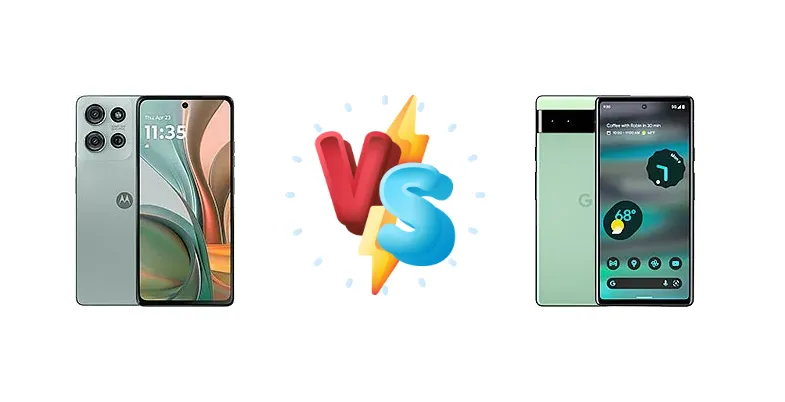
| Phone Names | Motorola Moto G75 | Google Pixel 6a |
| Network | ||
|---|---|---|
| 2G bands | GSM 850 / 900 / 1800 / 1900 | GSM 850 / 900 / 1800 / 1900 |
| 3G bands | HSDPA 850 / 900 / 1900 / 2100 | HSDPA 800 / 850 / 900 / 1700(AWS) / 1900 / 2100 |
| 4G bands | 1, 2, 3, 5, 7, 8, 20, 26, 28, 32, 38, 40, 41, 41, 42 | 1, 2, 3, 4, 5, 7, 8, 12, 13, 14, 17, 18, 19, 20, 25, 26, 28, 29, 30, 38, 39, 40, 41, 42, 48, 66, 71 - GX7AS, GB62Z (USA/Canada) |
| 5G bands | 1, 3, 5, 7, 8, 20, 26, 28, 38, 40, 41, 77, 78 SA/NSA/Sub6 | 1, 2, 3, 5, 7, 8, 12, 20, 25, 28, 30, 38, 40, 41, 48, 66, 71, 77, 78 SA/NSA/Sub6 - GX7AS (USA/Canada) |
| Speed | HSPA, LTE, 5G | HSPA, LTE, 5G |
| Technology | GSM / HSPA / LTE / 5G | GSM / HSPA / LTE / 5G |
| - | 1, 2, 3, 5, 7, 8, 12, 20, 25, 28, 30, 40, 48, 66, 71, 77, 78 SA/NSA/Sub6 - G1AZG (International) | |
| Launch | ||
|---|---|---|
| Announced | 2024, October 01 | 2022, May 11 |
| Status | Available. Released 2024, October 28 | Available. Released 2022, July 21 |
| Body | ||
|---|---|---|
| Build | Glass front (Gorilla Glass 5), silicone polymer (eco leather) back or plastic back, plastic frame | Glass front (Gorilla Glass 3), aluminum frame, plastic back |
| Dimensions | 166.1 x 77.2 x 8.3 mm (6.54 x 3.04 x 0.33 in) | 152.2 x 71.8 x 8.9 mm (5.99 x 2.83 x 0.35 in) |
| SIM | · Nano-SIM + eSIM· Nano-SIM + Nano-SIM | Nano-SIM + eSIM |
| Weight | 205 g or 208 g (7.23 oz) | 178 g (6.28 oz) |
| - | IP67 dust/water resistant (up to 1m for 30 min) | |
| Display | ||
|---|---|---|
| Protection | Corning Gorilla Glass 5, Mohs level 4 | Corning Gorilla Glass 3 |
| Resolution | 1080 x 2388 pixels (~387 ppi density) | 1080 x 2400 pixels, 20:9 ratio (~429 ppi density) |
| Size | 6.78 inches, 111.4 cm2 (~86.8% screen-to-body ratio) | 6.1 inches, 90.7 cm2 (~83.0% screen-to-body ratio) |
| Type | IPS LCD, 120Hz, 1000 nits (HBM) | OLED, HDR |
| - | Always-on display | |
| Platform | ||
|---|---|---|
| CPU | Octa-core (4x2.4 GHz Cortex-A78 & 4x1.8 GHz Cortex-A55) | Octa-core (2x2.80 GHz Cortex-X1 & 2x2.25 GHz Cortex-A76 & 4x1.80 GHz Cortex-A55) |
| Chipset | Qualcomm SM6475-AB Snapdragon 6 Gen 3 (4 nm) | Google Tensor (5 nm) |
| GPU | Adreno 710 | Mali-G78 MP20 |
| OS | Android 14, up to 5 major Android upgrades | Android 12, upgradable to Android 15, up to 5 major Android upgrades |
| Memory | ||
|---|---|---|
| Card slot | microSDXC (uses shared SIM slot) | No |
| Internal | 128GB 8GB RAM, 256GB 8GB RAM | 128GB 6GB RAM |
| - | UFS 3.1 | |
| Main Camera | ||
|---|---|---|
| Dual | 50 MP, f/1.8, (wide), 0.8µm, PDAF, OIS 8 MP, f/2.2, 119˚ (ultrawide), 1.12µm, AF | 12.2 MP, f/1.7, 27mm, (wide), 1/2.55", 1.4µm, dual pixel PDAF, OIS 12 MP, f/2.2, 17mm, 114˚ (ultrawide), 1.25µm |
| Features | LED flash, HDR, panorama | Dual-LED flash, Pixel Shift, Auto-HDR, panorama |
| Single | - | 8 MP, f/2.0, 24mm (wide), 1.12µm |
| Video | 4K@30fps, 1080p@30/60fps, gyro-EIS | 4K@30/60fps, 1080p@30/60/120/240fps; gyro-EIS, OIS |
| Selfie camera | ||
|---|---|---|
| Features | - | HDR, panorama |
| Single | 16 MP, f/2.5, (wide), 1.0µm | 8 MP, f/2.0, 24mm (wide), 1.12µm |
| Video | 4K@30fps, 1080p@30fps | 1080p@30fps |
| Sound | ||
|---|---|---|
| 3.5mm jack | - | No |
| 35mm jack | No | No |
| Loudspeaker | Yes, with stereo speakers | Yes, with stereo speakers |
| Comms | ||
|---|---|---|
| Bluetooth | 5.4, A2DP, LE, aptX HD | 5.2, A2DP, LE |
| NFC | Yes | Yes |
| Positioning | GPS, GALILEO, GLONASS, BDS, QZSS | GPS, GLONASS, GALILEO, QZSS |
| Radio | No | No |
| USB | USB Type-C 2.0 | USB Type-C 3.1 |
| WLAN | Wi-Fi 802.11 a/b/g/n/ac/6e, tri-band | Wi-Fi 802.11 a/b/g/n/ac/6e, dual-band, Wi-Fi Direct |
| Features | ||
|---|---|---|
| Sensors | Fingerprint (side-mounted), accelerometer, gyro, proximity, compass | Fingerprint (under display, optical), accelerometer, gyro, proximity, compass, barometer |
| Battery | ||
|---|---|---|
| Charging | 30W wired, 50% in 25 min 15W wireless | 18W wired, PD3.0 |
| Type | 5000 mAh | Li-Po 4410 mAh |
| Misc | ||
|---|---|---|
| Colors | Charcoal Gray, Aqua Blue, Succulent Green | Chalk, Charcoal, Sage |
| Models | XT2437-2, XT2437-3 | GX7AS, GB62Z, G1AZG, GB17L |
| Price | $ 215.99 / C$ 277.67 / £ 189.99 / € 189.00 | $ 138.99 / C$ 228.74 / ₹ 23,999 |
| Tests | ||
|---|---|---|
| Battery life | - | Endurance rating 94h |
| Display | - | Contrast ratio: Infinite (nominal) |
| EU LABEL | ||
|---|---|---|
| Battery | 48:58h endurance, 1000 cycles | - |
| Energy | Class B | - |
| Free fall | Class B (180 falls) | - |
| Repairability | Class B | - |
Motorola Moto G75
- Significantly longer battery life (48:58h endurance)
- Faster 30W wired and 15W wireless charging
- Newer Snapdragon 6 Gen 3 (4nm) chipset for improved efficiency
- Display brightness likely lower than Pixel 6a
- Camera performance potentially less refined than Pixel 6a
Google Pixel 6a
- Brighter display (876 nits)
- Excellent image processing powered by Google Tensor
- Clean and optimized Android software experience
- Shorter battery life compared to Moto G75
- Slower 18W wired charging, no wireless charging
Display Comparison
The Google Pixel 6a boasts a brighter display, peaking at 876 nits, which will be noticeably advantageous in direct sunlight. The Moto G75’s display specifications are not provided, but given its market positioning, it likely doesn’t reach the same peak brightness. The Pixel 6a’s ‘infinite’ contrast ratio, typical of OLED panels, delivers deeper blacks and more vibrant colors. While the G75’s panel type is unknown, the Pixel 6a’s OLED technology provides a superior viewing experience, particularly for media consumption.
Camera Comparison
Without detailed camera specs for the Moto G75, a direct comparison is limited. However, the Pixel 6a is renowned for its computational photography prowess, leveraging the Tensor chip’s AI capabilities for exceptional image processing. The Pixel 6a’s image processing excels in dynamic range and low-light performance. While the G75 may offer a higher megapixel count, the Pixel 6a’s software optimization is likely to deliver more consistently pleasing results. We can assume the G75 will have a standard camera setup for its price point, while the Pixel 6a’s strength lies in its software-driven image quality.
Performance
The chipset is where a significant difference lies. The Moto G75 utilizes the Qualcomm Snapdragon 6 Gen 3 (4nm), while the Pixel 6a is powered by Google’s Tensor (5nm). While both are octa-core CPUs, the architectural differences are key. The Pixel 6a’s Tensor features Cortex-X1 cores for peak performance, while the G75 relies on Cortex-A78 cores. However, the Snapdragon 6 Gen 3’s 4nm process offers improved power efficiency, potentially leading to better sustained performance and thermal management during extended tasks. The G75’s CPU configuration (4x2.4 GHz Cortex-A78 & 4x1.8 GHz Cortex-A55) suggests a focus on balanced performance, while the Pixel 6a (2x2.80 GHz Cortex-X1 & 2x2.25 GHz Cortex-A76 & 4x1.80 GHz Cortex-A55) prioritizes burst performance.
Battery Life
The Motorola Moto G75 boasts impressive battery endurance, rated at 48:58 hours, and supports 30W wired charging (50% in 25 minutes) plus 15W wireless charging. The Pixel 6a, with an endurance rating of 94 hours (older data), falls behind in longevity. While the 94-hour rating is respectable, the G75’s significantly longer endurance and the addition of wireless charging provide a more convenient and versatile charging experience. The Pixel 6a’s 18W wired charging with PD3.0 is slower than the G75’s 30W solution, and lacks wireless charging altogether.
Buying Guide
Buy the Motorola Moto G75 if you prioritize battery life, fast charging (including wireless), and a more recent processor for sustained performance. This phone is ideal for users who frequently stream media, game on the go, or simply want a phone that lasts all day. Buy the Google Pixel 6a if you value Google’s clean software experience, excellent image processing, and a brighter display, and are willing to trade off some battery and charging convenience.