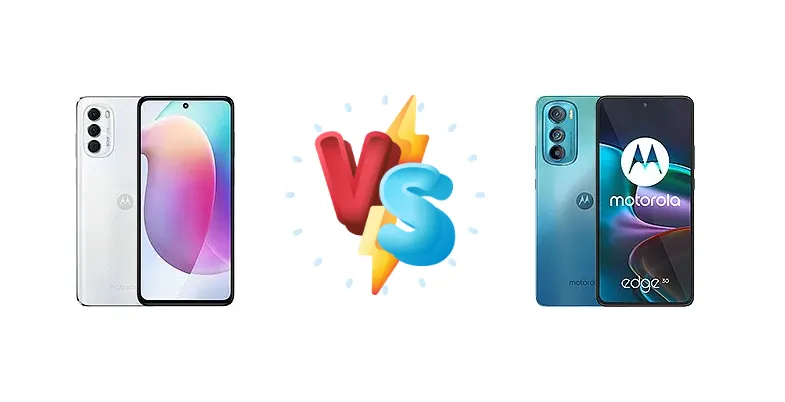
Motorola offers a range of smartphones catering to different budgets and needs. The Moto G71s and Edge 30 are two popular choices, but which one reigns supreme? This comprehensive comparison will delve into their key features, performance, and overall value to help you make an informed decision.
🏆 Quick Verdict
The Motorola Edge 30 offers a significant performance upgrade thanks to its Snapdragon 778G+ chipset and smoother display. While the G71s is a solid budget option, the Edge 30's superior speed, camera capabilities, and premium feel make it the clear winner for most users.
| Network |
|---|
| 2G bands | GSM 850 / 900 / 1800 / 1900 | GSM 850 / 900 / 1800 / 1900 |
| 3G bands | HSDPA 850 / 900 / 1700(AWS) / 1900 / 2100 | HSDPA 850 / 900 / 1700(AWS) / 1900 / 2100 |
| 4G bands | LTE | 1, 2, 3, 4, 5, 7, 8, 12, 13, 17, 20, 26, 28, 32, 38, 39, 40, 41, 41, 42, 43, 66 |
| 5G bands | SA/NSA | 1, 2, 3, 5, 7, 8, 20, 28, 38, 40, 41, 66, 78 SA/NSA/Sub6 |
| Speed | HSPA, LTE, 5G | HSPA, LTE, 5G |
| Technology | GSM / CDMA / HSPA / CDMA2000 / LTE / 5G | GSM / HSPA / LTE / 5G |
| | CDMA2000 1x | - |
| Launch |
|---|
| Announced | 2022, May 17 | 2022, April 27 |
| Status | Available. Released 2022, June 20 | Available. Released 2022, May 12 |
| Body |
|---|
| Build | Glass front, plastic frame, plastic back | Glass front (Gorilla Glass 3), plastic frame, plastic back |
| Dimensions | 160.9 x 74.5 x 8 mm (6.33 x 2.93 x 0.31 in) | 159.4 x 74.2 x 6.8 mm (6.28 x 2.92 x 0.27 in) |
| SIM | Nano-SIM + Nano-SIM | · Nano-SIM· Nano-SIM + Nano-SIM |
| Weight | 173 g (6.10 oz) | 155 g (5.47 oz) |
| | Water-repellent design | Water-repellent design |
| Display |
|---|
| Protection | - | Corning Gorilla Glass 3 |
| Resolution | 1080 x 2440 pixels (~404 ppi density) | 1080 x 2400 pixels, 20:9 ratio (~405 ppi density) |
| Size | 6.6 inches, 104.0 cm2 (~86.8% screen-to-body ratio) | 6.5 inches, 102.0 cm2 (~86.2% screen-to-body ratio) |
| Type | AMOLED, 1B colors, 120Hz | AMOLED, 1B colors, 144Hz, HDR10+ |
| Platform |
|---|
| CPU | Octa-core (2x2.2 GHz Kryo 660 Gold & 6x1.7 GHz Kryo 660 Silver) | Octa-core (1x2.5 GHz Cortex-A78 & 3x2.4 GHz Cortex-A78 & 4x1.9 GHz Cortex-A55) |
| Chipset | Qualcomm SM6375 Snapdragon 695 5G (6 nm) | Qualcomm SM7325-AE Snapdragon 778G+ 5G (6 nm) |
| GPU | Adreno 619 | Adreno 642L |
| OS | Android 12 | Android 12, upgradable to Android 14 |
| Memory |
|---|
| Card slot | microSDXC (dedicated slot) | No |
| Internal | 128GB 8GB RAM | 128GB 6GB RAM, 128GB 8GB RAM, 256GB 8GB RAM |
| | UFS | - |
| Main Camera |
|---|
| Features | LED flash, HDR, panorama | Dual-LED flash, HDR, panorama |
| Triple | 50 MP, f/1.8 (wide), 1/2.76", 0.64µm, PDAF, OIS
8 MP, f/2.2, 121˚ (ultrawide), 1/4.0", 1.12µm
2 MP (macro) | 50 MP, f/1.8, (wide), 1/1.55", 1.0µm, multi-directional PDAF, OIS
50 MP, f/2.2, 118˚ (ultrawide), 1/2.76", 0.64µm, PDAF
Auxiliary lens |
| Video | 1080p@30fps | 4K@30fps, 1080p@30/60/120fps, 720p@960fps, HDR10, gyro-EIS |
| Selfie camera |
|---|
| Features | - | HDR |
| Single | 16 MP, f/2.2, 17mm (ultrawide), 1.0µm | 32 MP, f/2.3, (wide), 0.7µm |
| Video | 1080p@30fps | 4K@30fps, 1080p@30/120fps |
| Sound |
|---|
| 3.5mm jack | Yes | No |
| 35mm jack | Yes | No |
| Loudspeaker | Yes, with stereo speakers | Yes, with stereo speakers |
| Comms |
|---|
| Bluetooth | 5.1, A2DP, LE | 5.2, A2DP, LE, aptX HD, aptX Adaptive |
| NFC | No | Yes |
| Positioning | GPS, GLONASS, GALILEO | GPS, GLONASS, BDS, GALILEO |
| Radio | No | No |
| USB | USB Type-C 2.0 | USB Type-C 2.0 |
| WLAN | Wi-Fi 802.11 a/b/g/n/ac, dual-band, Wi-Fi Direct | Wi-Fi 802.11 a/b/g/n/ac/6e, dual-band, Wi-Fi Direct |
| Features |
|---|
| Sensors | Fingerprint (side-mounted), accelerometer, gyro, proximity, compass | Fingerprint (under display, optical), accelerometer, gyro, proximity, compass |
| Battery |
|---|
| Charging | 33W wired | 33W wired |
| Type | Li-Po 5000 mAh | Li-Po 4020 mAh |
| Misc |
|---|
| Colors | Black, White | Meteor Grey, Supermoon Silver, Aurora Green |
| Models | - | XT2203-1 |
| Price | About 240 EUR | $ 529.00 / € 168.00 |
Motorola Moto G71s
- Large 6.8-inch display
- Decent battery life
- Affordable price
- 120Hz refresh rate
- Less powerful processor
- IPS LCD display (not as vibrant as OLED)
- Slower performance
- Less refined camera
Motorola Edge 30
- Powerful Snapdragon 778G+ processor
- Vibrant OLED display
- 144Hz refresh rate
- Superior camera performance
- Premium design and build quality
- Compact and lightweight
- Higher price
- Smaller battery compared to some competitors
- No expandable storage
Display Comparison
The Edge 30 boasts a 6.5-inch OLED display with a 144Hz refresh rate, offering vibrant colors and incredibly smooth scrolling. The G71s features a 6.8-inch IPS LCD display with a 120Hz refresh rate. While the G71s has a larger screen, the Edge 30's OLED technology and higher refresh rate provide a noticeably superior visual experience.
Camera Comparison
Both phones offer capable camera systems, but the Edge 30 generally produces better images. The Edge 30's image processing is more refined, resulting in more detailed and vibrant photos. While the G71s has a 50MP main sensor, the Edge 30's overall camera performance is superior.
Performance
The Snapdragon 778G+ in the Edge 30 is a considerable step up from the Snapdragon 695 in the G71s. Expect faster app loading times, smoother multitasking, and better gaming performance on the Edge 30. The Edge 30's Cortex-A78 cores provide a significant boost in processing power.
Battery Life
Both devices offer similar battery life, typically lasting a full day with moderate usage. Charging speeds are identical at 33W wired, providing relatively quick top-ups. Neither phone excels in battery performance, but they are both adequate.
Buying Guide
The Motorola Moto G71s is ideal for budget-conscious users who prioritize a large display and decent battery life. The Motorola Edge 30 is perfect for those seeking a faster, more premium experience with a better camera and a more compact design, willing to spend a bit more.
Frequently Asked Questions
❓ Is the Motorola Edge 30 worth the extra money?
Yes, if performance and camera quality are important to you. The Edge 30 offers a significantly better experience than the G71s.
❓ Does the Moto G71s have expandable storage?
No, neither phone offers expandable storage via microSD card.
❓ What type of display does each phone have?
The Moto G71s has an IPS LCD display, while the Edge 30 has an OLED display.