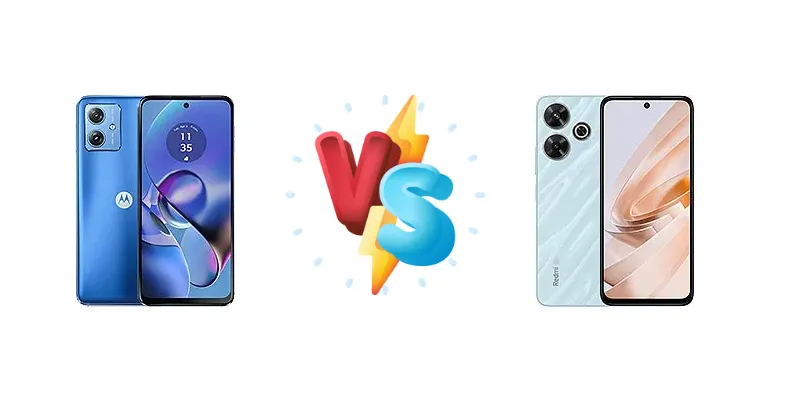
The Motorola Moto G64 and Xiaomi Redmi Note 13R represent compelling options in the increasingly competitive sub-$250 smartphone market. The G64 leverages MediaTek's Dimensity 7025, while the Redmi Note 13R opts for Qualcomm's Snapdragon 4+ Gen 2. This comparison dissects their key differences to determine which device offers the best blend of performance, battery life, and value.
🏆 Quick Verdict
For the average user prioritizing sustained performance and potentially better gaming, the Motorola Moto G64 emerges as the stronger choice. Its Dimensity 7025, built on a 6nm process, offers a slight edge in CPU and GPU capabilities, despite the Redmi Note 13R's more efficient 4nm Snapdragon.
| Network |
|---|
| 2G bands | GSM 850 / 900 / 1800 / 1900 | GSM 850 / 900 / 1800 / 1900 |
| 3G bands | HSDPA 800 / 850 / 900 / 1900 / 2100 | HSDPA 850 / 900 / 2100 |
| 4G bands | 1, 2, 3, 5, 7, 8, 18, 19, 20, 26, 28, 32, 38, 40, 41, 42 | 1, 3, 5, 8, 34, 38, 39, 40, 41 |
| 5G bands | 1, 2, 3, 5, 7, 8, 20, 28, 38, 40, 41, 66, 77, 78 SA/NSA | 1, 5, 8, 28, 41, 78 SA/NSA |
| Speed | HSPA, LTE, 5G | HSPA, LTE, 5G |
| Technology | GSM / HSPA / LTE / 5G | GSM / CDMA / HSPA / EVDO / LTE / 5G |
| Launch |
|---|
| Announced | 2024, April 11 | 2024, May 17 |
| Status | Available. Released 2024, April 23 | Available. Released 2024, May 17 |
| Body |
|---|
| Build | Glass front, plastic back, plastic frame | Glass front, plastic frame, glass back |
| Dimensions | 161.6 x 73.8 x 8.9 mm (6.36 x 2.91 x 0.35 in) | 168.6 x 76.3 x 8.2 mm (6.64 x 3.00 x 0.32 in) |
| SIM | Nano-SIM + Nano-SIM | Nano-SIM + Nano-SIM |
| Weight | 192 g (6.77 oz) | 205 g (7.23 oz) |
| Display |
|---|
| Resolution | 1080 x 2400 pixels, 20:9 ratio (~405 ppi density) | 1080 x 2460 pixels (~396 ppi density) |
| Size | 6.5 inches, 102.0 cm2 (~85.5% screen-to-body ratio) | 6.79 inches, 109.5 cm2 (~85.1% screen-to-body ratio) |
| Type | IPS LCD, 120Hz | IPS LCD, 120Hz, 550 nits |
| Platform |
|---|
| CPU | Octa-core (2x2.5 GHz Cortex-A78 & 6x2.0 GHz Cortex-A55) | Octa-core (2x2.3 GHz Cortex-A78 & 6x1.95 GHz Cortex-A55) |
| Chipset | Mediatek Dimensity 7025 (6 nm) | Qualcomm SM4450 Snapdragon 4+ Gen 2 (4 nm) |
| GPU | IMG BXM-8-256 | Adreno 613 |
| OS | Android 14, planned upgrade to Android 15 | Android 14, HyperOS |
| Memory |
|---|
| Card slot | microSDXC (uses shared SIM slot) | No |
| Internal | 128GB 8GB RAM, 256GB 12GB RAM | 128GB 6GB RAM, 128GB 8GB RAM, 256GB 8GB RAM, 256GB 12GB RAM, 512GB 12GB RAM |
| Main Camera |
|---|
| Dual | 50 MP, f/1.8 (wide), 0.61µm, PDAF, OIS
8 MP, f/2.2, 118˚ (ultrawide), 1.12µm, AF | 50 MP, f/1.8, (wide), 1/2.76", 0.64µm, PDAF
2 MP (macro) |
| Features | LED flash, HDR, panorama | LED flash, HDR |
| Video | 1080p@30fps | 1080p@30fps |
| Selfie camera |
|---|
| Features | HDR | - |
| Single | 16 MP, f/2.4, (wide), 1.0µm | 8 MP, (wide), 1/4.0", 1.12µm |
| Video | 1080p@30fps | 1080p@30fps |
| Sound |
|---|
| 35mm jack | Yes | Yes |
| Loudspeaker | Yes, with stereo speakers | Yes |
| Comms |
|---|
| Bluetooth | 5.3, A2DP, LE | 5.3, A2DP, LE |
| Infrared port | - | Yes |
| NFC | Yes | Yes |
| Positioning | GPS, GLONASS, GALILEO, QZSS | GPS, GLONASS, GALILEO, BDS |
| Radio | FM radio | No |
| USB | USB Type-C 2.0, OTG | USB Type-C |
| WLAN | Wi-Fi 802.11 a/b/g/n/ac, dual-band | Wi-Fi 802.11 a/b/g/n/ac, dual-band |
| Features |
|---|
| Sensors | Fingerprint (side-mounted), accelerometer, gyro, proximity, compass | Fingerprint (side-mounted), accelerometer, compass |
| Battery |
|---|
| Charging | 30W wired, PD3.0, QC3+, 50% in 33 min
Reverse wired | 33W wired |
| Type | 6000 mAh | 5030 mAh |
| Misc |
|---|
| Colors | Mint Green, Pearl Blue, Ice Lilac | Black, Blue, Silver |
| Models | - | 2406ERN9CC |
| Price | ₹ 13,499 | About 180 EUR |
Motorola Moto G64
- Potentially higher CPU/GPU performance with Dimensity 7025
- Faster charging with PD3.0 and QC3+ support
- Reverse wired charging capability
- 6nm process less efficient than Redmi Note 13R’s 4nm
- Potential for more thermal throttling under sustained load
Xiaomi Redmi Note 13R
- More power-efficient Snapdragon 4+ Gen 2 (4nm)
- Potentially longer battery life for everyday use
- Likely competitive pricing
- Slower charging speed (33W without fast charging protocols)
- Potentially lower peak performance compared to Dimensity 7025
Display Comparison
Display specifications are not provided in the context data. However, given the price bracket, both devices likely feature 6.6-6.7 inch LCD panels with FHD+ resolution. The absence of LTPO technology suggests standard refresh rates (likely 90Hz or 60Hz). Display quality will likely be a differentiating factor, with potential variations in color accuracy and peak brightness. We anticipate the Redmi Note 13R may have a slight edge in color calibration, given Xiaomi's historical focus on display tuning.
Camera Comparison
Camera details are limited. Both phones likely feature a primary camera, ultrawide, and potentially a macro lens. The sensor size of the main camera will be the most significant differentiator. Without specific sensor information, it’s difficult to definitively declare a winner. Image processing algorithms will also play a crucial role. Xiaomi’s image processing tends to be more saturated, while Motorola often aims for a more natural look. The absence of Optical Image Stabilization (OIS) on either device suggests reliance on software stabilization.
Performance
The core of the difference lies in the chipsets. The Motorola Moto G64’s Dimensity 7025 (6nm) features a 2x2.5 GHz Cortex-A78 and 6x2.0 GHz Cortex-A55 configuration. The Xiaomi Redmi Note 13R’s Snapdragon 4+ Gen 2 (4nm) has a 2x2.3 GHz Cortex-A78 and 6x1.95 GHz Cortex-A55 setup. While clock speeds are similar, the 4nm process of the Snapdragon offers superior transistor density and, crucially, better power efficiency. However, the Dimensity 7025’s slightly higher CPU clock speeds and potentially more powerful GPU architecture could translate to a noticeable performance advantage in demanding applications. The 6nm process, while less efficient than 4nm, still provides a good balance between performance and power consumption. The impact of RAM speed (LPDDR4x vs LPDDR5x, assumed) is not specified, but faster RAM would benefit the G64.
Battery Life
The Redmi Note 13R’s 33W charging is slower than the Moto G64’s 30W charging, despite the lower wattage. This is due to the inclusion of PD3.0 and QC3+ support on the G64, allowing for more efficient power delivery. The G64 claims 50% charge in 33 minutes. While battery capacity isn’t specified, the Snapdragon 4+ Gen 2’s efficiency could offset a potentially smaller battery in the Redmi Note 13R, providing comparable real-world battery life. The G64 also offers reverse wired charging, a feature absent on the Redmi Note 13R.
Buying Guide
Buy the Motorola Moto G64 if you need a phone capable of handling moderately demanding games and multitasking without significant slowdowns. Its processor provides a performance boost for users who frequently switch between apps or enjoy mobile gaming. Buy the Xiaomi Redmi Note 13R if you prioritize power efficiency and potentially longer battery life during everyday tasks like browsing and social media. The Snapdragon 4+ Gen 2’s 4nm process offers improved efficiency, making it ideal for lighter users.
Frequently Asked Questions
❓ Will the Dimensity 7025 in the Moto G64 overheat during prolonged gaming sessions?
While the Dimensity 7025 is a capable chip, the 6nm process means it will generate more heat than the Redmi Note 13R’s 4nm Snapdragon. Expect some thermal throttling during extended gaming, but the phone should manage heat adequately for typical gaming durations. Active cooling solutions are not present in this price range.
❓ How much faster is the charging on the Motorola Moto G64 compared to the Redmi Note 13R?
The Moto G64 supports PD3.0 and QC3+ alongside its 30W charging, allowing it to deliver power more efficiently than the Redmi Note 13R’s standard 33W charging. Motorola claims 50% charge in 33 minutes, suggesting a faster overall charging experience despite the lower wattage.
❓ Is the Snapdragon 4+ Gen 2 in the Redmi Note 13R powerful enough for demanding apps like video editing?
The Snapdragon 4+ Gen 2 is a solid performer for everyday tasks, but it may struggle with intensive applications like video editing. Expect longer processing times and potential lag when working with large files. The Dimensity 7025 in the Moto G64 would be a better choice for users who frequently engage in such tasks.