
Moto G64 vs. Samsung Galaxy A35: A Detailed Comparison of Mid-Range Contenders
| Phones Images | |||||
|---|---|---|---|---|---|
|
🏆 Quick Verdict
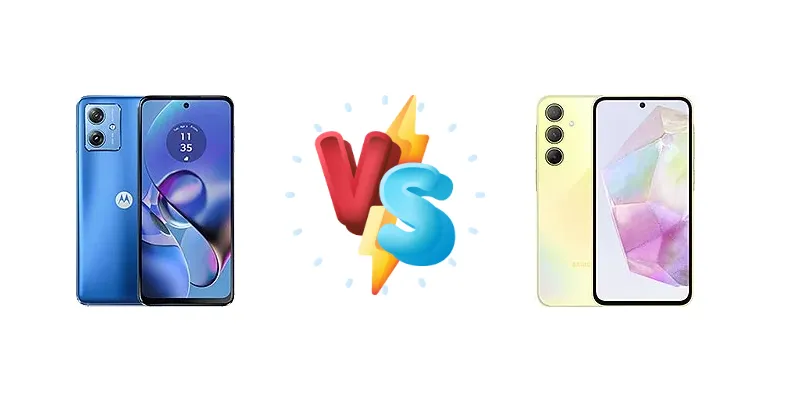
For users prioritizing raw performance and faster charging, the Motorola Moto G64 is the better choice. Its Dimensity 7025, built on a 6nm process, offers a slight edge in CPU performance. However, the Samsung Galaxy A35 excels with its brighter display and longer battery life in active use, making it ideal for media consumption and all-day usability.
| PHONES | ||
|---|---|---|
| Phone Names | Motorola Moto G64 | Samsung Galaxy A35 |
| Network | ||
|---|---|---|
| 2G bands | GSM 850 / 900 / 1800 / 1900 | GSM 850 / 900 / 1800 / 1900 |
| 3G bands | HSDPA 800 / 850 / 900 / 1900 / 2100 | HSDPA 850 / 900 / 1700(AWS) / 1900 / 2100 |
| 4G bands | 1, 2, 3, 5, 7, 8, 18, 19, 20, 26, 28, 32, 38, 40, 41, 42 | 1, 2, 3, 4, 5, 7, 8, 12, 13, 17, 20, 25, 26, 28, 32, 38, 40, 41, 66 |
| 5G bands | 1, 2, 3, 5, 7, 8, 20, 28, 38, 40, 41, 66, 77, 78 SA/NSA | 1, 3, 5, 7, 8, 26, 28, 40, 41, 66, 77, 78 SA/NSA/Sub6 |
| Speed | HSPA, LTE, 5G | HSPA, LTE, 5G |
| Technology | GSM / HSPA / LTE / 5G | GSM / HSPA / LTE / 5G |
| Launch | ||
|---|---|---|
| Announced | 2024, April 11 | 2024, March 11 |
| Status | Available. Released 2024, April 23 | Available. Released 2024, March 15 |
| Body | ||
|---|---|---|
| Build | Glass front, plastic back, plastic frame | Glass front (Gorilla Glass Victus+), plastic frame, glass back |
| Dimensions | 161.6 x 73.8 x 8.9 mm (6.36 x 2.91 x 0.35 in) | 161.7 x 78 x 8.2 mm (6.37 x 3.07 x 0.32 in) |
| SIM | Nano-SIM + Nano-SIM | · Nano-SIM + eSIM· Nano-SIM + Nano-SIM |
| Weight | 192 g (6.77 oz) | 209 g (7.37 oz) |
| Display | ||
|---|---|---|
| Protection | - | Corning Gorilla Glass Victus+ |
| Resolution | 1080 x 2400 pixels, 20:9 ratio (~405 ppi density) | 1080 x 2340 pixels, 19.5:9 ratio (~390 ppi density) |
| Size | 6.5 inches, 102.0 cm2 (~85.5% screen-to-body ratio) | 6.6 inches, 106.9 cm2 (~84.8% screen-to-body ratio) |
| Type | IPS LCD, 120Hz | Super AMOLED, 120Hz, 1000 nits (HBM) |
| Platform | ||
|---|---|---|
| CPU | Octa-core (2x2.5 GHz Cortex-A78 & 6x2.0 GHz Cortex-A55) | Octa-core (4x2.4 GHz Cortex-A78 & 4x2.0 GHz Cortex-A55) |
| Chipset | Mediatek Dimensity 7025 (6 nm) | Exynos 1380 (5 nm) |
| GPU | IMG BXM-8-256 | Mali-G68 MP5 |
| OS | Android 14, planned upgrade to Android 15 | Android 14, up to 4 major Android upgrades, One UI 7 |
| Memory | ||
|---|---|---|
| Card slot | microSDXC (uses shared SIM slot) | microSDXC (uses shared SIM slot) |
| Internal | 128GB 8GB RAM, 256GB 12GB RAM | 128GB 4GB RAM, 128GB 6GB RAM, 128GB 8GB RAM, 256GB 6GB RAM, 256GB 8GB RAM, 256GB 12GB RAM |
| Main Camera | ||
|---|---|---|
| Dual | 50 MP, f/1.8 (wide), 0.61µm, PDAF, OIS 8 MP, f/2.2, 118˚ (ultrawide), 1.12µm, AF | - |
| Features | LED flash, HDR, panorama | LED flash, panorama, HDR |
| Triple | - | 50 MP, f/1.8, (wide), 1/1.96", PDAF, OIS 8 MP, f/2.2, 123˚, (ultrawide), 1/4.0", 1.12µm 5 MP (macro) |
| Video | 1080p@30fps | 4K@30fps, 1080p@30/60fps, gyro-EIS |
| Selfie camera | ||
|---|---|---|
| Features | HDR | - |
| Single | 16 MP, f/2.4, (wide), 1.0µm | 13 MP, f/2.2, (wide), 1/3.06", 1.12µm |
| Video | 1080p@30fps | 4K@30fps, 1080p@30fps |
| Sound | ||
|---|---|---|
| 35mm jack | Yes | No |
| Loudspeaker | Yes, with stereo speakers | Yes, with stereo speakers |
| Comms | ||
|---|---|---|
| Bluetooth | 5.3, A2DP, LE | 5.3, A2DP, LE |
| NFC | Yes | Yes (market/region dependent) |
| Positioning | GPS, GLONASS, GALILEO, QZSS | GPS, GALILEO, GLONASS, BDS, QZSS |
| Radio | FM radio | No |
| USB | USB Type-C 2.0, OTG | USB Type-C 2.0, OTG |
| WLAN | Wi-Fi 802.11 a/b/g/n/ac, dual-band | Wi-Fi 802.11 a/b/g/n/ac/6, dual-band, Wi-Fi Direct |
| Features | ||
|---|---|---|
| Sensors | Fingerprint (side-mounted), accelerometer, gyro, proximity, compass | Fingerprint (under display, optical), accelerometer, gyro, compass |
| Battery | ||
|---|---|---|
| Charging | 30W wired, PD3.0, QC3+, 50% in 33 min Reverse wired | 25W wired |
| Type | 6000 mAh | Li-Ion 5000 mAh |
| Misc | ||
|---|---|---|
| Colors | Mint Green, Pearl Blue, Ice Lilac | Iceblue, Lilac, Navy, Lemon |
| Models | - | SM-A356E, SM-A356E/DS, SM-A356B, SM-A356B/DS, SM-A356U, SM-A356U1 |
| Price | ₹ 13,499 | $ 138.00 / C$ 419.99 / £ 205.99 / € 259.99 / ₹ 18,299 |
| SAR | - | 0.81 W/kg (head) |
| SAR EU | - | 0.44 W/kg (head) 0.92 W/kg (body) |
Motorola Moto G64
- Faster 30W charging with PD3.0/QC3+ support
- Potentially higher CPU performance due to clock speeds
- Reverse wired charging capability
- Likely lower peak display brightness
- Battery life likely shorter than the A35
Samsung Galaxy A35
- Brighter 1024 nit display for outdoor visibility
- Longer battery life in active use (12:26h)
- Efficient 5nm Exynos 1380 chipset
- Slower 25W charging
- Lacks reverse wireless charging
Display Comparison
The Samsung Galaxy A35 immediately stands out with its measured peak brightness of 1024 nits, significantly exceeding what we’d expect from the Moto G64 (spec not provided, but typically lower in this segment). This translates to superior visibility outdoors. While the Moto G64’s panel technology isn’t specified, the A35’s likely utilizes Samsung’s well-regarded AMOLED technology, offering vibrant colors and deep blacks. Bezels are expected to be comparable, but the A35’s higher brightness gives it a clear advantage for users who spend significant time outdoors or in brightly lit environments.
Camera Comparison
Without detailed camera specs, a direct comparison is challenging. However, the market positioning suggests the A35 will likely prioritize image processing and software features. Both phones will likely feature a primary camera, ultrawide, and potentially a macro lens (though the usefulness of 2MP macro lenses is questionable). The Exynos 1380’s ISP (Image Signal Processor) is generally capable of producing detailed and well-balanced images. The Moto G64 will rely on Mediatek’s ISP, which has improved significantly in recent generations. The presence or absence of Optical Image Stabilization (OIS) on the primary sensor will be a crucial differentiator, impacting low-light performance and video stabilization.
Performance
Both phones employ an octa-core CPU configuration with a similar core layout – four Cortex-A78 cores for performance and four Cortex-A55 cores for efficiency. However, the key difference lies in the chipset and fabrication process. The Moto G64’s Mediatek Dimensity 7025 is built on a 6nm process, while the A35’s Exynos 1380 uses a more efficient 5nm node. This 5nm process gives the Exynos a theoretical edge in power efficiency, but the Dimensity 7025 boasts slightly higher clock speeds on its performance cores (2.5 GHz vs 2.4 GHz). In real-world use, this translates to a potentially snappier experience on the G64 for bursty tasks, while the A35 may maintain performance for longer under sustained load. The A35’s GPU performance is also likely to be slightly better, given the Exynos 1380’s architecture.
Battery Life
The Samsung Galaxy A35 demonstrates a clear advantage in battery endurance, achieving 12 hours and 26 minutes of active use. While the Moto G64’s battery capacity isn’t specified, the A35’s result is impressive. The A35’s 25W charging is slower than the Moto G64’s 30W wired charging, which supports PD3.0 and QC3+ and can reach 50% charge in just 33 minutes. The G64 also offers reverse wired charging, a feature absent on the A35, allowing it to top up other devices. The faster charging on the G64 partially offsets the A35’s longer battery life, but users prioritizing minimal downtime will lean towards the Motorola.
Buying Guide
Buy the Motorola Moto G64 if you need a phone that can handle demanding apps and games without significant slowdown, and if fast charging is a priority. It’s the pick for users who frequently multitask or enjoy mobile gaming. Buy the Samsung Galaxy A35 if you prefer a phone with a brighter, more visually appealing display and longer battery life for everyday tasks like browsing, streaming, and social media. It’s the better option for users who value a polished software experience and extended usability.