
Moto G64 vs. Samsung Galaxy A25: A Detailed Comparison for Budget Buyers
| Phones Images | |||||
|---|---|---|---|---|---|
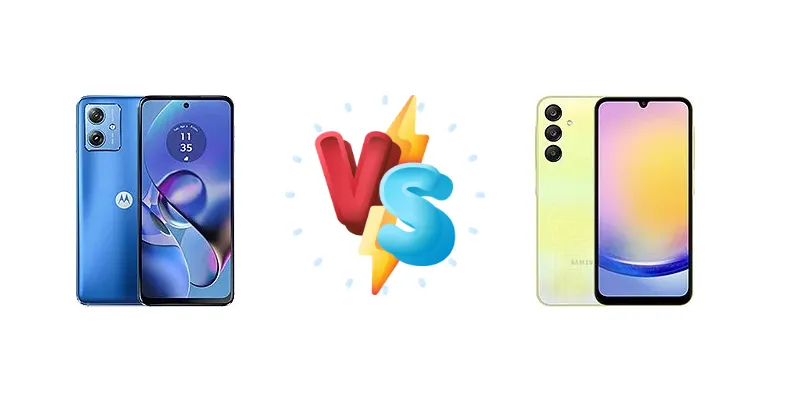
|
🏆 Quick Verdict
For users prioritizing raw performance and faster charging, the Motorola Moto G64 is the better choice. However, the Samsung Galaxy A25 excels in display brightness and offers significantly longer battery life, making it ideal for media consumption and all-day use.
| PHONES | ||
|---|---|---|
| Phone Names | Motorola Moto G64 | Samsung Galaxy A25 |
| Network | ||
|---|---|---|
| 2G bands | GSM 850 / 900 / 1800 / 1900 | GSM 850 / 900 / 1800 / 1900 |
| 3G bands | HSDPA 800 / 850 / 900 / 1900 / 2100 | HSDPA 850 / 900 / 1700(AWS) / 1900 / 2100 |
| 4G bands | 1, 2, 3, 5, 7, 8, 18, 19, 20, 26, 28, 32, 38, 40, 41, 42 | 1, 2, 3, 4, 5, 7, 8, 12, 13, 17, 20, 26, 28, 38, 40, 41, 66 |
| 5G bands | 1, 2, 3, 5, 7, 8, 20, 28, 38, 40, 41, 66, 77, 78 SA/NSA | 1, 3, 5, 7, 8, 26, 28, 40, 41, 66, 77, 78 SA/NSA/Sub6 |
| Speed | HSPA, LTE, 5G | HSPA, LTE, 5G |
| Technology | GSM / HSPA / LTE / 5G | GSM / HSPA / LTE / 5G |
| Launch | ||
|---|---|---|
| Announced | 2024, April 11 | 2023, December 11 |
| Status | Available. Released 2024, April 23 | Available. Released 2023, December 16 |
| Body | ||
|---|---|---|
| Build | Glass front, plastic back, plastic frame | Glass front, plastic frame, plastic back |
| Dimensions | 161.6 x 73.8 x 8.9 mm (6.36 x 2.91 x 0.35 in) | 161 x 76.5 x 8.3 mm (6.34 x 3.01 x 0.33 in) |
| SIM | Nano-SIM + Nano-SIM | · Nano-SIM· Nano-SIM + Nano-SIM |
| Weight | 192 g (6.77 oz) | 197 g (6.95 oz) |
| Display | ||
|---|---|---|
| Resolution | 1080 x 2400 pixels, 20:9 ratio (~405 ppi density) | 1080 x 2340 pixels, 19.5:9 ratio (~396 ppi density) |
| Size | 6.5 inches, 102.0 cm2 (~85.5% screen-to-body ratio) | 6.5 inches, 103.7 cm2 (~84.2% screen-to-body ratio) |
| Type | IPS LCD, 120Hz | Super AMOLED, 120Hz, 1000 nits (HBM) |
| Platform | ||
|---|---|---|
| CPU | Octa-core (2x2.5 GHz Cortex-A78 & 6x2.0 GHz Cortex-A55) | Octa-core (2x2.4 GHz Cortex-A78 & 6x2.0 GHz Cortex-A55) |
| Chipset | Mediatek Dimensity 7025 (6 nm) | Exynos 1280 (5 nm) |
| GPU | IMG BXM-8-256 | Mali-G68 |
| OS | Android 14, planned upgrade to Android 15 | Android 14, up to 4 major Android upgrades, One UI 7 |
| Memory | ||
|---|---|---|
| Card slot | microSDXC (uses shared SIM slot) | microSDXC (uses shared SIM slot) |
| Internal | 128GB 8GB RAM, 256GB 12GB RAM | 128GB 4GB RAM, 128GB 6GB RAM, 128GB 8GB RAM, 256GB 6GB RAM, 256GB 8GB RAM |
| Main Camera | ||
|---|---|---|
| Dual | 50 MP, f/1.8 (wide), 0.61µm, PDAF, OIS 8 MP, f/2.2, 118˚ (ultrawide), 1.12µm, AF | - |
| Features | LED flash, HDR, panorama | LED flash, panorama, HDR |
| Triple | - | 50 MP, f/1.8, 27mm (wide), 1/2.76", 0.64µm, PDAF, OIS 8 MP, f/2.2, 120˚ (ultrawide), 1/4", 1.12µm 2 MP (macro) |
| Video | 1080p@30fps | 4K@30fps, 1080p@30/60fps, gyro-EIS |
| Selfie camera | ||
|---|---|---|
| Features | HDR | - |
| Single | 16 MP, f/2.4, (wide), 1.0µm | 13 MP, f/2.2, (wide), 1/3.06", 1.12µm |
| Video | 1080p@30fps | 1080p@30fps |
| Sound | ||
|---|---|---|
| 35mm jack | Yes | Yes |
| Loudspeaker | Yes, with stereo speakers | Yes, with stereo speakers |
| Comms | ||
|---|---|---|
| Bluetooth | 5.3, A2DP, LE | 5.3, A2DP, LE |
| NFC | Yes | Yes (market/region dependent) |
| Positioning | GPS, GLONASS, GALILEO, QZSS | GPS, GLONASS, GALILEO, BDS, QZSS |
| Radio | FM radio | Market/region dependent |
| USB | USB Type-C 2.0, OTG | USB Type-C 2.0 |
| WLAN | Wi-Fi 802.11 a/b/g/n/ac, dual-band | Wi-Fi 802.11 a/b/g/n/ac, dual-band, Wi-Fi Direct |
| Features | ||
|---|---|---|
| Sensors | Fingerprint (side-mounted), accelerometer, gyro, proximity, compass | Fingerprint (side-mounted), accelerometer, gyro, compass |
| Battery | ||
|---|---|---|
| Charging | 30W wired, PD3.0, QC3+, 50% in 33 min Reverse wired | 25W wired |
| Type | 6000 mAh | 5000 mAh |
| Misc | ||
|---|---|---|
| Colors | Mint Green, Pearl Blue, Ice Lilac | Brave Black, Personality Yellow, Fantasy Blue, Optimistic Blue |
| Models | - | SM-A256E, SM-A256E/DS, SM-A256E/DSN, SM-A256B, SM-A256B/DS, SM-A256B/DSN, SM-A256U, SM-A256U1 |
| Price | ₹ 13,499 | € 175.99 / $ 120.32 / ₹ 18,399 |
| SAR EU | - | 0.46 W/kg (head) 1.19 W/kg (body) |
Motorola Moto G64
- Faster processor for smoother performance
- Faster 30W charging with Quick Charge support
- Potentially better thermal management due to 6nm process
- Likely shorter battery life compared to the A25
- Display brightness likely lower than the A25
Samsung Galaxy A25
- Exceptional battery life (10:19h active use)
- Brighter display for better outdoor visibility
- Samsung's refined software and image processing
- Slower processor compared to the G64
- Slower 25W charging
Display Comparison
The Samsung Galaxy A25 boasts a significantly brighter display, reaching a measured 1030 nits. This is a substantial advantage over what we'd expect from the Moto G64, making the A25 far more usable outdoors in direct sunlight. While the G64's panel specifics are unknown, the A25's brightness alone is a major selling point. Both likely utilize LCD panels given the price point, but the A25's superior brightness is a clear win for visibility.
Camera Comparison
Detailed camera specs are limited, but the focus should be on the main sensors. Without knowing the sensor sizes, it's difficult to make a definitive judgment. However, Samsung's image processing is generally more refined, offering more consistent results. The inclusion of a 2MP macro camera on both devices is largely irrelevant; image quality from these sensors is typically poor. The A25's video capabilities are also likely superior due to Samsung's more advanced image signal processor (ISP).
Performance
Both the Moto G64 and Galaxy A25 utilize octa-core CPUs with a similar core configuration – two Cortex-A78 performance cores and six Cortex-A55 efficiency cores. However, the G64’s Mediatek Dimensity 7025, fabricated on a 6nm process, has a slight clock speed advantage (2.5 GHz vs 2.4 GHz) and a more modern architecture. The A25’s Exynos 1280 is built on a 5nm process, which *should* offer better efficiency, but the G64’s newer chipset architecture likely translates to better overall performance in CPU-intensive tasks. The 6nm Dimensity 7025 will likely exhibit less thermal throttling under sustained load.
Battery Life
The Samsung Galaxy A25 shines in battery life, achieving an impressive 10:19 hours of active use. While the Moto G64’s battery capacity is unknown, the A25’s endurance is a significant advantage. The G64 compensates with faster 30W charging (with PD3.0 and QC3+ support), allowing a 50% charge in just 33 minutes, compared to the A25’s slower 25W charging. This trade-off – longer runtime versus faster replenishment – is a key consideration.
Buying Guide
Buy the Motorola Moto G64 if you need a phone for demanding tasks like gaming or multitasking, and value faster charging speeds. Buy the Samsung Galaxy A25 if you prioritize a vibrant, easily visible display, exceptional battery endurance, and a more polished software experience, even if it means sacrificing some processing power.