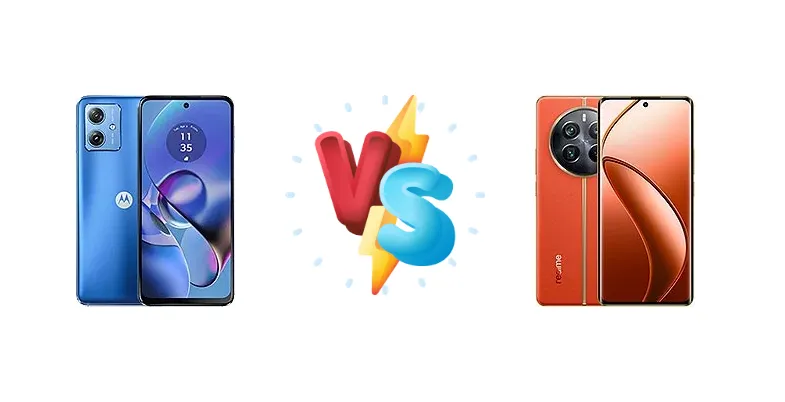
The mid-range smartphone market is fiercely competitive, and the Motorola Moto G64 and Realme 12 Pro+ represent compelling options for budget-conscious buyers. The G64 leverages MediaTek's Dimensity 7025, while the 12 Pro+ opts for Qualcomm's Snapdragon 7s Gen 2. This comparison dissects their key differences, focusing on performance, battery, and charging to determine which device delivers the best overall experience.
🏆 Quick Verdict
For the average user prioritizing fast charging and a brighter display, the Realme 12 Pro+ is the stronger choice. Its 67W charging significantly reduces downtime, and the 802 nits peak brightness enhances outdoor visibility. However, the Moto G64 offers a competitive processor and a potentially more efficient chipset.
| Network |
|---|
| 2G bands | GSM 850 / 900 / 1800 / 1900 | GSM 850 / 900 / 1800 / 1900 |
| 3G bands | HSDPA 800 / 850 / 900 / 1900 / 2100 | HSDPA 850 / 900 / 2100 |
| 4G bands | 1, 2, 3, 5, 7, 8, 18, 19, 20, 26, 28, 32, 38, 40, 41, 42 | 1, 3, 5, 8, 28, 40, 41 |
| 5G bands | 1, 2, 3, 5, 7, 8, 20, 28, 38, 40, 41, 66, 77, 78 SA/NSA | 1, 3, 5, 8, 28, 40, 41, 77, 78 SA/NSA |
| Speed | HSPA, LTE, 5G | HSPA, LTE, 5G |
| Technology | GSM / HSPA / LTE / 5G | GSM / HSPA / LTE / 5G |
| Launch |
|---|
| Announced | 2024, April 11 | 2024, January 29 |
| Status | Available. Released 2024, April 23 | Available. Released 2024, January 29 |
| Body |
|---|
| Build | Glass front, plastic back, plastic frame | - |
| Dimensions | 161.6 x 73.8 x 8.9 mm (6.36 x 2.91 x 0.35 in) | 161.5 x 74 x 8.8 mm (6.36 x 2.91 x 0.35 in) |
| SIM | Nano-SIM + Nano-SIM | Nano-SIM + Nano-SIM |
| Weight | 192 g (6.77 oz) | 196 g (6.91 oz) |
| Display |
|---|
| Resolution | 1080 x 2400 pixels, 20:9 ratio (~405 ppi density) | 1080 x 2412 pixels, 20:9 ratio (~394 ppi density) |
| Size | 6.5 inches, 102.0 cm2 (~85.5% screen-to-body ratio) | 6.7 inches, 108.0 cm2 (~90.4% screen-to-body ratio) |
| Type | IPS LCD, 120Hz | AMOLED, 1B colors, 120Hz, 800 nits (HBM), 950 nits (peak) |
| Platform |
|---|
| CPU | Octa-core (2x2.5 GHz Cortex-A78 & 6x2.0 GHz Cortex-A55) | Octa-core (4x2.40 GHz Cortex-A78 & 4x1.95 GHz Cortex-A55) |
| Chipset | Mediatek Dimensity 7025 (6 nm) | Qualcomm SM7435-AB Snapdragon 7s Gen 2 (4 nm) |
| GPU | IMG BXM-8-256 | Adreno 710 |
| OS | Android 14, planned upgrade to Android 15 | Android 14, Realme UI 5.0 |
| Memory |
|---|
| Card slot | microSDXC (uses shared SIM slot) | No |
| Internal | 128GB 8GB RAM, 256GB 12GB RAM | 128GB 8GB RAM, 256GB 8GB RAM, 256GB 12GB RAM, 512GB 12GB RAM |
| Main Camera |
|---|
| Dual | 50 MP, f/1.8 (wide), 0.61µm, PDAF, OIS
8 MP, f/2.2, 118˚ (ultrawide), 1.12µm, AF | - |
| Features | LED flash, HDR, panorama | LED flash, HDR, panorama |
| Triple | - | 50 MP, f/1.8, 24mm (wide), 1/1.56", 1.0µm, multi-directional PDAF, OIS
64 MP, f/2.8, 71mm, (periscope telephoto), 1/2.0", 0.7µm, PDAF, OIS, 3x optical zoom
8 MP, f/2.2, 16mm, 112˚ (ultrawide), 1/4.0", 1.12µm |
| Video | 1080p@30fps | 4K@30fps, 1080p@30/60/120fps, gyro-EIS |
| Selfie camera |
|---|
| Features | HDR | - |
| Single | 16 MP, f/2.4, (wide), 1.0µm | 32 MP, f/2.4, 22mm (wide) |
| Video | 1080p@30fps | 1080p@30fps |
| Sound |
|---|
| 35mm jack | Yes | No |
| Loudspeaker | Yes, with stereo speakers | Yes, with stereo speakers |
| Comms |
|---|
| Bluetooth | 5.3, A2DP, LE | 5.2, A2DP, LE |
| NFC | Yes | Yes (market/region dependent) |
| Positioning | GPS, GLONASS, GALILEO, QZSS | GPS, GLONASS, GALILEO, BDS, QZSS |
| Radio | FM radio | No |
| USB | USB Type-C 2.0, OTG | USB Type-C 2.0 |
| WLAN | Wi-Fi 802.11 a/b/g/n/ac, dual-band | Wi-Fi 802.11 a/b/g/n/ac/6, dual-band |
| Features |
|---|
| Sensors | Fingerprint (side-mounted), accelerometer, gyro, proximity, compass | Fingerprint (under display, optical), accelerometer, gyro, proximity, compass |
| Battery |
|---|
| Charging | 30W wired, PD3.0, QC3+, 50% in 33 min
Reverse wired | 67W wired, 50% in 19 min |
| Type | 6000 mAh | 5000 mAh |
| Misc |
|---|
| Colors | Mint Green, Pearl Blue, Ice Lilac | Submarine Blue, Navigator Beige, Explorer Red |
| Models | - | RMX3840, RMX3841 |
| Price | ₹ 13,499 | $ 465.00 / £ 299.00 / € 344.26 / ₹ 28,400 |
Motorola Moto G64
- Potentially more efficient 6nm Dimensity 7025 chipset.
- Competitive performance for everyday tasks.
- Reverse wired charging capability.
- Slower 30W charging.
- Likely lower peak display brightness.
Realme 12 Pro+
- Significantly faster 67W charging.
- Brighter 802 nits display for outdoor use.
- More efficient 4nm Snapdragon 7s Gen 2.
- Battery capacity not specified.
- Potential for higher thermal output under sustained load.
Display Comparison
The Realme 12 Pro+ boasts a significantly brighter display, reaching a measured 802 nits, compared to an unstated brightness for the Moto G64. This difference is crucial for outdoor visibility, giving the Realme a clear advantage in sunny conditions. While panel technology isn't specified for either, the Realme's higher peak brightness suggests a more advanced panel. Bezels are likely comparable given the price points, and color accuracy will depend on software calibration, a factor not detailed in the provided data.
Camera Comparison
Without detailed camera specifications beyond the presence of sensors, a direct comparison is limited. However, the market positioning of the Realme 12 Pro+ suggests a greater emphasis on camera capabilities. The Snapdragon 7s Gen 2's ISP (Image Signal Processor) is generally considered more advanced than the Dimensity 7025's, potentially leading to better image processing, especially in low-light conditions. The absence of sensor size information makes it difficult to assess image quality definitively, but the Realme's branding implies a more robust camera system.
Performance
The Realme 12 Pro+ utilizes the Qualcomm Snapdragon 7s Gen 2 (4nm), while the Moto G64 features the MediaTek Dimensity 7025 (6nm). The 4nm process node of the Snapdragon offers inherent advantages in power efficiency and thermal management compared to the 6nm Dimensity. While both CPUs feature octa-core architectures with Cortex-A78 performance cores, the Snapdragon’s configuration (4x2.40 GHz) is clocked slightly higher than the G64’s (2x2.5 GHz, 6x2.0 GHz). This suggests a potential edge in sustained performance for the Realme, particularly in demanding applications. The G64's higher clocked prime cores *could* offer a burst of speed, but the Snapdragon's efficiency is likely to win out in longer tasks.
Battery Life
The Realme 12 Pro+ demonstrates a clear advantage in charging speed with its 67W wired charging, achieving 50% charge in just 19 minutes. The Moto G64’s 30W charging takes 33 minutes for the same milestone. While the Realme 12 Pro+’s battery capacity isn’t specified, its active use score of 13:24h indicates strong battery life. The Dimensity 7025’s 6nm process *could* contribute to better efficiency, potentially offsetting a smaller battery capacity, but the Realme’s faster charging is a significant convenience factor.
Buying Guide
Buy the Motorola Moto G64 if you need a balanced performer with a focus on efficient processing for everyday tasks and moderate gaming. It’s ideal for users who don’t mind slightly slower charging in exchange for a potentially cooler running device. Buy the Realme 12 Pro+ if you prioritize rapid charging, a brighter screen for outdoor use, and a more streamlined user experience, even if it means potentially slightly higher thermal output during intensive tasks.
Frequently Asked Questions
❓ Will the Snapdragon 7s Gen 2 in the Realme 12 Pro+ handle demanding games like Genshin Impact at high settings?
The Snapdragon 7s Gen 2 is capable of running Genshin Impact, but expect to make some compromises on graphics settings. While it can handle high settings, maintaining a stable frame rate may require lowering the settings to medium or even low, depending on your desired level of smoothness. The 4nm process should help mitigate thermal throttling during extended gaming sessions.
❓ How does the charging speed difference impact daily use between the Moto G64 and Realme 12 Pro+?
The Realme 12 Pro+'s 67W charging is a game-changer for convenience. A quick 20-minute top-up can provide a substantial amount of battery life, ideal for users who frequently find themselves needing a boost throughout the day. The Moto G64’s 30W charging, while adequate, requires a longer commitment to reach a similar charge level.
❓ Is the Dimensity 7025 in the Moto G64 sufficient for multitasking and running multiple apps simultaneously?
The Dimensity 7025 is a capable processor for multitasking. Its octa-core architecture and ample RAM (though the amount isn't specified) should handle most everyday multitasking scenarios without significant slowdowns. However, extremely demanding applications or a large number of open apps simultaneously may push its limits.