
Motorola Moto G64 vs. Nothing Phone (2a) Plus: A Detailed Comparison
| Phones Images | |||||
|---|---|---|---|---|---|
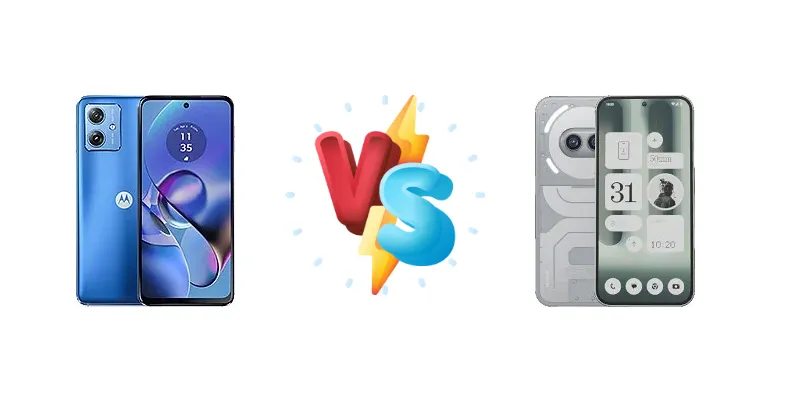
|
🏆 Quick Verdict
For the average user prioritizing a vibrant display and smoother performance, the Nothing Phone (2a) Plus is the superior choice. Its Dimensity 7350 Pro chipset and 1097 nit display offer a noticeable upgrade over the Moto G64’s Dimensity 7025 and less bright screen. However, the Moto G64 remains a strong contender for budget-conscious buyers.
| PHONES | ||
|---|---|---|
| Phone Names | Motorola Moto G64 | Nothing Phone (2a) Plus |
| Network | ||
|---|---|---|
| 2G bands | GSM 850 / 900 / 1800 / 1900 | GSM 850 / 900 / 1800 / 1900 |
| 3G bands | HSDPA 800 / 850 / 900 / 1900 / 2100 | HSDPA 800 / 850 / 900 / 1700(AWS) / 1900 / 2100 |
| 4G bands | 1, 2, 3, 5, 7, 8, 18, 19, 20, 26, 28, 32, 38, 40, 41, 42 | 1, 3, 4, 5, 7, 8, 18, 19, 20, 26, 28, 38, 39, 40, 41, 42, 66 |
| 5G bands | 1, 2, 3, 5, 7, 8, 20, 28, 38, 40, 41, 66, 77, 78 SA/NSA | 1, 3, 5, 7, 8, 20, 28, 38, 40, 41, 66, 77, 78 SA/NSA |
| Speed | HSPA, LTE, 5G | HSPA, LTE, 5G |
| Technology | GSM / HSPA / LTE / 5G | GSM / HSPA / LTE / 5G |
| Launch | ||
|---|---|---|
| Announced | 2024, April 11 | 2024, July 31 |
| Status | Available. Released 2024, April 23 | Available. Released 2024, August 03 |
| Body | ||
|---|---|---|
| Build | Glass front, plastic back, plastic frame | Glass front (Gorilla Glass 5), plastic frame, plastic back |
| Dimensions | 161.6 x 73.8 x 8.9 mm (6.36 x 2.91 x 0.35 in) | 161.7 x 76.3 x 8.5 mm (6.37 x 3.00 x 0.33 in) |
| SIM | Nano-SIM + Nano-SIM | Nano-SIM + Nano-SIM |
| Weight | 192 g (6.77 oz) | 190 g (6.70 oz) |
| Display | ||
|---|---|---|
| Protection | - | Corning Gorilla Glass 5 |
| Resolution | 1080 x 2400 pixels, 20:9 ratio (~405 ppi density) | 1080 x 2412 pixels, 20:9 ratio (~395 ppi density) |
| Size | 6.5 inches, 102.0 cm2 (~85.5% screen-to-body ratio) | 6.7 inches, 107.5 cm2 (~87.1% screen-to-body ratio) |
| Type | IPS LCD, 120Hz | AMOLED, 1B colors, 120Hz, 2160Hz PWM, HDR10+, 700 nits (typ), 1100 nits (HBM), 1300 nits (peak) |
| Platform | ||
|---|---|---|
| CPU | Octa-core (2x2.5 GHz Cortex-A78 & 6x2.0 GHz Cortex-A55) | Octa-core (2x3.0 GHz Cortex-A715 & 6x 2.0 GHz Cortex-A510) |
| Chipset | Mediatek Dimensity 7025 (6 nm) | Mediatek Dimensity 7350 Pro (4 nm) |
| GPU | IMG BXM-8-256 | Mali-G610 MC4 |
| OS | Android 14, planned upgrade to Android 15 | Android 14, up to 3 major Android upgrades, Nothing OS 3.0 |
| Memory | ||
|---|---|---|
| Card slot | microSDXC (uses shared SIM slot) | No |
| Internal | 128GB 8GB RAM, 256GB 12GB RAM | 256GB 8GB RAM, 256GB 12GB RAM |
| Main Camera | ||
|---|---|---|
| Dual | 50 MP, f/1.8 (wide), 0.61µm, PDAF, OIS 8 MP, f/2.2, 118˚ (ultrawide), 1.12µm, AF | 50 MP, f/1.9, 24mm (wide), 1/1.57", 1.0µm, PDAF, OIS 50 MP, f/2.2, 114˚ (ultrawide), 1/2.76", 0.64µm |
| Features | LED flash, HDR, panorama | LED flash, panorama, HDR |
| Video | 1080p@30fps | 4K@30fps, 1080p@60/120fps, gyro-EIS |
| Selfie camera | ||
|---|---|---|
| Features | HDR | HDR |
| Single | 16 MP, f/2.4, (wide), 1.0µm | 50 MP, f/2.2, (wide), 1/2.76" |
| Video | 1080p@30fps | 4K@30fps |
| Sound | ||
|---|---|---|
| 35mm jack | Yes | No |
| Loudspeaker | Yes, with stereo speakers | Yes, with stereo speakers |
| Comms | ||
|---|---|---|
| Bluetooth | 5.3, A2DP, LE | 5.3, A2DP, LE |
| NFC | Yes | Yes, 360˚ |
| Positioning | GPS, GLONASS, GALILEO, QZSS | GPS, GALILEO, GLONASS, BDS, QZSS |
| Radio | FM radio | No |
| USB | USB Type-C 2.0, OTG | USB Type-C 2.0, OTG |
| WLAN | Wi-Fi 802.11 a/b/g/n/ac, dual-band | Wi-Fi 802.11 a/b/g/n/ac/6, dual-band, Wi-Fi Direct |
| Features | ||
|---|---|---|
| Sensors | Fingerprint (side-mounted), accelerometer, gyro, proximity, compass | Fingerprint (under display, optical), accelerometer, gyro, proximity, compass |
| Battery | ||
|---|---|---|
| Charging | 30W wired, PD3.0, QC3+, 50% in 33 min Reverse wired | 50W wired, 50% in 21 min, 100% in 56 min |
| Type | 6000 mAh | 5000 mAh |
| Misc | ||
|---|---|---|
| Colors | Mint Green, Pearl Blue, Ice Lilac | Black, Grey |
| Models | - | A142P |
| Price | ₹ 13,499 | € 269.90 / ₹ 22,599 |
Motorola Moto G64
- More affordable price point
- Reverse wired charging capability
- Decent performance for everyday tasks
- Slower charging speeds
- Less powerful chipset
- Likely lower display brightness
Nothing Phone (2a) Plus
- Faster and more efficient Dimensity 7350 Pro chipset
- Significantly brighter display (1097 nits)
- Faster charging (50W)
- Higher price tag
- May not offer reverse wireless charging
- Potentially less battery capacity (unconfirmed)
Display Comparison
The Nothing Phone (2a) Plus immediately distinguishes itself with a peak brightness of 1097 nits, measured directly, offering significantly better visibility outdoors compared to the Moto G64 (brightness data unavailable, but expected to be lower based on segment). While both likely utilize LCD panels, the Nothing Phone (2a) Plus’s higher brightness translates to a more enjoyable viewing experience in all lighting conditions. The G64’s display specs are less defined, suggesting a more standard LCD experience. Bezels are expected to be comparable, but the Nothing Phone (2a) Plus’s overall display quality is a clear advantage.
Camera Comparison
Without detailed camera specs, a direct comparison is limited. However, the market positioning suggests the Nothing Phone (2a) Plus likely features a more sophisticated camera system. The Dimensity 7350 Pro’s ISP (Image Signal Processor) is more advanced, enabling better image processing and potentially superior low-light performance. While the Moto G64 likely offers a capable camera for everyday snapshots, the Nothing Phone (2a) Plus is expected to deliver more detailed and dynamic images. We can assume both phones will include standard features like HDR and portrait modes, but the Nothing Phone (2a) Plus’s processing power gives it an advantage.
Performance
The core difference lies in the chipsets: the Motorola Moto G64 features the Mediatek Dimensity 7025 (6nm), while the Nothing Phone (2a) Plus boasts the Dimensity 7350 Pro (4nm). The 4nm process node of the 7350 Pro is more efficient, leading to better thermal management and sustained performance under load. The CPU configuration also favors the Nothing Phone (2a) Plus, with 2x3.0 GHz Cortex-A715 cores versus the G64’s 2x2.5 GHz Cortex-A78 cores. This translates to faster app launch times and smoother multitasking. While both phones utilize 6x2.0 GHz cores for efficiency, the Nothing Phone (2a) Plus’s architecture provides a clear performance edge.
Battery Life
The Nothing Phone (2a) Plus demonstrates a significant advantage in charging speed, achieving 50% charge in just 21 minutes and 100% in 56 minutes with its 50W wired charging. The Moto G64’s 30W charging takes 33 minutes to reach 50%, indicating a slower overall charging experience. The Nothing Phone (2a) Plus also boasts an impressive active use battery score of 16:34h, suggesting excellent battery life. While the Moto G64’s battery capacity is not specified, the faster charging and longer active use time of the Nothing Phone (2a) Plus make it the clear winner in this category.
Buying Guide
Buy the Motorola Moto G64 if you need a reliable, affordable smartphone with decent performance for everyday tasks and appreciate the convenience of reverse wired charging. Buy the Nothing Phone (2a) Plus if you prioritize a brighter, more responsive display, faster processing for demanding apps and games, and quicker charging speeds, even if it means spending a bit more.