
Motorola Moto G64 vs. Moto G54: A Deep Dive into Dimensity Power and Value
| Phones Images | |||||
|---|---|---|---|---|---|
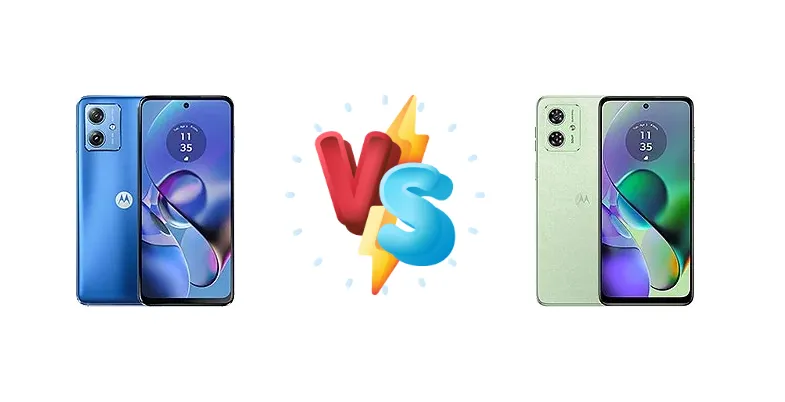
|
🏆 Quick Verdict
For users prioritizing performance and faster charging, the Motorola Moto G64 is the clear winner. Its Dimensity 7025, with its higher clocked Cortex-A78 cores and 30W charging, offers a noticeable edge. However, the G54 remains a strong contender for budget-conscious buyers who don't demand peak performance.
| PHONES | ||
|---|---|---|
| Phone Names | Motorola Moto G64 | Motorola Moto G54 |
| Network | ||
|---|---|---|
| 2G bands | GSM 850 / 900 / 1800 / 1900 | GSM 850 / 900 / 1800 / 1900 |
| 3G bands | HSDPA 800 / 850 / 900 / 1900 / 2100 | HSDPA 850 / 900 / 1900 / 2100 |
| 4G bands | 1, 2, 3, 5, 7, 8, 18, 19, 20, 26, 28, 32, 38, 40, 41, 42 | 1, 2, 3, 5, 7, 8, 20, 26, 28, 32, 38, 40, 41, 42 |
| 5G bands | 1, 2, 3, 5, 7, 8, 20, 28, 38, 40, 41, 66, 77, 78 SA/NSA | 1, 3, 5, 7, 8, 20, 26, 28, 38, 40, 41, 77, 78 SA/NSA |
| Speed | HSPA, LTE, 5G | HSPA, LTE, 5G |
| Technology | GSM / HSPA / LTE / 5G | GSM / HSPA / LTE / 5G |
| Launch | ||
|---|---|---|
| Announced | 2024, April 11 | 2023, September 05 |
| Status | Available. Released 2024, April 23 | Available. Released 2023, September 05 |
| Body | ||
|---|---|---|
| Build | Glass front, plastic back, plastic frame | Glass front, plastic back or silicone polymer back (eco leather), plastic frame |
| Dimensions | 161.6 x 73.8 x 8.9 mm (6.36 x 2.91 x 0.35 in) | 161.6 x 73.8 x 8 mm (6.36 x 2.91 x 0.31 in) |
| SIM | Nano-SIM + Nano-SIM | · Nano-SIM + eSIM· Nano-SIM + Nano-SIM |
| Weight | 192 g (6.77 oz) | 177 g (6.24 oz) |
| Display | ||
|---|---|---|
| Resolution | 1080 x 2400 pixels, 20:9 ratio (~405 ppi density) | 1080 x 2400 pixels, 20:9 ratio (~405 ppi density) |
| Size | 6.5 inches, 102.0 cm2 (~85.5% screen-to-body ratio) | 6.5 inches, 102.0 cm2 (~85.5% screen-to-body ratio) |
| Type | IPS LCD, 120Hz | IPS LCD, 120Hz |
| Platform | ||
|---|---|---|
| CPU | Octa-core (2x2.5 GHz Cortex-A78 & 6x2.0 GHz Cortex-A55) | Octa-core (2x2.2 GHz Cortex-A78 & 6x2.0 GHz Cortex-A55) |
| Chipset | Mediatek Dimensity 7025 (6 nm) | Mediatek Dimensity 7020 (6 nm) |
| GPU | IMG BXM-8-256 | IMG BXM-8-256 |
| OS | Android 14, planned upgrade to Android 15 | Android 13, upgradable to Android 15 |
| Memory | ||
|---|---|---|
| Card slot | microSDXC (uses shared SIM slot) | microSDXC (dedicated slot) - InternationalmicroSDXC (uses shared SIM slot) - China |
| Internal | 128GB 8GB RAM, 256GB 12GB RAM | 128GB 4GB RAM, 128GB 8GB RAM, 256GB 4GB RAM, 256GB 8GB RAM, 256GB 12GB RAM |
| Main Camera | ||
|---|---|---|
| Dual | 50 MP, f/1.8 (wide), 0.61µm, PDAF, OIS 8 MP, f/2.2, 118˚ (ultrawide), 1.12µm, AF | 50 MP, f/1.8 (wide), 0.61µm, PDAF, OIS 2 MP (macro) |
| Features | LED flash, HDR, panorama | Dual-LED dual-tone flash, HDR, panorama |
| Video | 1080p@30fps | 1080p@30/60fps |
| Selfie camera | ||
|---|---|---|
| Features | HDR | HDR |
| Single | 16 MP, f/2.4, (wide), 1.0µm | 16 MP, f/2.4, (wide), 1.0µm |
| Video | 1080p@30fps | 1080p@30fps |
| Sound | ||
|---|---|---|
| 35mm jack | Yes | Yes |
| Loudspeaker | Yes, with stereo speakers | Yes, with stereo speakers |
| Comms | ||
|---|---|---|
| Bluetooth | 5.3, A2DP, LE | 5.3, A2DP, LE |
| NFC | Yes | Yes |
| Positioning | GPS, GLONASS, GALILEO, QZSS | GPS, GLONASS, GALILEO, BDS, QZSS |
| Radio | FM radio | FM radio (market/region dependent) |
| USB | USB Type-C 2.0, OTG | USB Type-C 2.0, OTG |
| WLAN | Wi-Fi 802.11 a/b/g/n/ac, dual-band | Wi-Fi 802.11 a/b/g/n/ac, dual-band |
| Features | ||
|---|---|---|
| Sensors | Fingerprint (side-mounted), accelerometer, gyro, proximity, compass | Fingerprint (side-mounted), accelerometer, gyro, proximity, compass |
| Battery | ||
|---|---|---|
| Charging | 30W wired, PD3.0, QC3+, 50% in 33 min Reverse wired | 15W wired Reverse wired |
| Type | 6000 mAh | Li-Po 5000 mAh |
| Misc | ||
|---|---|---|
| Colors | Mint Green, Pearl Blue, Ice Lilac | Midnight blue, Indigo blue, Glacier blue, Mint green |
| Models | - | XT2343-1, XT2343-2 |
| Price | ₹ 13,499 | € 147.00 / $ 189.99 / £ 161.57 |
Motorola Moto G64
- Faster processor (Dimensity 7025)
- Significantly faster 30W charging
- Potential for better image processing
- Likely higher price point
- May experience slightly more heat under sustained load
Motorola Moto G54
- More affordable price
- Good battery life for everyday use
- Reverse wired charging
- Slower processor (Dimensity 7020)
- Slow 15W charging
Display Comparison
Both the Moto G64 and G54 are expected to feature 6.6-inch FHD+ displays, but detailed specifications like peak brightness and panel type (IPS LCD vs AMOLED) are currently unavailable. However, given the G-series positioning, expect IPS LCD panels on both. The absence of LTPO technology suggests neither phone will offer adaptive refresh rates for improved battery efficiency. Bezels are likely comparable, focusing on maximizing screen real estate within their price brackets.
Camera Comparison
Without detailed camera sensor information, a direct comparison is limited. However, Motorola typically employs a primary sensor with a decent megapixel count in this segment. The G64’s slightly more powerful processor could enable more sophisticated image processing algorithms, potentially resulting in better dynamic range and low-light performance. The inclusion of Optical Image Stabilization (OIS) would be a significant advantage for either phone, but is unconfirmed. The ubiquitous 2MP macro lenses found on both devices offer limited practical value, serving primarily as marketing features.
Performance
The core difference lies in the chipsets. The Moto G64 boasts the MediaTek Dimensity 7025 (6nm), featuring a dual-core CPU configuration with 2x2.5 GHz Cortex-A78 cores and 6x2.0 GHz Cortex-A55 cores. The G54 utilizes the Dimensity 7020 (6nm), stepping down to 2x2.2 GHz Cortex-A78 cores and the same 6x2.0 GHz Cortex-A55 configuration. This 300 MHz clock speed difference on the prime cores translates to a tangible performance boost for the G64 in CPU-intensive tasks. While both phones likely share similar RAM configurations (LPDDR4X is probable), the G64’s processor will handle multitasking and demanding applications more efficiently. Thermal management will be crucial; the 6nm process should keep temperatures in check, but sustained loads may reveal the G64’s advantage.
Battery Life
Both phones are expected to house batteries around the 5000 mAh mark, providing all-day battery life for moderate usage. However, the G64’s 30W wired charging (supporting PD3.0 and QC3+) is a substantial upgrade over the G54’s 15W charging. The G64 can reach 50% charge in approximately 33 minutes, while the G54 will require significantly longer. This difference is critical for users who frequently need to top up their battery quickly. Both phones offer reverse wired charging, allowing them to function as power banks for smaller devices.
Buying Guide
Buy the Motorola Moto G64 if you need a phone capable of handling demanding apps and games with more headroom, and if minimizing charging time is a priority. Its faster processor and charging will appeal to power users and those frequently on the go. Buy the Motorola Moto G54 if you prefer a more affordable option for everyday tasks like browsing, social media, and light gaming, and are comfortable with slower charging speeds.