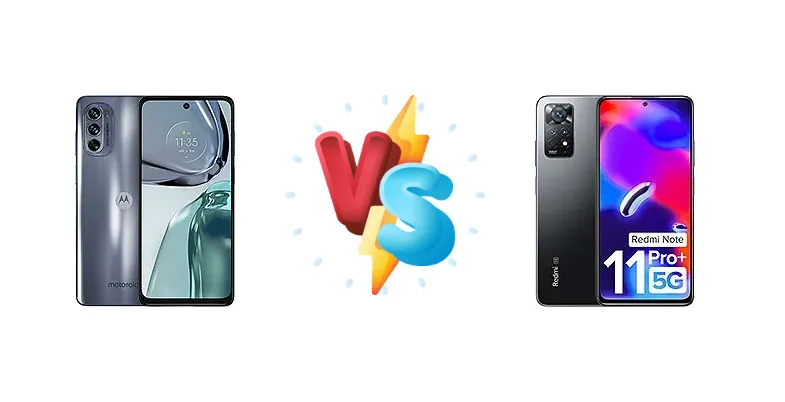
Both the Motorola Moto G62 and the Xiaomi Redmi Note 11 Pro+ 5G target the competitive Indian mid-range 5G market, powered by the same Qualcomm Snapdragon 695 chipset. However, they diverge significantly in charging technology and potentially, overall user experience. This comparison dissects these differences to help you choose the right phone for your needs.
🏆 Quick Verdict
For the average user prioritizing convenience and speed, the Xiaomi Redmi Note 11 Pro+ 5G is the clear winner. Its 67W charging dramatically reduces downtime compared to the Moto G62’s 15W charging, making it ideal for those constantly on the go. While performance is identical, the charging advantage is substantial.
| Network |
|---|
| 2G bands | GSM 850 / 900 / 1800 / 1900 | GSM 850 / 900 / 1800 / 1900 |
| 3G bands | HSDPA 850 / 900 / 1700(AWS) / 1900 / 2100 | HSDPA 850 / 900 / 1900 / 2100 |
| 4G bands | 1, 2, 3, 4, 5, 7, 8, 12, 13, 17, 18, 19, 20, 26, 28, 32, 38, 39, 40, 41, 42, 43 | 1, 3, 5, 8, 40, 41 |
| 5G bands | 1, 3, 5, 7, 8, 20, 28, 38, 40, 41, 77, 78 SA/NSA | 1, 3, 5, 8, 28, 40, 78 SA/NSA |
| Speed | HSPA, LTE, 5G | HSPA, LTE, 5G |
| Technology | GSM / HSPA / LTE / 5G | GSM / HSPA / LTE / 5G |
| Launch |
|---|
| Announced | 2022, August 11 | 2022, March 09 |
| Status | Available. Released 2022, August 19 | Available. Released 2022, March 15 |
| Body |
|---|
| Build | Glass front, plastic frame, plastic back | Glass front (Gorilla Glass 5), glass back |
| Dimensions | 161.8 x 74 x 8.6 mm (6.37 x 2.91 x 0.34 in) | 164.2 x 76.1 x 8.1 mm (6.46 x 3.00 x 0.32 in) |
| SIM | Nano-SIM + Nano-SIM | Nano-SIM + Nano-SIM |
| Weight | 184 g (6.49 oz) | 202 g (7.13 oz) |
| | Water-repellent design | - |
| Display |
|---|
| Protection | - | Corning Gorilla Glass 5 |
| Resolution | 1080 x 2400 pixels, 20:9 ratio (~405 ppi density) | 1080 x 2400 pixels, 20:9 ratio (~395 ppi density) |
| Size | 6.5 inches, 102.0 cm2 (~85.2% screen-to-body ratio) | 6.67 inches, 107.4 cm2 (~86.0% screen-to-body ratio) |
| Type | IPS LCD, 120Hz | Super AMOLED, 120Hz, 700 nits, 1200 nits (peak) |
| Platform |
|---|
| CPU | Octa-core (2x2.2 GHz Kryo 660 Gold & 6x1.7 GHz Kryo 660 Silver) | Octa-core (2x2.2 GHz Kryo 660 Gold & 6x1.7 GHz Kryo 660 Silver) |
| Chipset | Qualcomm SM6375 Snapdragon 695 5G (6 nm) | Qualcomm SM6375 Snapdragon 695 5G (6 nm) |
| GPU | Adreno 619 | Adreno 619 |
| OS | Android 12 | Android 11, MIUI 13 |
| Memory |
|---|
| Card slot | microSDXC (uses shared SIM slot) | microSDXC (uses shared SIM slot) |
| Internal | 128GB 6GB RAM, 128GB 8GB RAM | 64GB 6GB RAM, 128GB 6GB RAM, 128GB 8GB RAM, 256GB 8GB RAM |
| Main Camera |
|---|
| Features | LED flash, HDR, panorama | LED flash, HDR, panorama |
| Triple | 50 MP, f/1.8 (wide), 1/2.76", 0.64µm, PDAF
8 MP, f/2.2, 118˚ (ultrawide), 1/4.0", 1.12µm
2 MP (macro) | 108 MP, f/1.9, 26mm (wide), 1/1.52", 0.7µm, PDAF
8 MP, f/2.2, 118˚ (ultrawide)
2 MP (macro) |
| Video | 1080p@30/60fps | 1080p@30fps |
| Selfie camera |
|---|
| Single | 16 MP, f/2.2, (wide), 1.0µm | 16 MP, f/2.5, (wide), 1/3.06" 1.0µm |
| Video | 1080p@30fps | 1080p@30fps |
| Sound |
|---|
| 3.5mm jack | Yes | - |
| 35mm jack | Yes | Yes |
| Loudspeaker | Yes, with stereo speakers | Yes, with stereo speakers |
| Comms |
|---|
| Bluetooth | 5.1, A2DP, LE | 5.1, A2DP, LE |
| Infrared port | - | Yes |
| NFC | No | No |
| Positioning | GPS, GLONASS, GALILEO, BDS | GPS, GLONASS, BDS, GALILEO |
| Radio | FM radio, recording | Unspecified |
| USB | USB Type-C 2.0 | USB Type-C 2.0, OTG |
| WLAN | Wi-Fi 802.11 a/b/g/n/ac, dual-band, Wi-Fi Direct | Wi-Fi 802.11 a/b/g/n/ac, dual-band, Wi-Fi Direct |
| Features |
|---|
| Sensors | Fingerprint (side-mounted), accelerometer, gyro, proximity, compass | Fingerprint (side-mounted), accelerometer, gyro, proximity, compass |
| Battery |
|---|
| Charging | 15W wired | 67W wired, PD3.0, QC3, 50% in 15 min, 100% in 42 min |
| Type | Li-Po 5000 mAh | Li-Po 5000 mAh |
| Misc |
|---|
| Colors | Midnight Gray, Frosted Blue | Mirage Blue, Phantom White, Stealth Black |
| Models | - | 2201116SI |
| Price | About 220 EUR | About 250 EUR |
| SAR | 1.05 W/kg (head) 1.21 W/kg (body) | - |
Motorola Moto G62 (India)
- Clean, near-stock Android experience
- Potentially more affordable price point
- Reliable Qualcomm Snapdragon 695 performance
- Significantly slower 15W charging
- Likely less feature-rich camera system
- Software updates may be less frequent
Xiaomi Redmi Note 11 Pro+ 5G (India)
- Ultra-fast 67W charging with PD3.0/QC3
- Potentially better camera hardware
- Feature-rich MIUI software
- MIUI can be bloated with pre-installed apps
- Potentially higher price
- Software updates can be inconsistent
Display Comparison
Both devices share a similar display profile, likely utilizing FHD+ LCD panels. However, detailed specifications like peak brightness and color gamut coverage are missing. Given Xiaomi’s history, the Redmi Note 11 Pro+ likely boasts a slightly higher peak brightness for better outdoor visibility. Bezels are expected to be comparable, with both aiming for a modern, immersive viewing experience. PWM dimming rates are unknown, but a higher rate on either device would benefit users sensitive to screen flicker.
Camera Comparison
Camera details beyond the main sensor are sparse. While both likely feature multi-camera setups, the Redmi Note 11 Pro+ 5G’s potential for a higher resolution main sensor (Xiaomi often prioritizes megapixel count) could translate to more detailed photos in good lighting. Optical Image Stabilization (OIS) is a key differentiator to look for, as it significantly improves low-light photography and video stability. Image processing styles will differ – Motorola typically aims for a more natural look, while Xiaomi’s MIUI tends towards more vibrant, saturated colors. The usefulness of any 2MP macro or depth sensors on either device is questionable.
Performance
The core performance is identical: both phones are powered by the Qualcomm SM6375 Snapdragon 695 5G (6 nm) with an octa-core CPU configuration (2x2.2 GHz Kryo 660 Gold & 6x1.7 GHz Kryo 660 Silver). This means similar performance in everyday tasks and moderate gaming. Thermal management will likely be comparable, though Xiaomi’s larger chassis *could* offer slightly better heat dissipation. RAM configurations are not specified, but LPDDR4X is probable on both, limiting potential performance gains. The GPU performance will also be identical, suitable for most mobile games at medium settings.
Battery Life
The battery capacity is not specified for either device. However, the defining difference is charging speed. The Redmi Note 11 Pro+ 5G’s 67W wired charging, supporting PD3.0 and QC3, is a game-changer, promising a 50% charge in just 15 minutes and a full charge in 42 minutes. The Moto G62’s 15W charging is significantly slower, requiring considerably more time to reach 100%. This disparity means the Redmi Note 11 Pro+ 5G offers far greater convenience, especially for users who frequently need to top up their battery.
Buying Guide
Buy the Motorola Moto G62 (India) if you prioritize a clean software experience and are comfortable with slower charging speeds. It’s a solid choice for users who aren’t heavily reliant on quick top-ups. Buy the Xiaomi Redmi Note 11 Pro+ 5G (India) if you value fast charging above all else, and appreciate a feature-rich MIUI experience. This phone is best for users who need to minimize downtime and maximize screen-on time.
Frequently Asked Questions
❓ Will the Snapdragon 695 in the Redmi Note 11 Pro+ 5G overheat during prolonged gaming sessions?
The Snapdragon 695 is a relatively efficient chipset. While some throttling is possible during extended gaming, the Redmi Note 11 Pro+ 5G’s larger chassis may provide slightly better thermal dissipation compared to the Moto G62, potentially mitigating overheating. Expect playable frame rates with medium settings in most titles.
❓ Is the 15W charging on the Moto G62 slow enough to be a dealbreaker for frequent travelers?
Yes, the 15W charging is significantly slower than the 67W charging on the Redmi Note 11 Pro+. For users who frequently travel or have limited time to charge, the Moto G62’s slow charging could be a major inconvenience. You'll need to plan ahead and charge overnight.
❓ Does the Redmi Note 11 Pro+ 5G's MIUI software offer any significant advantages over the Moto G62's near-stock Android?
MIUI offers a wealth of customization options and features, including themes, gesture controls, and advanced camera modes. However, it also comes with pre-installed bloatware and can be less efficient than the cleaner Android experience on the Moto G62. The choice depends on your preference for customization versus simplicity.