
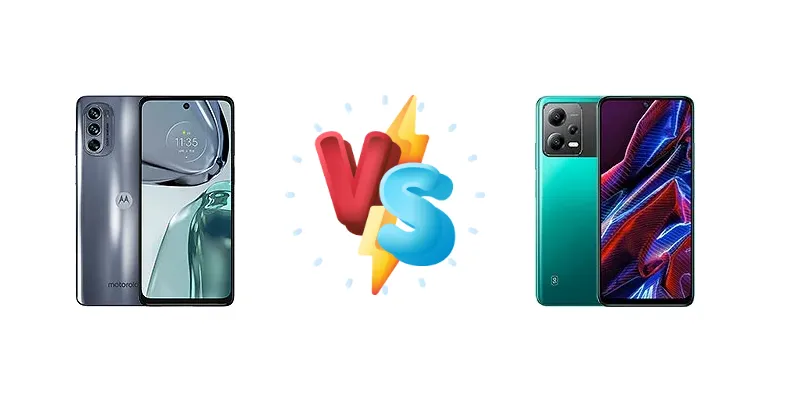
Motorola Moto G62 vs Xiaomi Poco X5: The Ultimate Budget Showdown
| Phones Images | |||||
|---|---|---|---|---|---|
|
🏆 Quick Verdict
The Poco X5 takes the crown thanks to its significantly faster charging, brighter display, and potentially better camera performance. While the Moto G62 is a solid option, the Poco X5 offers a more premium experience for a similar price.
| PHONES | ||
|---|---|---|
| Phone Names | Motorola Moto G62 (India) | Xiaomi Poco X5 |
| Network | ||
|---|---|---|
| 2G bands | GSM 850 / 900 / 1800 / 1900 | GSM 850 / 900 / 1800 / 1900 |
| 3G bands | HSDPA 850 / 900 / 1700(AWS) / 1900 / 2100 | HSDPA 850 / 900 / 1700(AWS) / 1900 / 2100 |
| 4G bands | 1, 2, 3, 4, 5, 7, 8, 12, 13, 17, 18, 19, 20, 26, 28, 32, 38, 39, 40, 41, 42, 43 | 1, 2, 3, 4, 5, 7, 8, 20, 28, 38, 40, 41, 66 - International |
| 5G bands | 1, 3, 5, 7, 8, 20, 28, 38, 40, 41, 77, 78 SA/NSA | 1, 3, 5, 7, 8, 20, 28, 38, 40, 41, 77, 78 SA/NSA/Sub6 - International |
| Speed | HSPA, LTE, 5G | HSPA, LTE, 5G |
| Technology | GSM / HSPA / LTE / 5G | GSM / HSPA / LTE / 5G |
| - | 1, 3, 5, 8, 28, 40, 78 SA/NSA - India | |
| Launch | ||
|---|---|---|
| Announced | 2022, August 11 | 2023, February 06 |
| Status | Available. Released 2022, August 19 | Available. Released 2023, February 07 |
| Body | ||
|---|---|---|
| Build | Glass front, plastic frame, plastic back | - |
| Dimensions | 161.8 x 74 x 8.6 mm (6.37 x 2.91 x 0.34 in) | 165.9 x 76.2 x 8 mm (6.53 x 3.00 x 0.31 in) |
| SIM | Nano-SIM + Nano-SIM | Nano-SIM + Nano-SIM |
| Weight | 184 g (6.49 oz) | 189 g (6.67 oz) |
| Water-repellent design | IP53, dust and splash resistant | |
| Display | ||
|---|---|---|
| Protection | - | Corning Gorilla Glass 3 |
| Resolution | 1080 x 2400 pixels, 20:9 ratio (~405 ppi density) | 1080 x 2400 pixels, 20:9 ratio (~395 ppi density) |
| Size | 6.5 inches, 102.0 cm2 (~85.2% screen-to-body ratio) | 6.67 inches, 107.4 cm2 (~85.0% screen-to-body ratio) |
| Type | IPS LCD, 120Hz | Super AMOLED, 120Hz, 700 nits (HBM), 1200 nits (peak) |
| Platform | ||
|---|---|---|
| CPU | Octa-core (2x2.2 GHz Kryo 660 Gold & 6x1.7 GHz Kryo 660 Silver) | Octa-core (2x2.2 GHz Kryo 660 Gold & 6x1.7 GHz Kryo 660 Silver) |
| Chipset | Qualcomm SM6375 Snapdragon 695 5G (6 nm) | Qualcomm SM6375 Snapdragon 695 5G (6 nm) |
| GPU | Adreno 619 | Adreno 619 |
| OS | Android 12 | Android 12, MIUI 13 for POCO |
| Memory | ||
|---|---|---|
| Card slot | microSDXC (uses shared SIM slot) | microSDXC (uses shared SIM slot) |
| Internal | 128GB 6GB RAM, 128GB 8GB RAM | 128GB 6GB RAM, 256GB 8GB RAM |
| - | UFS 2.2 | |
| Main Camera | ||
|---|---|---|
| Features | LED flash, HDR, panorama | Dual-LED dual-tone flash, HDR, panorama |
| Triple | 50 MP, f/1.8 (wide), 1/2.76", 0.64µm, PDAF 8 MP, f/2.2, 118˚ (ultrawide), 1/4.0", 1.12µm 2 MP (macro) | 48 MP, f/1.8, (wide), PDAF 8 MP, f/2.2, 118˚ (ultrawide), 1/4.0", 1.12µm 2 MP (macro) |
| Video | 1080p@30/60fps | 1080p@30fps |
| Selfie camera | ||
|---|---|---|
| Features | - | HDR |
| Single | 16 MP, f/2.2, (wide), 1.0µm | 13 MP, f/2.5, (wide) |
| Video | 1080p@30fps | 1080p@30fps |
| Sound | ||
|---|---|---|
| 3.5mm jack | Yes | Yes |
| 35mm jack | Yes | Yes |
| Loudspeaker | Yes, with stereo speakers | Yes |
| - | 24-bit/192kHz audio | |
| Comms | ||
|---|---|---|
| Bluetooth | 5.1, A2DP, LE | 5.1, A2DP, LE |
| Infrared port | - | Yes |
| NFC | No | Yes (market/region dependent) |
| Positioning | GPS, GLONASS, GALILEO, BDS | GPS, GLONASS |
| Radio | FM radio, recording | FM radio, recording |
| USB | USB Type-C 2.0 | USB Type-C 2.0, OTG |
| WLAN | Wi-Fi 802.11 a/b/g/n/ac, dual-band, Wi-Fi Direct | Wi-Fi 802.11 a/b/g/n/ac, dual-band |
| Features | ||
|---|---|---|
| Sensors | Fingerprint (side-mounted), accelerometer, gyro, proximity, compass | Fingerprint (side-mounted), accelerometer, gyro, proximity, compass |
| Battery | ||
|---|---|---|
| Charging | 15W wired | 33W wired, 100% in 60 min |
| Type | Li-Po 5000 mAh | Li-Po 5000 mAh |
| Misc | ||
|---|---|---|
| Colors | Midnight Gray, Frosted Blue | Jaguar Black, Wildcat Blue, Supernova Green |
| Models | - | 22111317PG, 22111317PI |
| Price | About 220 EUR | About 230 EUR |
| SAR | 1.05 W/kg (head) 1.21 W/kg (body) | 0.84 W/kg (head) 0.68 W/kg (body) |
| SAR EU | - | 0.52 W/kg (head) 0.77 W/kg (body) |
| Tests | ||
|---|---|---|
| Battery life | - | Endurance rating 106h |
| Camera | - | Photo / Video |
| Display | - | Contrast ratio: Infinite (nominal) |
| Loudspeaker | - | -27.3 LUFS (Good) |
| Performance | - | AnTuTu: 400895 (v9) GeekBench: 2088 (v5.1) |
Motorola Moto G62 (India)
- Clean Android experience
- Reliable performance
- Decent build quality
- 5G Connectivity
- Slow charging (15W)
- Less bright display
- Potentially weaker camera
Xiaomi Poco X5
- Fast charging (33W)
- Bright display (728 nits)
- Potentially better camera
- Excellent battery life (106h endurance)
- Aggressive performance tweaks (MIUI)
- MIUI software (can be polarizing)
- Potential for bloatware
- Design may not appeal to everyone
Display Comparison
The Poco X5 boasts a measured peak brightness of 728 nits, significantly brighter than the Moto G62. While the Moto G62's display is adequate, the Poco X5's higher brightness makes it more visible in direct sunlight. The Poco X5 also advertises an 'infinite' contrast ratio, suggesting excellent image quality, though this is a nominal value.
Camera Comparison
While both phones are listed as having 'Photo/Video' capabilities, the Poco X5 is generally expected to have a slightly better camera system due to Xiaomi's focus on camera features in their budget devices. Specific sensor details and image processing algorithms would need further testing to confirm.
Performance
Both phones share the same Snapdragon 695 5G chipset and CPU configuration, meaning performance in everyday tasks and moderate gaming should be comparable. However, software optimization can play a significant role, and Xiaomi's MIUI often offers more aggressive performance tweaks.
Battery Life
The Poco X5 shines here with a reported endurance rating of 106 hours, suggesting exceptional battery life. The Moto G62's battery life is likely good, but not as impressive. Furthermore, the Poco X5's 33W charging is a major advantage over the Moto G62's 15W charging, allowing for significantly faster top-ups.
Buying Guide
The Motorola Moto G62 is ideal for users prioritizing a clean software experience and reliable performance for everyday tasks. The Xiaomi Poco X5 is a better choice for those who value fast charging, a vibrant display, and potentially improved camera capabilities, especially if photography is a priority.