
Poco X4 Pro 5G vs. Motorola Moto G62: A Detailed Comparison
| Phones Images | |||||
|---|---|---|---|---|---|
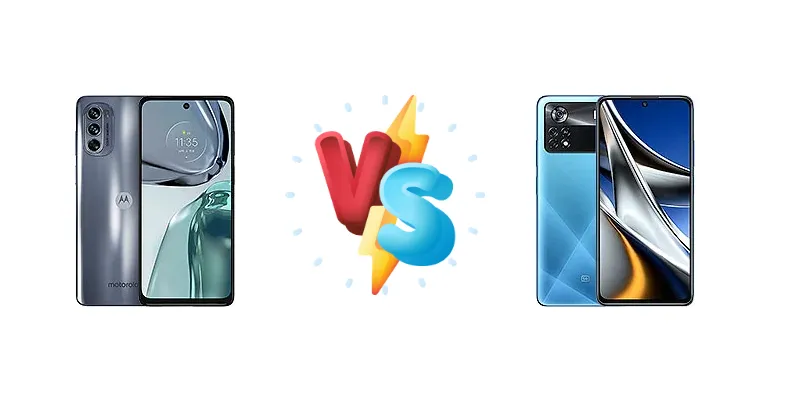
|
🏆 Quick Verdict
For the average user prioritizing convenience, the Xiaomi Poco X4 Pro 5G is the clear winner. Its 67W fast charging dramatically reduces downtime compared to the Moto G62’s 15W charging, despite both phones sharing the same Snapdragon 695 5G processor and similar battery endurance ratings.
| PHONES | ||
|---|---|---|
| Phone Names | Motorola Moto G62 (India) | Xiaomi Poco X4 Pro 5G |
| Network | ||
|---|---|---|
| 2G bands | GSM 850 / 900 / 1800 / 1900 | GSM 850 / 900 / 1800 / 1900 |
| 3G bands | HSDPA 850 / 900 / 1700(AWS) / 1900 / 2100 | HSDPA 800 / 850 / 900 / 1700(AWS) / 1900 / 2100 - Global |
| 4G bands | 1, 2, 3, 4, 5, 7, 8, 12, 13, 17, 18, 19, 20, 26, 28, 32, 38, 39, 40, 41, 42, 43 | 1, 2, 3, 4, 5, 7, 8, 12, 17, 18, 19, 20, 26, 28, 38, 40, 41 - Global |
| 5G bands | 1, 3, 5, 7, 8, 20, 28, 38, 40, 41, 77, 78 SA/NSA | 1, 3, 5, 7, 8, 20, 28, 38, 40, 41, 77, 78 SA/NSA - Global |
| Speed | HSPA, LTE, 5G | HSPA, LTE, 5G |
| Technology | GSM / HSPA / LTE / 5G | GSM / HSPA / LTE / 5G |
| - | 1, 3, 5, 8, 28, 40, 78 SA/NSA - India | |
| Launch | ||
|---|---|---|
| Announced | 2022, August 11 | 2022, February 28 |
| Status | Available. Released 2022, August 19 | Available. Released 2022, March 23 |
| Body | ||
|---|---|---|
| Build | Glass front, plastic frame, plastic back | Glass front (Gorilla Glass 5), glass back, plastic frame |
| Dimensions | 161.8 x 74 x 8.6 mm (6.37 x 2.91 x 0.34 in) | 164.2 x 76.1 x 8.1 mm (6.46 x 3.00 x 0.32 in) |
| SIM | Nano-SIM + Nano-SIM | Nano-SIM + Nano-SIM |
| Weight | 184 g (6.49 oz) | 205 g (7.23 oz) |
| Water-repellent design | IP53, dust and splash resistant | |
| Display | ||
|---|---|---|
| Protection | - | Corning Gorilla Glass 5 |
| Resolution | 1080 x 2400 pixels, 20:9 ratio (~405 ppi density) | 1080 x 2400 pixels, 20:9 ratio (~395 ppi density) |
| Size | 6.5 inches, 102.0 cm2 (~85.2% screen-to-body ratio) | 6.67 inches, 107.4 cm2 (~86.0% screen-to-body ratio) |
| Type | IPS LCD, 120Hz | Super AMOLED, 120Hz, 700 nits, 1200 nits (peak) |
| Platform | ||
|---|---|---|
| CPU | Octa-core (2x2.2 GHz Kryo 660 Gold & 6x1.7 GHz Kryo 660 Silver) | Octa-core (2x2.2 GHz Kryo 660 Gold & 6x1.7 GHz Kryo 660 Silver) |
| Chipset | Qualcomm SM6375 Snapdragon 695 5G (6 nm) | Qualcomm SM6375 Snapdragon 695 5G (6 nm) |
| GPU | Adreno 619 | Adreno 619 |
| OS | Android 12 | Android 11, MIUI 13 for POCO |
| Memory | ||
|---|---|---|
| Card slot | microSDXC (uses shared SIM slot) | microSDXC (uses shared SIM slot) |
| Internal | 128GB 6GB RAM, 128GB 8GB RAM | 64GB 6GB RAM, 128GB 6GB RAM, 128GB 8GB RAM, 256GB 6GB RAM, 256GB 8GB RAM |
| - | UFS 2.2 | |
| Main Camera | ||
|---|---|---|
| Features | LED flash, HDR, panorama | LED flash, HDR, panorama |
| Single | - | 16 MP, f/2.5, (wide), 1/3.06" 1.0µm |
| Triple | 50 MP, f/1.8 (wide), 1/2.76", 0.64µm, PDAF 8 MP, f/2.2, 118˚ (ultrawide), 1/4.0", 1.12µm 2 MP (macro) | 108 MP, f/1.9, 26mm (wide), 1/1.52", 0.7µm, PDAF - Global version 64 MP, f/1.8, 26mm (wide), 0.7µm, PDAF - India version 8 MP, f/2.2, 118˚ (ultrawide), 1/4.0", 1.12µm 2 MP (macro) |
| Video | 1080p@30/60fps | 1080p@30fps |
| Selfie camera | ||
|---|---|---|
| Features | - | HDR, panorama |
| Single | 16 MP, f/2.2, (wide), 1.0µm | 16 MP, f/2.5, (wide), 1/3.06" 1.0µm |
| Video | 1080p@30fps | 1080p@30fps |
| Sound | ||
|---|---|---|
| 3.5mm jack | Yes | Yes |
| 35mm jack | Yes | Yes |
| Loudspeaker | Yes, with stereo speakers | Yes, with stereo speakers |
| - | 24-bit/192kHz audio | |
| Comms | ||
|---|---|---|
| Bluetooth | 5.1, A2DP, LE | 5.1, A2DP, LE |
| Infrared port | - | Yes |
| NFC | No | Yes (market/region dependent) |
| Positioning | GPS, GLONASS, GALILEO, BDS | GPS, GLONASS, BDS, GALILEO |
| Radio | FM radio, recording | FM radio |
| USB | USB Type-C 2.0 | USB Type-C 2.0, OTG |
| WLAN | Wi-Fi 802.11 a/b/g/n/ac, dual-band, Wi-Fi Direct | Wi-Fi 802.11 a/b/g/n/ac, dual-band, Wi-Fi Direct |
| Features | ||
|---|---|---|
| Sensors | Fingerprint (side-mounted), accelerometer, gyro, proximity, compass | Fingerprint (side-mounted), accelerometer, gyro, proximity, compass |
| Battery | ||
|---|---|---|
| Charging | 15W wired | 67W wired, PD3.0, QC3, 70% in 22 min, 100% in 41 min |
| Type | Li-Po 5000 mAh | Li-Po 5000 mAh |
| Misc | ||
|---|---|---|
| Colors | Midnight Gray, Frosted Blue | Laser Black, Laser Blue, Poco Yellow |
| Models | - | 2201116PG |
| Price | About 220 EUR | € 160.40 / $ 419.99 / £ 255.00 / ₹ 12,940 |
| SAR | 1.05 W/kg (head) 1.21 W/kg (body) | 1.06 W/kg (head) 1.09 W/kg (body) |
| SAR EU | - | 0.60 W/kg (head) 0.96 W/kg (body) |
| Tests | ||
|---|---|---|
| Battery life | - | Endurance rating 119h |
| Camera | - | Photo / Video |
| Display | - | Contrast ratio: Infinite (nominal) |
| Loudspeaker | - | -26.8 LUFS (Good) |
| Performance | - | AnTuTu: 335353 (v8), 384646 (v9) GeekBench: 2063 (v5.1) GFXBench: 17fps (ES 3.1 onscreen) |
Motorola Moto G62 (India)
- Clean Motorola Software Experience
- Similar Battery Endurance to Poco X4 Pro
- Snapdragon 695 5G provides adequate performance
- Significantly Slower 15W Charging
- Missing Display Specs (brightness, refresh rate)
- Camera specs are unknown
Xiaomi Poco X4 Pro 5G
- 67W Fast Charging (PD3.0, QC3)
- Faster Charging Time (100% in 41 minutes)
- Similar Battery Endurance to Moto G62
- MIUI Software (can be bloated)
- Missing Display Specs (brightness, refresh rate)
- Camera specs are unknown
Display Comparison
Both devices share an 'Infinite' (nominal) contrast ratio, suggesting typical IPS LCD characteristics. However, detailed display specs like peak brightness, color gamut coverage, and refresh rate are missing from the provided data. Given the price bracket, we can assume both utilize 60Hz panels. The absence of LTPO technology suggests neither offers adaptive refresh rates for power saving. Display quality will likely be similar, with the user experience hinging on color calibration, which is brand-specific.
Camera Comparison
Both phones feature 'Photo / Video' capabilities, but lack specific details regarding sensor size, aperture, or optical image stabilization (OIS). The absence of this information makes a direct comparison difficult. It’s likely both rely on primary sensors in the 50MP-64MP range, common in this price segment. The usefulness of any included 2MP macro cameras is questionable, offering limited image quality. Image processing algorithms will be the key differentiator, with Xiaomi’s typically leaning towards more saturated colors.
Performance
The core performance is identical: both the Moto G62 and Poco X4 Pro 5G are powered by the Qualcomm Snapdragon 695 5G (6nm). This octa-core CPU, with its 2x2.2 GHz Kryo 660 Gold and 6x1.7 GHz Kryo 660 Silver configuration, delivers comparable processing power for everyday tasks and moderate gaming. The 6nm process node offers a good balance of performance and efficiency. However, thermal management, which isn’t specified, will dictate sustained performance under load. RAM configuration (LPDDR4X vs LPDDR5) is unknown, but could impact multitasking smoothness.
Battery Life
Both devices boast an endurance rating of 119 hours, indicating similar battery life under typical usage. However, the charging experience is drastically different. The Moto G62 is limited to 15W wired charging, requiring significantly longer to reach a full charge. The Poco X4 Pro 5G, with its 67W wired charging (supporting PD3.0 and QC3), can reach 70% in just 22 minutes and 100% in 41 minutes. This difference in charging speed is a major advantage for the Poco X4 Pro 5G, especially for users who frequently need to top up their battery.
Buying Guide
Buy the Motorola Moto G62 (India) if you prioritize a clean software experience and are comfortable with slower charging speeds. It’s a solid choice for users who don’t mind topping up their phone overnight. Buy the Xiaomi Poco X4 Pro 5G if you value rapid charging and don’t mind Xiaomi’s MIUI software, offering a significant time saving for those who frequently need to recharge their device throughout the day.