
Motorola Moto G62 vs Samsung Galaxy F23: A Head-to-Head Comparison
| Phones Images | |||||
|---|---|---|---|---|---|
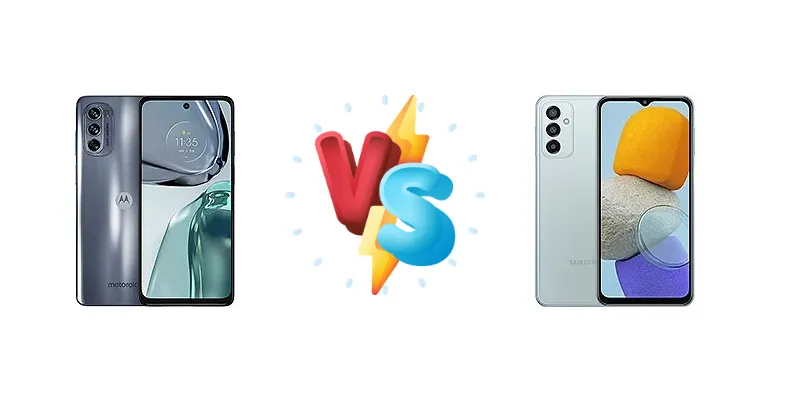
|
🏆 Quick Verdict
The Samsung Galaxy F23 edges out the Moto G62 thanks to its superior Snapdragon 750G chipset, faster charging, and generally more polished software experience. While the Moto G62 offers a decent display, the F23's performance and charging speed make it the better choice for most users.
| PHONES | ||
|---|---|---|
| Phone Names | Motorola Moto G62 (India) | Samsung Galaxy F23 |
| Network | ||
|---|---|---|
| 2G bands | GSM 850 / 900 / 1800 / 1900 | GSM 850 / 900 / 1800 / 1900 |
| 3G bands | HSDPA 850 / 900 / 1700(AWS) / 1900 / 2100 | HSDPA 850 / 900 / 1700(AWS) / 1900 / 2100 |
| 4G bands | 1, 2, 3, 4, 5, 7, 8, 12, 13, 17, 18, 19, 20, 26, 28, 32, 38, 39, 40, 41, 42, 43 | 1, 2, 3, 4, 5, 7, 8, 12, 17, 20, 26, 28, 38, 40, 41, 66 |
| 5G bands | 1, 3, 5, 7, 8, 20, 28, 38, 40, 41, 77, 78 SA/NSA | 1, 3, 5, 7, 8, 20, 28, 38, 40, 41, 66, 78 SA/NSA/Sub6 |
| Speed | HSPA, LTE, 5G | HSPA, LTE, 5G |
| Technology | GSM / HSPA / LTE / 5G | GSM / HSPA / LTE / 5G |
| Launch | ||
|---|---|---|
| Announced | 2022, August 11 | 2022, March 08 |
| Status | Available. Released 2022, August 19 | Available. Released 2022, March 16 |
| Body | ||
|---|---|---|
| Build | Glass front, plastic frame, plastic back | Glass front (Gorilla Glass 5), plastic frame, plastic back |
| Dimensions | 161.8 x 74 x 8.6 mm (6.37 x 2.91 x 0.34 in) | 165.5 x 77 x 8.4 mm (6.52 x 3.03 x 0.33 in) |
| SIM | Nano-SIM + Nano-SIM | Nano-SIM + Nano-SIM |
| Weight | 184 g (6.49 oz) | 198 g (6.98 oz) |
| Water-repellent design | - | |
| Display | ||
|---|---|---|
| Protection | - | Corning Gorilla Glass 5 |
| Resolution | 1080 x 2400 pixels, 20:9 ratio (~405 ppi density) | 1080 x 2408 pixels, 20:9 ratio (~400 ppi density) |
| Size | 6.5 inches, 102.0 cm2 (~85.2% screen-to-body ratio) | 6.6 inches, 104.9 cm2 (~82.3% screen-to-body ratio) |
| Type | IPS LCD, 120Hz | TFT LCD, 120Hz |
| Platform | ||
|---|---|---|
| CPU | Octa-core (2x2.2 GHz Kryo 660 Gold & 6x1.7 GHz Kryo 660 Silver) | Octa-core (2x2.2 GHz Kryo 570 & 6x1.8 GHz Kryo 570) |
| Chipset | Qualcomm SM6375 Snapdragon 695 5G (6 nm) | Qualcomm SM7225 Snapdragon 750G 5G (8 nm) |
| GPU | Adreno 619 | Adreno 619 |
| OS | Android 12 | Android 12, upgradable to Android 14, One UI 6 |
| Memory | ||
|---|---|---|
| Card slot | microSDXC (uses shared SIM slot) | microSDXC (dedicated slot) |
| Internal | 128GB 6GB RAM, 128GB 8GB RAM | 128GB 4GB RAM, 128GB 6GB RAM |
| Main Camera | ||
|---|---|---|
| Features | LED flash, HDR, panorama | LED flash, panorama, HDR |
| Single | - | 8 MP, f/2.2, (wide) |
| Triple | 50 MP, f/1.8 (wide), 1/2.76", 0.64µm, PDAF 8 MP, f/2.2, 118˚ (ultrawide), 1/4.0", 1.12µm 2 MP (macro) | 50 MP, f/1.8, (wide), PDAF 8 MP, f/2.2, 123˚ (ultrawide), 1/4.0", 1.12µm 2 MP (macro) |
| Video | 1080p@30/60fps | 4K@30fps, 1080p@30fps, 720p@480fps |
| Selfie camera | ||
|---|---|---|
| Single | 16 MP, f/2.2, (wide), 1.0µm | 8 MP, f/2.2, (wide) |
| Video | 1080p@30fps | 1080p@30fps |
| Sound | ||
|---|---|---|
| 3.5mm jack | Yes | Yes |
| 35mm jack | Yes | Yes |
| Loudspeaker | Yes, with stereo speakers | Yes |
| Comms | ||
|---|---|---|
| Bluetooth | 5.1, A2DP, LE | 5.0, A2DP, LE |
| NFC | No | Yes |
| Positioning | GPS, GLONASS, GALILEO, BDS | GPS, GLONASS, GALILEO, BDS, QZSS |
| Radio | FM radio, recording | FM radio, recording |
| USB | USB Type-C 2.0 | USB Type-C 2.0, OTG |
| WLAN | Wi-Fi 802.11 a/b/g/n/ac, dual-band, Wi-Fi Direct | Wi-Fi 802.11 a/b/g/n/ac, dual-band, Wi-Fi Direct |
| Features | ||
|---|---|---|
| Sensors | Fingerprint (side-mounted), accelerometer, gyro, proximity, compass | Fingerprint (side-mounted), accelerometer, gyro, compass |
| - | Virtual Proximity Sensing | |
| Battery | ||
|---|---|---|
| Charging | 15W wired | 25W wired |
| Type | Li-Po 5000 mAh | Li-Po 5000 mAh |
| Misc | ||
|---|---|---|
| Colors | Midnight Gray, Frosted Blue | Aqua Blue, Forest Green |
| Models | - | SM-E236B, SM-E236B/DS |
| Price | About 220 EUR | About 190 EUR |
| SAR | 1.05 W/kg (head) 1.21 W/kg (body) | 1.24 W/kg (head) |
Motorola Moto G62 (India)
- Clean Android experience
- 120Hz refresh rate display
- Decent main camera with OIS
- Competitive price
- Slower charging (15W)
- Less powerful chipset
- Potentially less vibrant display
- Software updates may be slower
Samsung Galaxy F23
- More powerful Snapdragon 750G chipset
- Faster charging (25W)
- Generally better software experience
- Potentially better display quality
- 60Hz refresh rate display
- Slightly higher price
- Samsung's One UI can be polarizing
Display Comparison
Both phones feature a 6.5-inch FHD+ display, but the Galaxy F23 likely has slightly better color accuracy and brightness due to Samsung's display technology. The Moto G62 has a 120Hz refresh rate, offering smoother scrolling, while the F23 typically has a 60Hz refresh rate. This is a key differentiator for daily use.
Camera Comparison
The Moto G62 boasts a 50MP main camera with OIS, potentially offering better low-light performance and more stable videos. The Galaxy F23 typically features a 50MP main camera as well, but its image processing might differ. Both phones have ultrawide and macro lenses, but image quality will vary depending on the scene and lighting conditions. Samsung's software processing often results in more vibrant images.
Performance
The Samsung Galaxy F23's Snapdragon 750G chipset (8nm) is significantly more powerful than the Moto G62's Snapdragon 695 5G (6nm). Expect noticeably faster app loading times, smoother multitasking, and better gaming performance on the F23. The F23's CPU architecture is also more efficient.
Battery Life
The Galaxy F23 has a clear advantage with 25W fast charging compared to the Moto G62's 15W charging. Both phones likely have a similar battery capacity (around 5000mAh), but the F23 will charge much faster, reducing downtime.
Buying Guide
The Motorola Moto G62 is a good option for budget-conscious buyers who prioritize a clean Android experience and a decent display. The Samsung Galaxy F23 is ideal for users who want a smoother performance, faster charging, and a more feature-rich software ecosystem, even if it comes at a slightly higher price.