
Motorola Moto G62 (India) vs Samsung Galaxy A33 5G: A Detailed Comparison
| Phones Images | |||||
|---|---|---|---|---|---|
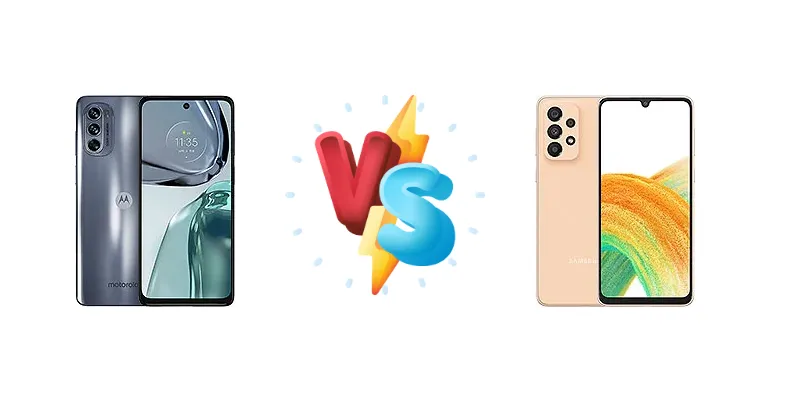
|
🏆 Quick Verdict
For the average user prioritizing a balance of performance and efficiency, the Motorola Moto G62 emerges as the stronger choice. Its Snapdragon 695, built on a 6nm process, offers better thermal management and power efficiency than the A33’s 5nm Exynos 1280, despite the latter’s higher clock speeds. However, the A33’s brighter display is a significant advantage for outdoor visibility.
| PHONES | ||
|---|---|---|
| Phone Names | Motorola Moto G62 (India) | Samsung Galaxy A33 5G |
| Network | ||
|---|---|---|
| 2G bands | GSM 850 / 900 / 1800 / 1900 | GSM 850 / 900 / 1800 / 1900 |
| 3G bands | HSDPA 850 / 900 / 1700(AWS) / 1900 / 2100 | HSDPA 850 / 900 / 1700(AWS) / 1900 / 2100 |
| 4G bands | 1, 2, 3, 4, 5, 7, 8, 12, 13, 17, 18, 19, 20, 26, 28, 32, 38, 39, 40, 41, 42, 43 | 1, 2, 3, 4, 5, 7, 8, 12, 17, 20, 26, 28, 32, 38, 40, 41, 66 |
| 5G bands | 1, 3, 5, 7, 8, 20, 28, 38, 40, 41, 77, 78 SA/NSA | 1, 3, 5, 7, 8, 20, 28, 38, 40, 41, 66, 78 SA/NSA/Sub6 |
| Speed | HSPA, LTE, 5G | HSPA, LTE, 5G |
| Technology | GSM / HSPA / LTE / 5G | GSM / HSPA / LTE / 5G |
| Launch | ||
|---|---|---|
| Announced | 2022, August 11 | 2022, March 17 |
| Status | Available. Released 2022, August 19 | Available. Released 2022, April 20 |
| Body | ||
|---|---|---|
| Build | Glass front, plastic frame, plastic back | Glass front (Gorilla Glass 5), plastic frame, plastic back |
| Dimensions | 161.8 x 74 x 8.6 mm (6.37 x 2.91 x 0.34 in) | 159.7 x 74 x 8.1 mm (6.29 x 2.91 x 0.32 in) |
| SIM | Nano-SIM + Nano-SIM | · Nano-SIM· Nano-SIM + Nano-SIM |
| Weight | 184 g (6.49 oz) | 186 g (6.56 oz) |
| Water-repellent design | IP67 dust/water resistant (up to 1m for 30 min) | |
| Display | ||
|---|---|---|
| Protection | - | Corning Gorilla Glass 5 |
| Resolution | 1080 x 2400 pixels, 20:9 ratio (~405 ppi density) | 1080 x 2400 pixels, 20:9 ratio (~411 ppi density) |
| Size | 6.5 inches, 102.0 cm2 (~85.2% screen-to-body ratio) | 6.4 inches, 98.9 cm2 (~83.7% screen-to-body ratio) |
| Type | IPS LCD, 120Hz | Super AMOLED, 90Hz |
| Platform | ||
|---|---|---|
| CPU | Octa-core (2x2.2 GHz Kryo 660 Gold & 6x1.7 GHz Kryo 660 Silver) | Octa-core (2x2.4 GHz Cortex-A78 & 6x2.0 GHz Cortex-A55) |
| Chipset | Qualcomm SM6375 Snapdragon 695 5G (6 nm) | Exynos 1280 (5 nm) |
| GPU | Adreno 619 | Mali-G68 |
| OS | Android 12 | Android 12, up to 4 major Android upgrades, One UI 8 |
| Memory | ||
|---|---|---|
| Card slot | microSDXC (uses shared SIM slot) | microSDXC (uses shared SIM slot) |
| Internal | 128GB 6GB RAM, 128GB 8GB RAM | 128GB 4GB RAM, 128GB 6GB RAM, 128GB 8GB RAM, 256GB 8GB RAM |
| Main Camera | ||
|---|---|---|
| Features | LED flash, HDR, panorama | LED flash, panorama, HDR |
| Quad | - | 48 MP, f/1.8, 26mm (wide), 1/2.0", 0.8µm, PDAF, OIS 8 MP, f/2.2, 123˚, (ultrawide), 1/4.0", 1.12µm 5 MP (macro) Auxiliary lens |
| Single | - | 13 MP, f/2.2, (wide), 1/3.1", 1.12µm |
| Triple | 50 MP, f/1.8 (wide), 1/2.76", 0.64µm, PDAF 8 MP, f/2.2, 118˚ (ultrawide), 1/4.0", 1.12µm 2 MP (macro) | - |
| Video | 1080p@30/60fps | 4K@30fps, 1080p@30/60fps |
| Selfie camera | ||
|---|---|---|
| Single | 16 MP, f/2.2, (wide), 1.0µm | 13 MP, f/2.2, (wide), 1/3.1", 1.12µm |
| Video | 1080p@30fps | 4K@30fps, 1080p@30fps |
| Sound | ||
|---|---|---|
| 3.5mm jack | Yes | No |
| 35mm jack | Yes | No |
| Loudspeaker | Yes, with stereo speakers | Yes, with stereo speakers |
| Comms | ||
|---|---|---|
| Bluetooth | 5.1, A2DP, LE | 5.1, A2DP, LE |
| NFC | No | Yes (market/region dependent) |
| Positioning | GPS, GLONASS, GALILEO, BDS | GPS, GLONASS, GALILEO, BDS |
| Radio | FM radio, recording | No |
| USB | USB Type-C 2.0 | USB Type-C 2.0, OTG |
| WLAN | Wi-Fi 802.11 a/b/g/n/ac, dual-band, Wi-Fi Direct | Wi-Fi 802.11 a/b/g/n/ac, dual-band, Wi-Fi Direct |
| Features | ||
|---|---|---|
| Sensors | Fingerprint (side-mounted), accelerometer, gyro, proximity, compass | Fingerprint (under display, optical), accelerometer, gyro, compass |
| - | Virtual proximity sensing | |
| Battery | ||
|---|---|---|
| Charging | 15W wired | 25W wired |
| Type | Li-Po 5000 mAh | Li-Po 5000 mAh |
| Misc | ||
|---|---|---|
| Colors | Midnight Gray, Frosted Blue | Black, White, Blue, Peach |
| Models | - | SM-A336E, SM-A336B, SM-A336B/DS, SM-A336B/DSN, SM-A336E/DS, SM-A336M, SM-A3360 |
| Price | About 220 EUR | £ 174.99 / € 187.50 / ₹ 21,999 |
| SAR | 1.05 W/kg (head) 1.21 W/kg (body) | 0.35 W/kg (head) |
| SAR EU | - | 0.57 W/kg (head) 1.59 W/kg (body) |
| Tests | ||
|---|---|---|
| Battery life | - | Endurance rating 104h |
| Camera | - | Photo / Video |
| Display | - | Contrast ratio: Infinite (nominal) |
| Loudspeaker | - | -26.5 LUFS (Good) |
| Performance | - | AnTuTu: 354420 (v8), 394918 (v9) GeekBench: 1900 (v5.1) GFXBench: 20fps (ES 3.1 onscreen) |
Motorola Moto G62 (India)
- More efficient Snapdragon 695 chipset
- Better thermal management for sustained performance
- Potentially longer battery life due to efficiency
- Slower 15W charging
- Less detailed display specifications
Samsung Galaxy A33 5G
- Brighter 728 nit display for outdoor visibility
- Faster 25W wired charging
- Samsung’s One UI software ecosystem
- Exynos 1280 prone to throttling under load
- Potentially lower battery life due to less efficient chipset
Display Comparison
The Samsung Galaxy A33 5G boasts a significantly brighter display, reaching a measured 728 nits, compared to the Moto G62’s unspecified brightness. This makes the A33 far more usable in direct sunlight. While the A33’s contrast ratio is listed as ‘Infinite’ (nominal), this is typical marketing hyperbole; the actual contrast will depend on the panel technology. The Moto G62’s display specifications are less detailed, but its focus is likely on power efficiency rather than peak brightness. The absence of LTPO technology on either device suggests neither offers adaptive refresh rate capabilities, potentially impacting battery life during dynamic content viewing.
Camera Comparison
Both devices offer photo and video capabilities, but detailed sensor information is lacking for both. The A33 likely benefits from Samsung’s established image processing algorithms, potentially delivering more vibrant and shareable photos. However, without knowing the main sensor size and aperture, it’s difficult to assess the low-light performance of either device. The inclusion of a 2MP macro camera on the A33 is largely a marketing gimmick, offering limited practical benefit due to its low resolution and lack of optical image stabilization (OIS).
Performance
The Exynos 1280 in the Galaxy A33 5G, fabricated on a 5nm process, features a more powerful CPU configuration with 2x2.4 GHz Cortex-A78 cores and 6x2.0 GHz Cortex-A55 cores, compared to the Moto G62’s Snapdragon 695’s 2x2.2 GHz Kryo 660 Gold and 6x1.7 GHz Kryo 660 Silver. However, the Snapdragon 695’s 6nm process provides a crucial advantage in thermal efficiency. This means the G62 is less likely to throttle under sustained load, offering more consistent performance during gaming or demanding tasks. While the Exynos 1280 has a theoretical performance edge, the G62’s efficiency could translate to a smoother, more reliable experience in real-world scenarios.
Battery Life
Both the Motorola Moto G62 and Samsung Galaxy A33 5G achieve an Endurance rating of 104 hours, suggesting comparable overall battery life. However, the charging speeds differ significantly. The A33 supports 25W wired charging, allowing for a faster 0-100% charge time compared to the G62’s 15W charging. Despite the identical endurance rating, the G62’s more efficient Snapdragon 695 chipset could translate to longer screen-on time for users who prioritize battery longevity over quick top-ups.
Buying Guide
Buy the Motorola Moto G62 (India) if you need a phone that prioritizes sustained performance during extended gaming sessions or multitasking, and value battery life. Its efficient Snapdragon 695 chipset minimizes throttling and maximizes uptime. Buy the Samsung Galaxy A33 5G if you prefer a brighter, more vibrant display for media consumption, and are heavily invested in the Samsung ecosystem, benefiting from features like One UI and seamless integration with other Samsung devices.