
Moto G62 5G vs. Moto G Stylus 5G (2022): Which Motorola 5G Phone Wins?
| Phones Images | |||||
|---|---|---|---|---|---|
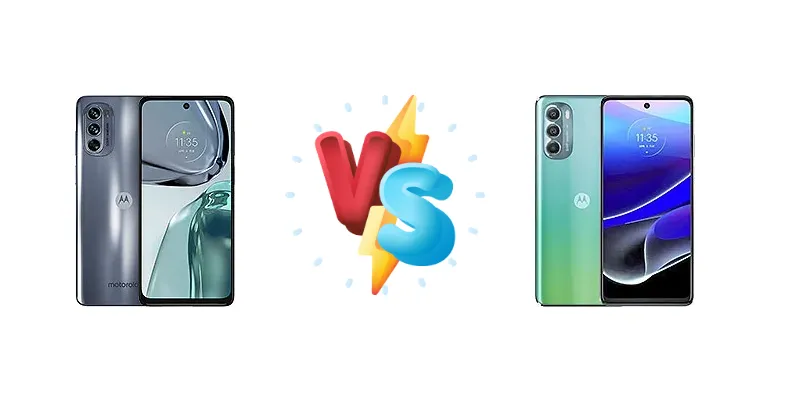
|
🏆 Quick Verdict
For most users, the Motorola Moto G Stylus 5G (2022) is the better choice. Its Snapdragon 695 chipset, built on a more efficient 6nm process, delivers noticeably improved performance over the G62 5G’s Snapdragon 480+. While the G62 boasts respectable endurance, the G Stylus’s faster processor justifies the slight trade-off in charging speed.
| PHONES | ||
|---|---|---|
| Phone Names | Motorola Moto G62 5G | Motorola Moto G Stylus 5G (2022) |
| Network | ||
|---|---|---|
| 2G bands | GSM 850 / 900 / 1800 / 1900 | GSM 850 / 900 / 1800 / 1900 |
| 3G bands | HSDPA 850 / 900 / 1700(AWS) / 1900 / 2100 | HSDPA 850 / 900 / 1700(AWS) / 1900 / 2100 |
| 4G bands | 1, 2, 3, 4, 5, 7, 8, 12, 13, 17, 18, 19, 20, 26, 28, 32, 38, 39, 40, 41, 42, 43 - Europe | 1, 2, 3, 4, 5, 7, 8, 12, 13, 17, 18, 19, 20, 25, 26, 28, 29, 30, 38, 39, 40, 41, 48, 66, 71 - USA |
| 5G bands | 1, 3, 5, 7, 8, 20, 28, 38, 40, 41, 77, 78 SA/NSA - Europe | 1, 2, 5, 12, 14, 24, 26, 29, 30, 41, 48, 66, 70, 71, 77, 78 SA/NSA - USA |
| Speed | HSPA, LTE, 5G | HSPA, LTE, 5G |
| Technology | GSM / HSPA / LTE / 5G | GSM / HSPA / LTE / 5G |
| 1, 5, 7, 28, 40, 41, 66, 78 SA/NSA - LATAM, Brazil | - | |
| Launch | ||
|---|---|---|
| Announced | 2022, June 09 | 2022, April 22 |
| Status | Available. Released 2022, June 28 | Available. Released 2022, April 27 |
| Body | ||
|---|---|---|
| Build | Glass front, plastic frame, plastic back | Glass front, plastic frame, plastic back |
| Dimensions | 161.8 x 74 x 8.6 mm (6.37 x 2.91 x 0.34 in) | 168.9 x 75.8 x 9.3 mm (6.65 x 2.98 x 0.37 in) |
| SIM | Nano-SIM + Nano-SIM | Nano-SIM |
| Weight | 184 g (6.49 oz) | 215 g (7.58 oz) |
| Water-repellent design | Stylus Water-repellent design | |
| Display | ||
|---|---|---|
| Resolution | 1080 x 2400 pixels, 20:9 ratio (~405 ppi density) | 1080 x 2460 pixels (~395 ppi density) |
| Size | 6.5 inches, 102.0 cm2 (~85.2% screen-to-body ratio) | 6.8 inches, 109.8 cm2 (~85.8% screen-to-body ratio) |
| Type | IPS LCD, 120Hz | IPS LCD, 120Hz |
| Platform | ||
|---|---|---|
| CPU | Octa-core (2x2.2 GHz Kryo 460 & 6x1.8 GHz Kryo 460) | Octa-core (2x2.2 GHz Kryo 660 Gold & 6x1.7 GHz Kryo 660 Silver) |
| Chipset | Qualcomm SM4350-AC Snapdragon 480+ 5G (8 nm) | Qualcomm SM6375 Snapdragon 695 5G (6 nm) |
| GPU | Adreno 619 | Adreno 619 |
| OS | Android 12, upgradable to Android 13 | Android 12, planned upgrade to Android 13 |
| Memory | ||
|---|---|---|
| Card slot | microSDXC (uses shared SIM slot) | microSDXC (dedicated slot) |
| Internal | 64GB 4GB RAM, 128GB 4GB RAM, 128GB 6GB RAM, 128GB 8GB RAM | 128GB 4GB RAM, 128GB 6GB RAM, 128GB 8GB RAM, 256GB 8GB RAM |
| Main Camera | ||
|---|---|---|
| Features | LED flash, HDR, panorama | LED flash, HDR, panorama |
| Triple | 50 MP, f/1.8 (wide), 1/2.76", 0.64µm, PDAF 8 MP, f/2.2, 118˚ (ultrawide), 1/4.0", 1.12µm 2 MP (macro) | 50 MP, f/1.9, 26mm (wide), 0.64µm, PDAF, OIS 8 MP, f/2.2, 118˚ (ultrawide), 1/4.0, 1.12µm Auxiliary lens |
| Video | 1080p@30/60fps | 1080p@30/60fps; gyro-EIS |
| Selfie camera | ||
|---|---|---|
| Features | - | HDR |
| Single | 16 MP, f/2.2, (wide), 1/3.0", 1.0µm | 16 MP, f/2.2, (wide), 1/3.06", 1.0µm |
| Video | 1080p@30fps | 1080p@30fps |
| Sound | ||
|---|---|---|
| 3.5mm jack | Yes | Yes |
| 35mm jack | Yes | Yes |
| Loudspeaker | Yes, with stereo speakers | Yes |
| Comms | ||
|---|---|---|
| Bluetooth | 5.1, A2DP, LE | 5.1, A2DP, LE |
| NFC | Yes | Yes |
| Positioning | GPS, GLONASS, GALILEO, BDS | GPS, GLONASS, BDS, GALILEO |
| Radio | Unspecified | FM radio |
| USB | USB Type-C 2.0 | USB Type-C 2.0 |
| WLAN | Wi-Fi 802.11 a/b/g/n/ac, dual-band, Wi-Fi Direct | Wi-Fi 802.11 a/b/g/n/ac, dual-band, Wi-Fi Direct |
| Features | ||
|---|---|---|
| Sensors | Fingerprint (side-mounted), accelerometer, gyro, proximity, compass | Fingerprint (side-mounted), accelerometer, gyro, proximity |
| Battery | ||
|---|---|---|
| Charging | 15W wired | 10W wired, QC3 |
| Type | Li-Po 5000 mAh | Li-Po 5000 mAh |
| Misc | ||
|---|---|---|
| Colors | Midnight Gray, Frosted Blue | Steel Blue, Seafoam Green |
| Models | - | XT2215, XT2215-1, XT2215-2, XT2215-3, XT2215-4 |
| Price | About 110 EUR | $ 66.60 |
| Tests | ||
|---|---|---|
| Battery life | Endurance rating 122h | - |
| Camera | Photo / Video | - |
| Display | Contrast ratio: 1571:1 | - |
| Loudspeaker | -25.9 LUFS (Very good) | - |
| Performance | AnTuTu: 303072 (v9) GeekBench: 1697 (v5.1) GFXBench: 14fps (ES 3.1 onscreen) | - |
Motorola Moto G62 5G
- Excellent battery endurance (122h)
- Potentially more affordable price point
- Decent display contrast ratio (1571:1)
- Less powerful Snapdragon 480+ chipset
- Slower 15W charging
- Likely less responsive user experience
Motorola Moto G Stylus 5G (2022)
- More powerful Snapdragon 695 chipset (6nm)
- Faster processing for multitasking and gaming
- Quick Charge 3.0 compatibility
- Potentially shorter battery life
- Slower 10W charging (without QC3.0)
- May be slightly more expensive
Display Comparison
Both phones lack detailed display specifications beyond the G62’s measured 552 nits of peak brightness and 1571:1 contrast ratio. However, the G62’s brightness suggests a reasonably viewable outdoor experience. Without comparable data for the G Stylus, we can infer that it likely falls within a similar range, typical for this price bracket. The absence of high refresh rate panels on either device means neither will offer the silky-smooth scrolling found on more premium phones. The G62’s contrast ratio indicates a decent, if not exceptional, picture quality.
Camera Comparison
Both phones are listed with 'Photo / Video' capabilities, offering minimal insight. Without sensor size or aperture details, a direct comparison is difficult. It’s reasonable to assume both employ standard camera setups for their price range, likely prioritizing versatility over outright image quality. The absence of any mention of OIS (Optical Image Stabilization) suggests neither phone will excel in low-light photography. Focusing on the processor, the G Stylus’s superior image signal processor (ISP) within the Snapdragon 695 will likely result in faster image processing and potentially better dynamic range.
Performance
The core difference lies in the chipsets. The Moto G Stylus 5G (2022) utilizes the Qualcomm Snapdragon 695 5G (6nm), a significant upgrade over the G62 5G’s Snapdragon 480+ 5G (8nm). The 6nm process node of the 695 translates to improved power efficiency and thermal performance, allowing for sustained performance under load. The CPU configuration also favors the G Stylus, with 2x2.2 GHz Kryo 660 Gold cores and 6x1.7 GHz Kryo 660 Silver cores, compared to the G62’s 2x2.2 GHz Kryo 460 and 6x1.8 GHz Kryo 460. This architectural difference, combined with the process node advantage, results in a more responsive user experience on the G Stylus.
Battery Life
The Moto G62 5G boasts an endurance rating of 122 hours, a strong indicator of excellent battery life. However, its 15W wired charging is comparatively slow. The G Stylus 5G (2022) offers 10W wired charging with Quick Charge 3.0 compatibility. While slower than the G62, QC3.0 can provide a faster initial charge rate with a compatible charger. The G Stylus’s more powerful processor will consume more power, potentially offsetting some of the battery life advantage held by the G62. The 6nm process of the 695 should mitigate this somewhat, but real-world usage will determine the actual difference.
Buying Guide
Buy the Motorola Moto G62 5G if you prioritize long battery life and a consistently smooth experience for basic tasks like browsing and social media. Buy the Motorola Moto G Stylus 5G (2022) if you prefer a more responsive device for multitasking, gaming, and demanding applications, and are willing to accept slightly slower charging and potentially marginally reduced battery endurance.