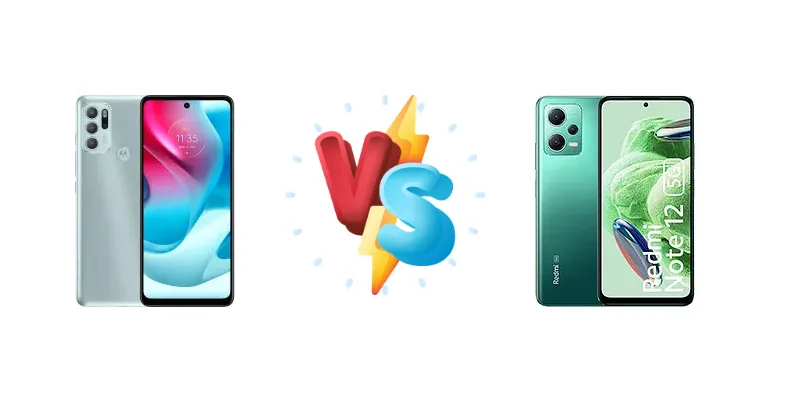
Choosing a new smartphone can be overwhelming, especially with so many options in the mid-range category. Today, we're pitting two popular contenders against each other: the Motorola Moto G60S and the Xiaomi Redmi Note 12. Let's dive into a detailed comparison to help you decide which one deserves your money.
🏆 Quick Verdict
The Redmi Note 12 edges out the Moto G60S thanks to its superior battery life, brighter display, and efficient Snapdragon chipset. While the G60S boasts faster charging, the Note 12's overall package offers a more compelling experience for most users.
| Network |
|---|
| 2G bands | GSM 850 / 900 / 1800 / 1900 | GSM 850 / 900 / 1800 / 1900 |
| 3G bands | HSDPA 850 / 900 / 1700(AWS) / 1900 / 2100 | HSDPA 850 / 900 / 2100 |
| 4G bands | 1, 2, 3, 4, 5, 7, 8, 12, 13, 17, 28, 40, 66 | 1, 3, 5, 8, 40, 41 |
| 5G bands | - | 1, 3, 5, 8, 28, 40, 78 SA/NSA |
| Speed | HSPA, LTE | HSPA, LTE, 5G |
| Technology | GSM / HSPA / LTE | GSM / HSPA / LTE / 5G |
| Launch |
|---|
| Announced | 2021, August 12 | 2022, October 27 |
| Status | Available. Released 2021, August 12 | Available. Released 2023, January 11 |
| Body |
|---|
| Build | Glass front, plastic frame, plastic back | - |
| Dimensions | 169.7 x 75.9 x 9.6 mm (6.68 x 2.99 x 0.38 in) | 165.9 x 76.2 x 8 mm (6.53 x 3.00 x 0.31 in) |
| SIM | Nano-SIM + Nano-SIM | Nano-SIM + Nano-SIM |
| Weight | 212 g (7.48 oz) | 188 g (6.63 oz) |
| | Water repellent design | IP53, dust and splash resistant |
| Display |
|---|
| Protection | - | Corning Gorilla Glass 3 |
| Resolution | 1080 x 2460 pixels (~395 ppi density) | 1080 x 2400 pixels, 20:9 ratio (~395 ppi density) |
| Size | 6.8 inches, 109.8 cm2 (~85.3% screen-to-body ratio) | 6.67 inches, 107.4 cm2 (~85.0% screen-to-body ratio) |
| Type | IPS LCD, 120Hz, HDR10, 450 nits (typ), 562 nits (HBM) | AMOLED, 120Hz, 1200 nits (peak) |
| Platform |
|---|
| CPU | Octa-core (2x2.05 GHz Cortex-A76 & 6x2.0 GHz Cortex-A55) | Octa-core (2x2.0 GHz Cortex-A78 & 6x1.8 GHz Cortex-A55) |
| Chipset | Mediatek MT6785V/CD Helio G95 (12 nm) | Qualcomm SM4375 Snapdragon 4 Gen 1 (6 nm) |
| GPU | Mali-G76 MC4 | Adreno 619 |
| OS | Android 11 | Android 12, MIUI 14 (International), MIUI 13 (India) |
| Memory |
|---|
| Card slot | microSDXC (uses shared SIM slot) | microSDXC (uses shared SIM slot) |
| Internal | 128GB 4GB RAM, 128GB 6GB RAM | 128GB 4GB RAM, 128GB 6GB RAM, 256GB 8GB RAM |
| | UFS 2.1 | UFS 2.2 |
| Main Camera |
|---|
| Features | LED flash, HDR, panorama | Dual-LED dual-tone flash, HDR, panorama |
| Quad | 64 MP, f/1.7, 26mm (wide), PDAF
8 MP, f/2.2, 119˚, (ultrawide)
5 MP (macro)
Auxiliary lens | - |
| Triple | - | 48 MP, f/1.8, (wide), PDAF
8 MP, f/2.2, 120˚ (ultrawide), 1/4.0", 1.12µm
2 MP (macro) |
| Video | 4K@30/120fps, 1080p@30/60/240fps | 1080p@30fps |
| Selfie camera |
|---|
| Features | LED flash, HDR | HDR |
| Single | 16 MP, f/2.2, (wide) | 13 MP, f/2.5, (wide), 1/3.0" |
| Video | 4K@30fps, 1080p@30/60/240fps | 1080p@30fps |
| Sound |
|---|
| 3.5mm jack | Yes | Yes |
| 35mm jack | Yes | Yes |
| Loudspeaker | Yes | Yes |
| | - | 24-bit/192kHz audio |
| Comms |
|---|
| Bluetooth | 5.0, A2DP, LE | 5.1, A2DP, LE |
| Infrared port | - | Yes |
| NFC | Yes | Yes (market/region dependent) |
| Positioning | GPS, GLONASS, GALILEO | GPS, GLONASS |
| Radio | FM radio | Unspecified |
| USB | USB Type-C 2.0, OTG | USB Type-C 2.0, OTG |
| WLAN | Wi-Fi 802.11 a/b/g/n/ac, dual-band, Wi-Fi Direct | Wi-Fi 802.11 a/b/g/n/ac, dual-band |
| Features |
|---|
| Sensors | Fingerprint (rear-mounted), accelerometer, gyro, proximity | Fingerprint (side-mounted), accelerometer, gyro, proximity, compass |
| Battery |
|---|
| Charging | 50W wired, QC4 | 33W wired, 50% in 22 min |
| Type | Li-Po 5000 mAh | Li-Po 5000 mAh |
| Misc |
|---|
| Colors | Green, Blue | Frosted Green, Matte Black, Mystique Blue |
| Models | XT2133-2, XT2133-1 | 22111317I, 22111317G |
| Price | About 200 EUR | € 151.99 / $ 219.99 / ₹ 11,999 |
| SAR | - | 1.09 W/kg (head) 1.05 W/kg (body) |
| SAR EU | - | 0.68 W/kg (head) 0.91 W/kg (body) |
| Tests |
|---|
| Battery life | - |
Endurance rating 101h
|
| Camera | - |
Photo / Video |
| Display | - |
Contrast ratio: Infinite (nominal) |
| Loudspeaker | - |
-28.0 LUFS (Good)
|
| Performance | - |
AnTuTu: 360745 (v9)
GeekBench: 1998 (v5.1), 2017 (v6) |
Motorola Moto G60S
- Faster Charging (50W)
- Potentially better gaming performance (GPU)
- Clean Android experience
- Lower display brightness
- Less impressive battery life
- Camera performance may be inconsistent
Xiaomi Redmi Note 12
- Exceptional battery life
- Brighter and more vibrant display
- Efficient Snapdragon 4 Gen 1 chipset
- Good value for money
- Slower charging (33W)
- Design may be less appealing to some
- Software can be a bit bloated
Display Comparison
The Redmi Note 12 takes the display crown with a measured peak brightness of 706 nits, offering significantly better visibility in sunlight. Its 'infinite' contrast ratio (though nominal) suggests excellent image quality. The Moto G60S has a decent display, but lacks the Note 12's brightness and potentially contrast.
Camera Comparison
Both phones offer capable camera systems, but detailed camera comparisons require more in-depth testing. The Redmi Note 12 likely benefits from Xiaomi's image processing expertise. The Moto G60S's camera is generally considered decent for the price point.
Performance
The Moto G60S's Helio G95 chipset is geared towards gaming, offering a slightly more powerful GPU. However, the Redmi Note 12's Snapdragon 4 Gen 1, built on a more efficient 6nm process, provides excellent overall performance and better power efficiency. Day-to-day tasks will feel smooth on both, but the Note 12's efficiency is a key advantage.
Battery Life
The Redmi Note 12 absolutely dominates in battery life, boasting an endurance rating of 101 hours and active use lasting 10 hours and 58 minutes. The Moto G60S, while having faster charging (50W vs 33W), simply can't match the Note 12's longevity.
Buying Guide
The Motorola Moto G60S is a good choice for users prioritizing fast charging and a slightly more powerful chipset for gaming. The Xiaomi Redmi Note 12 is ideal for those seeking exceptional battery life, a vibrant display, and a smooth, efficient user experience.
Frequently Asked Questions
❓ Which phone has better gaming performance?
The Motorola Moto G60S potentially has a slight edge in gaming due to its GPU, but the Redmi Note 12's efficient chipset ensures smooth gameplay as well.
❓ Is the Redmi Note 12's 'infinite' contrast ratio accurate?
The 'infinite' contrast ratio is a marketing term and is nominal. However, it suggests excellent image quality and deep blacks on the display.