
Motorola Moto G60 vs. Moto G50 5G: A Deep Dive into Budget 5G Performance
| Phones Images | |||||
|---|---|---|---|---|---|
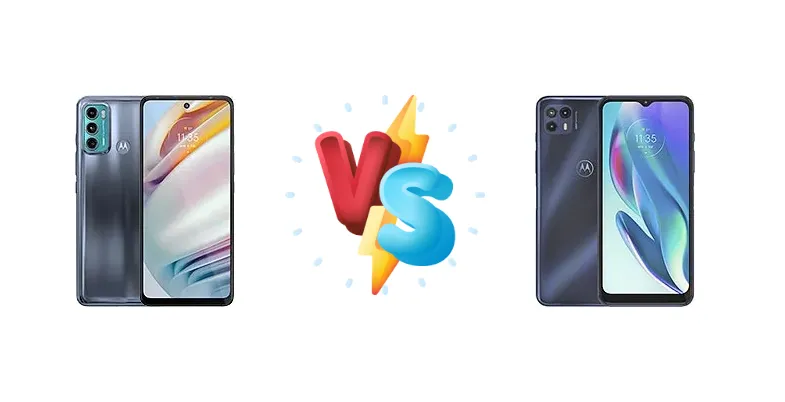
|
🏆 Quick Verdict
For most users, the Motorola Moto G60 emerges as the stronger choice. Its Snapdragon 732G chipset provides a noticeable performance edge in demanding tasks and gaming, and the 20W Quick Charge support offers faster refueling. While the G50 5G offers 5G at a lower price, the performance trade-off is significant.
| PHONES | ||
|---|---|---|
| Phone Names | Motorola Moto G60 | Motorola Moto G50 5G |
| Network | ||
|---|---|---|
| 2G bands | GSM 850 / 900 / 1800 / 1900 | GSM 850 / 900 / 1800 / 1900 |
| 3G bands | HSDPA 850 / 900 / 1700(AWS) / 1900 / 2100 | HSDPA 850 / 900 / 1700(AWS) / 1900 / 2100 - Australia |
| 4G bands | 1, 2, 3, 4, 5, 7, 8, 12, 13, 17, 19, 28, 40, 66 - LATAM | 1, 2, 3, 4, 5, 7, 8, 12, 13, 17, 18, 19, 20, 26, 28, 38, 40, 41, 42, 43, 66 - Australia |
| 5G bands | - | 1, 3, 5, 7, 8, 20, 28, 38, 40, 41, 77, 78 SA/NSA - Australia |
| Speed | HSPA, LTE | HSPA, LTE, 5G |
| Technology | GSM / HSPA / LTE | GSM / HSPA / LTE / 5G |
| 1, 2, 3, 4, 5, 7, 8, 18, 19, 20, 26, 28, 38, 40, 41 - India | - | |
| Launch | ||
|---|---|---|
| Announced | 2021, April 20 | 2021, August 25 |
| Status | Available. Released 2021, April 27 | Available. Released 2021, August 25 |
| Body | ||
|---|---|---|
| Build | Glass front, plastic frame, plastic back | Glass front, plastic back, plastic frame |
| Dimensions | 169.6 x 75.9 x 9.8 mm (6.68 x 2.99 x 0.39 in) | 167 x 76.4 x 9.3 mm (6.57 x 3.01 x 0.37 in) |
| SIM | · Nano-SIM· Nano-SIM + Nano-SIM | Nano-SIM + Nano-SIM |
| Weight | 225 g (7.94 oz) | 206 g (7.27 oz) |
| Water repellent design | Water-repellent design | |
| Display | ||
|---|---|---|
| Resolution | 1080 x 2460 pixels (~395 ppi density) | 720 x 1600 pixels, 20:9 ratio (~269 ppi density) |
| Size | 6.8 inches, 109.8 cm2 (~85.3% screen-to-body ratio) | 6.5 inches, 102.8 cm2 (~80.5% screen-to-body ratio) |
| Type | IPS LCD, 120Hz, HDR10 | IPS LCD, 90Hz |
| Platform | ||
|---|---|---|
| CPU | Octa-core (2x2.3 GHz Kryo 470 Gold & 6x1.8 GHz Kryo 470 Silver) | Octa-core (2x2.2 GHz Cortex-A76 & 6x2.0 GHz Cortex-A55) |
| Chipset | Qualcomm SM7150 Snapdragon 732G (8 nm) | Mediatek Dimensity 700 (7 nm) |
| GPU | Adreno 618 | Mali-G57 MC2 |
| OS | Android 11, upgradable to Android 12 | Android 11 |
| Memory | ||
|---|---|---|
| Card slot | microSDXC (uses shared SIM slot) | microSDXC (uses shared SIM slot) |
| Internal | 128GB 4GB RAM, 128GB 6GB RAM | 64GB 4GB RAM, 128GB 4GB RAM |
| UFS 2.1 | - | |
| Main Camera | ||
|---|---|---|
| Features | LED flash, HDR, panorama | LED flash, HDR, panorama |
| Triple | 108 MP, f/1.9, (wide), 1/1.52", 0.7µm, PDAF 8 MP, f/2.2, 118˚ (ultrawide), 1/4.0", 1.12µm Auxiliary lens | 48 MP, f/1.7, 26mm (wide), 1/2.0", 0.8µm, PDAF 2 MP (macro) Auxiliary lens |
| Video | 4K@30/120fps, 1080p@30/60/240fps | 1080p@30/60fps |
| Selfie camera | ||
|---|---|---|
| Features | LED flash, HDR | HDR |
| Single | 32 MP, f/2.2, (wide), 0.7µm | 13 MP, f/2.0, (wide), 1/3.1", 1.12µm |
| Video | 4K@30fps, 1080p@30/60/240fps | 1080p@30/60fps |
| Sound | ||
|---|---|---|
| 3.5mm jack | Yes | Yes |
| 35mm jack | Yes | Yes |
| Loudspeaker | Yes | Yes |
| Comms | ||
|---|---|---|
| Bluetooth | 5.0, A2DP, LE | 5.0, A2DP, LE |
| NFC | Yes | Yes |
| Positioning | GPS, GLONASS, GALILEO | GPS |
| Radio | FM radio | Unspecified |
| USB | USB Type-C 2.0, OTG | USB Type-C 2.0, OTG |
| WLAN | Wi-Fi 802.11 a/b/g/n/ac, dual-band, Wi-Fi Direct | Wi-Fi 802.11 a/b/g/n/ac, dual-band, Wi-Fi Direct |
| Features | ||
|---|---|---|
| Sensors | Fingerprint (rear-mounted), accelerometer, gyro, proximity | Fingerprint (side-mounted), accelerometer, gyro, proximity |
| Battery | ||
|---|---|---|
| Charging | 20W wired, QC4 | 15W wired |
| Type | Li-Po 6000 mAh | Li-Po 5000 mAh |
| Misc | ||
|---|---|---|
| Colors | Dynamic Gray, Frosted Champagne | Meteorite Grey |
| Models | PANB0001IN, PANB0013IN, PANB0015IN | XT2149-1 |
| Price | About 280 EUR | About 170 EUR |
| SAR | 0.85 W/kg (head) 1.20 W/kg (body) | - |
Motorola Moto G60
- Faster Snapdragon 732G processor for smoother performance
- 20W Quick Charge 4 for faster charging
- Potentially better image processing due to the Snapdragon ISP
- May be slightly more expensive than the G50 5G
- Detailed display specs are unknown
Motorola Moto G50 5G
- More affordable price point
- 5G connectivity
- Likely large battery capacity
- Slower MediaTek Dimensity 700 processor
- Slower 15W charging
- Potentially inferior image processing
Display Comparison
Both phones likely feature LCD panels, a common trait in this price bracket. However, detailed display specs (resolution, refresh rate, brightness) are missing. The G60's Snapdragon 732G has a more powerful ISP, suggesting potentially better image processing for display output. The absence of high refresh rate information is a key omission, impacting smoothness. Bezels are likely comparable given the similar target market.
Camera Comparison
Without detailed camera sensor information, a direct comparison is difficult. However, the Snapdragon 732G’s superior ISP in the G60 suggests better image processing capabilities, potentially leading to improved dynamic range and low-light performance. The G60 is likely to handle more complex computational photography tasks more effectively. The presence of a 2MP macro camera on both devices is largely a marketing gimmick and unlikely to deliver significant image quality improvements. Focusing on the main sensor's capabilities is crucial.
Performance
The core difference lies in the chipsets. The Moto G60’s Qualcomm Snapdragon 732G (8nm) boasts a more refined architecture with Kryo 470 cores, offering a performance advantage over the Moto G50 5G’s MediaTek Dimensity 700 (7nm). While both are octa-core, the Snapdragon’s 2x2.3 GHz Kryo 470 Gold cores are clocked slightly higher than the Dimensity’s 2x2.2 GHz Cortex-A76 cores. The 8nm process of the Snapdragon 732G also suggests potentially better thermal efficiency, reducing throttling during sustained workloads. This translates to a smoother experience for gamers and power users. The G50 5G's Dimensity 700 prioritizes 5G connectivity, but at the cost of raw processing power.
Battery Life
Both phones likely feature large batteries (exact mAh not specified), typical of Motorola's G-series. However, the G60’s 20W wired charging with Quick Charge 4 (QC4) support is a significant advantage over the G50 5G’s 15W charging. This means the G60 can be topped up much faster, reducing downtime. While a larger battery capacity on the G50 5G might offer slightly longer overall runtime, the faster charging of the G60 provides a more convenient user experience.
Buying Guide
Buy the Motorola Moto G60 if you need a phone capable of handling multitasking, moderate gaming, and benefit from faster charging speeds. It's ideal for users who prioritize a smoother, more responsive experience. Buy the Motorola Moto G50 5G if your primary concern is accessing 5G connectivity on a very tight budget and you primarily use your phone for basic tasks like calling, texting, and light social media browsing. The G50 5G is a good entry point into 5G, but expect compromises.