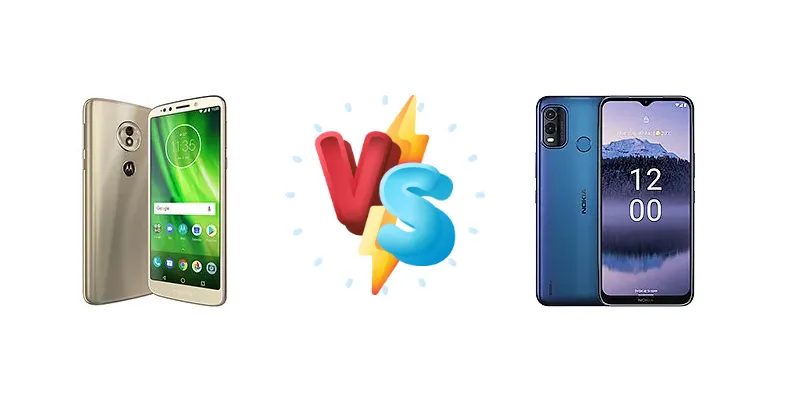
Looking for a reliable and affordable smartphone? The Motorola Moto G6 Play and Nokia G11 Plus are both strong contenders in the budget market. But which one offers the best value for your money? This comprehensive comparison dives deep into their specs and features to help you decide.
🏆 Quick Verdict
The Nokia G11 Plus edges out the Moto G6 Play thanks to its more modern chipset and potentially better performance. While the Moto G6 Play boasts incredible battery life, the G11 Plus's newer processor and slightly improved features make it the overall winner for most users.
| Network |
|---|
| 2G bands | GSM 850 / 900 / 1800 / 1900 | GSM 850 / 900 / 1800 / 1900 |
| 3G bands | HSDPA 850 / 900 / 1900 / 2100 - Europe, Brazil | HSDPA 850 / 900 / 2100 - International |
| 4G bands | 1, 3, 5, 7, 8, 20, 38 - Europe | 1, 3, 5, 7, 8, 20, 28, 38, 40, 41 - International |
| Speed | HSPA 42.2/5.76 Mbps, LTE Cat4 150/50 Mbps | HSPA 42.2/5.76 Mbps, LTE Cat4 150/50 Mbps |
| Technology | GSM / CDMA / HSPA / EVDO / LTE | GSM / HSPA / LTE |
| | 1, 2, 3, 4, 5, 7, 28 - Brazil | 1, 3, 5, 8, 40, 41 - India |
| Launch |
|---|
| Announced | 2018, April. Released 2018, May | 2022, June 29 |
| Status | Discontinued | Available. Released 2022, July 20 |
| Body |
|---|
| Build | Glass front (Gorilla Glass), plastic back, plastic frame | Glass front, plastic frame, plastic back |
| Dimensions | 154.4 x 72.2 x 9 mm (6.08 x 2.84 x 0.35 in) | 164.8 x 75.9 x 8.6 mm (6.49 x 2.99 x 0.34 in) |
| SIM | · Nano-SIM· Nano-SIM + Nano-SIM | · Nano-SIM· Nano-SIM + Nano-SIM |
| Weight | 175 g (6.17 oz) | 192 g (6.77 oz) |
| | Splash resistant | Splash protection |
| Display |
|---|
| Protection | Corning Gorilla Glass (unspecified version) | - |
| Resolution | 720 x 1440 pixels, 18:9 ratio (~282 ppi density) | 720 x 1600 pixels, 20:9 ratio (~269 ppi density) |
| Size | 5.7 inches, 83.8 cm2 (~75.2% screen-to-body ratio) | 6.52 inches, 102.6 cm2 (~82.1% screen-to-body ratio) |
| Type | IPS LCD | IPS LCD, 90Hz, 400 nits (typ) |
| Platform |
|---|
| CPU | Octa-core 1.4 GHz Cortex-A53Quad-core 1.4 GHz Cortex-A53 - USA | Octa-core (2x1.6 GHz Cortex-A75 & 6x1.6 GHz Cortex-A55) |
| Chipset | Qualcomm MSM8937 Snapdragon 430 (28 nm)Qualcomm MSM8920 Snapdragon 427 (28 nm) - USA | Unisoc T606 (12 nm) |
| GPU | Adreno 505Adreno 308 - USA | Mali-G57 MP1 |
| OS | Android 8.0 (Oreo), upgradable to Android 9.0 (Pie) | Android 12, upgradable to Android 13 |
| Memory |
|---|
| Card slot | microSDXC (dedicated slot) | microSDXC (dedicated slot) |
| Internal | 16GB 2GB RAM, 16GB 3GB RAM, 32GB 3GB RAM | 32GB 3GB RAM, 64GB 3GB RAM, 64GB 4GB RAM, 128GB 3GB RAM |
| | eMMC 5.1 | eMMC 5.1 |
| Main Camera |
|---|
| Dual | - | 50 MP, f/1.8, (wide), 1/2.67", PDAF
Auxiliary lens |
| Features | LED flash, HDR, panorama | LED flash |
| Single | 13 MP, f/2.0, 1/3.1", 1.12µm, PDAF | 8 MP, f/2.0, (wide), 1/4.0" |
| Video | 1080p@30fps | 1080p@30fps |
| Selfie camera |
|---|
| Features | LED flash | - |
| Single | 5 MP (USA)
8 MP (other markets) | 8 MP, f/2.0, (wide), 1/4.0" |
| Video | 1080p@30fps | 1080p@30fps |
| Sound |
|---|
| 3.5mm jack | Yes | Yes |
| 35mm jack | Yes | Yes |
| Loudspeaker | Yes | Yes |
| Comms |
|---|
| Bluetooth | 4.2, A2DP, LE, EDR | 5.0, A2DP, LE |
| NFC | Yes (Europe) | No |
| Positioning | GPS, GLONASS, BDS | GPS |
| Radio | FM radio | FM radio |
| USB | microUSB 2.0 | USB Type-C 2.0, OTG |
| WLAN | Wi-Fi 802.11 b/g/n, Wi-Fi DirectWi-Fi 802.11 a/b/g/n, dual-band, Wi-Fi Direct - USA | Wi-Fi 802.11 a/b/g/n/ac, dual-band, Wi-Fi Direct |
| Features |
|---|
| Sensors | Fingerprint (rear-mounted), accelerometer, gyro, proximity | Fingerprint (rear-mounted), accelerometer, proximity |
| Battery |
|---|
| Charging | 10W / 15W wired (market dependent) | 10W wired |
| Type | Li-Ion 4000 mAh, non-removable | Li-Ion 5000 mAh |
| Misc |
|---|
| Colors | Deep Indigo, Silver, Flash Gray, Gold | Lake Blue, Charcoal Grey |
| Models | XT1922-1, XT1922-2, XT1922-3, XT1922-4, XT1922-5, XT1922-10 | - |
| Price | About 150 EUR | About 130 EUR |
| SAR | 1.20 W/kg (head) 1.11 W/kg (body) | - |
| SAR EU | 0.66 W/kg (head) 1.42 W/kg (body) | - |
| Tests |
|---|
| Audio quality |
Noise -89.0dB / Crosstalk -87.3dB | - |
| Battery life |
Endurance rating 92h
| - |
| Camera |
Photo / Video | - |
| Display |
Contrast ratio: 1404 (nominal), 3.419 (sunlight) | - |
| Loudspeaker |
Voice 66dB / Noise 70dB / Ring 76dB
| - |
| Performance |
AnTuTu: 58757 (v7)
GeekBench: 2328 (v4.4)
GFXBench: 5.3fps (ES 3.1 onscreen) | - |
Motorola Moto G6 Play
- Exceptional battery life (92h endurance rating)
- Simple, clean Android experience
- Good sunlight display visibility
- Outdated chipset and performance
- Basic camera quality
- Slow charging (10W/15W market dependent)
Nokia G11 Plus
- More modern chipset (Unisoc T606) for better performance
- Potentially improved camera processing
- Sleeker design (likely)
- Slower charging (10W)
- Battery life likely not as exceptional as Moto G6 Play
- Limited camera details available
Display Comparison
The Moto G6 Play features a respectable contrast ratio (1404 nominal, 3.419 in sunlight), suggesting good visibility even outdoors. The Nokia G11 Plus likely has a more modern display panel, potentially with better color accuracy and brightness, though specific details are unavailable. Both phones likely feature HD+ resolution displays, suitable for everyday use.
Camera Comparison
Camera details are limited for both devices. The Moto G6 Play's camera is likely adequate for basic photography, but image quality won't be exceptional. The Nokia G11 Plus may offer slightly improved image processing and potentially better low-light performance due to its newer chipset, but a direct comparison would require detailed testing.
Performance
Here's where the Nokia G11 Plus shines. Its Unisoc T606 chipset with Cortex-A75 cores offers a significant performance boost over the Moto G6 Play's Snapdragon 430/427. Expect smoother multitasking, faster app loading, and a more responsive user experience on the G11 Plus. The Moto G6 Play, while functional, will show its age in demanding tasks.
Battery Life
The Moto G6 Play's endurance rating of 92h is truly remarkable, indicating exceptional battery life. The Nokia G11 Plus, while likely offering good battery life, probably won't match the G6 Play's longevity. However, the G11 Plus may support faster charging (though only 10W is confirmed), potentially offsetting some of the battery life difference.
Buying Guide
The Motorola Moto G6 Play is ideal for users prioritizing exceptional battery life and a familiar, simple Android experience. The Nokia G11 Plus is a better choice for those seeking a more modern processor, smoother performance, and a slightly more contemporary design, even with a slower charging speed.
Frequently Asked Questions
❓ Is the Moto G6 Play still worth buying?
If battery life is your absolute top priority and you're on a very tight budget, the Moto G6 Play remains a viable option. However, the Nokia G11 Plus offers a more modern experience overall.
❓ What is the difference between the Snapdragon 430 and the Unisoc T606?
The Unisoc T606 is a newer chipset with a more efficient architecture and Cortex-A75 cores, providing significantly better performance than the older Snapdragon 430.