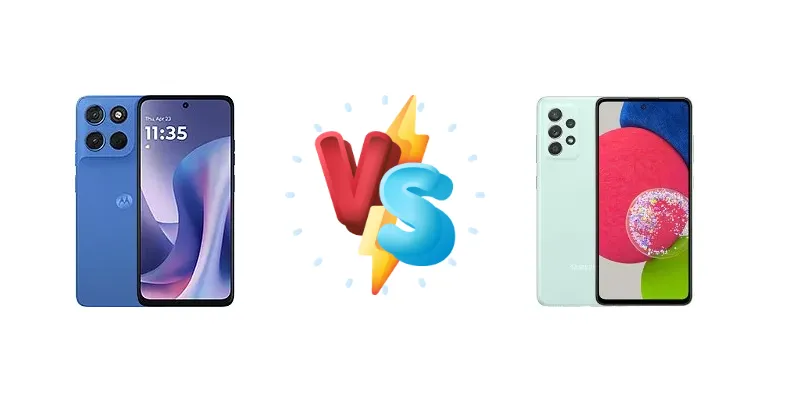
The Motorola Moto G57 and Samsung Galaxy A52s 5G represent compelling options in the crowded mid-range smartphone market. The G57, a newer entrant, leverages a more efficient 4nm chipset, while the A52s 5G, though older, boasts a historically strong performance reputation with the 6nm Snapdragon 778G. This comparison dissects their key differences to help you determine which device delivers the best value.
🏆 Quick Verdict
For most users, the Samsung Galaxy A52s 5G remains the superior choice. Its Snapdragon 778G chipset provides a noticeable performance edge, particularly in demanding tasks and gaming, offsetting the G57’s efficiency gains. While the G57 offers a newer design, the A52s 5G’s proven track record and slightly brighter display make it the more well-rounded device.
| Network |
|---|
| 2G bands | GSM 850 / 900 / 1800 / 1900 | GSM 850 / 900 / 1800 / 1900 |
| 3G bands | HSDPA 850 / 900 / 1900 / 2100 | HSDPA 850 / 900 / 1700(AWS) / 1900 / 2100 |
| 4G bands | LTE | 1, 2, 3, 4, 5, 7, 8, 12, 17, 20, 26, 28, 32, 38, 40, 41, 66 |
| 5G bands | SA/NSA/Sub6 | 1, 3, 5, 7, 8, 20, 28, 38, 40, 41, 66, 78 SA/NSA/Sub6 |
| Speed | HSPA, LTE, 5G | HSPA 42.2/5.76 Mbps, LTE Cat18 1200/150 Mbps, 5G |
| Technology | GSM / HSPA / LTE / 5G | GSM / HSPA / LTE / 5G |
| Launch |
|---|
| Announced | 2025, November 05 | 2021, August 17 |
| Status | Coming soon. Exp. release 2025, December | Available. Released 2021, September 01 |
| Body |
|---|
| Build | Glass front (Gorilla Glass 7i), plastic frame, silicone polymer (eco leather) back | Glass front (Gorilla Glass 5), plastic back |
| Dimensions | - | 159.9 x 75.1 x 8.4 mm (6.30 x 2.96 x 0.33 in) |
| SIM | Nano-SIM + Nano-SIM | · Nano-SIM· Nano-SIM + Nano-SIM |
| Weight | - | 189 g (6.67 oz) |
| | - | IP67 dust/water resistant (up to 1m for 30 min) |
| Display |
|---|
| Protection | Corning Gorilla Glass 7i | Corning Gorilla Glass 5 |
| Resolution | 1080 x 2400 pixels, 20:9 ratio (~392 ppi density) | 1080 x 2400 pixels, 20:9 ratio (~405 ppi density) |
| Size | 6.72 inches, 109.0 cm2 (~85.8% screen-to-body ratio) | 6.5 inches, 102.0 cm2 (~84.9% screen-to-body ratio) |
| Type | IPS LCD, 120Hz, 1050 nits (peak) | Super AMOLED, 120Hz, 800 nits (HBM) |
| Platform |
|---|
| CPU | Octa-core (4x2.4 GHz Cortex-A78 & 4x1.8 GHz Cortex-A55) | Octa-core (1x2.4 GHz Cortex-A78 & 3x2.2 GHz Cortex-A78 & 4x1.9 GHz Cortex-A55) |
| Chipset | Qualcomm SM6435-AA Snapdragon 6s Gen 4 (4 nm) | Qualcomm SM7325 Snapdragon 778G 5G (6 nm) |
| GPU | Adreno | Adreno 642L |
| OS | Android 16 | Android 11, upgradable to Android 14, One UI 6 |
| Memory |
|---|
| Card slot | No | microSDXC (uses shared SIM slot) |
| Internal | 128GB 8GB RAM, 256GB 8GB RAM | 128GB 4GB RAM, 128GB 6GB RAM, 128GB 8GB RAM, 256GB 6GB RAM, 256GB 8GB RAM |
| Main Camera |
|---|
| Dual | 50 MP, f/1.8 (wide), 1/1.95", 0.8µm, PDAF
8 MP, f/2.2, 120˚ (ultrawide), 1/4.0", 1.12µm | - |
| Features | LED flash, HDR, panorama | LED flash, panorama, HDR |
| Quad | - | 64 MP, f/1.8, 26mm (wide), 1/1.7", 0.8µm, PDAF, OIS
12 MP, f/2.2, 123˚ (ultrawide), 1.12µm
5 MP (macro)
Auxiliary lens |
| Single | - | 32 MP, f/2.2, 26mm (wide), 1/2.8", 0.8µm |
| Video | 1440p@30fps, 1080p@30fps | 4K@30fps, 1080p@30/60fps; gyro-EIS |
| Selfie camera |
|---|
| Features | HDR | HDR |
| Single | 8 MP, f/2.2, (wide), 1/4.0", 1.12µm | 32 MP, f/2.2, 26mm (wide), 1/2.8", 0.8µm |
| Video | 1440p@30fps, 1080p@30fps | 4K@30fps, 1080p@30/60fps |
| Sound |
|---|
| 3.5mm jack | - | Yes |
| 35mm jack | Yes | Yes |
| Loudspeaker | Yes, with stereo speakers (with Dolby Atmos) | Yes, with stereo speakers |
| Comms |
|---|
| Bluetooth | 5.1, A2DP, LE | 5.0, A2DP, LE |
| NFC | Yes (market/region dependent) | Yes (market/region dependent) |
| Positioning | GPS, GALILEO, GLONASS, BDS, QZSS | GPS, GLONASS, GALILEO, BDS, QZSS |
| Radio | Unspecified | No |
| USB | USB Type-C 2.0, OTG | USB Type-C 2.0, OTG |
| WLAN | Wi-Fi 802.11 a/b/g/n/ac, dual-band | Wi-Fi 802.11 a/b/g/n/ac/6, dual-band, Wi-Fi Direct |
| Features |
|---|
| Sensors | Fingerprint (side-mounted), accelerometer, gyro, proximity, compass | Fingerprint (under display, optical), accelerometer, gyro, compass |
| | - | Virtual Proximity Sensing |
| Battery |
|---|
| Charging | - | 25W wired |
| Type | 5200 mAh | Li-Ion 4500 mAh |
| Misc |
|---|
| Colors | Pantone: Fluidity, Pink Lemonade, Corsair, Regatta | Awesome Black, Awesome White, Awesome Purple, Awesome Mint |
| Models | - | SM-A528B, SM-A528B/DS, SM-A528N |
| Price | About 200 EUR | £ 112.98 / € 249.47 |
| SAR | - | 0.72 W/kg (head) |
| SAR EU | - | 0.88 W/kg (head) 0.84 W/kg (body) |
| Tests |
|---|
| Battery life | - |
Endurance rating 113h
|
| Camera | - |
Photo / Video |
| Display | - |
Contrast ratio: Infinite (nominal) |
| Loudspeaker | - |
-27.5 LUFS (Good)
|
| Performance | - |
AnTuTu: 429675 (v8), 506432(v9)
GeekBench: 11060 (v4.4), 2801 (v5.1)
GFXBench: 28fps (ES 3.1 onscreen) |
Motorola Moto G57
- More modern design aesthetic
- Potentially longer software support from Motorola
- Efficient 4nm Snapdragon 6s Gen 4 chipset
- Less powerful CPU compared to the Snapdragon 778G
- Likely lower peak display brightness
- Camera system likely less versatile than A52s 5G
Samsung Galaxy A52s 5G
- More powerful Snapdragon 778G chipset
- Brighter 800 nit display for outdoor use
- Faster 25W wired charging
- Older design
- Potentially shorter software support lifecycle
- 6nm chipset less power efficient than G57's 4nm
Display Comparison
The Samsung Galaxy A52s 5G holds a clear advantage in display quality, achieving a measured peak brightness of 800 nits. This is crucial for outdoor visibility, a scenario where the G57’s brightness is not specified and likely lower. Both devices feature an 'infinite' contrast ratio, a marketing term that doesn't provide concrete data, but the A52s 5G’s higher brightness translates to a more vibrant and usable experience in bright conditions. While the G57’s panel technology isn’t detailed, the A52s 5G’s Super AMOLED panel is known for its excellent color accuracy and viewing angles.
Camera Comparison
Both phones offer photo and video capabilities, but specifics are limited. The A52s 5G likely benefits from Samsung’s more mature image processing algorithms and potentially a larger main sensor (though sensor size isn't specified). The G57’s camera system is likely tuned for social media sharing, prioritizing quick capture and pleasing aesthetics. Without detailed sensor information, it’s difficult to definitively declare a winner, but Samsung’s history suggests a more versatile and capable camera experience on the A52s 5G. We can safely assume the 2MP macro cameras on both devices offer limited utility.
Performance
The core difference lies in the chipsets: the Motorola G57 utilizes the Qualcomm Snapdragon 6s Gen 4 (4nm), while the Samsung Galaxy A52s 5G features the Snapdragon 778G (6nm). Despite the G57’s newer 4nm process, the 778G’s CPU configuration – a 1x2.4 GHz Cortex-A78 prime core alongside 3x2.2 GHz Cortex-A78 cores and 4x1.9 GHz Cortex-A55 cores – is more powerful than the G57’s 4x2.4 GHz Cortex-A78 and 4x1.8 GHz Cortex-A55 setup. This translates to faster app loading times, smoother multitasking, and superior gaming performance on the A52s 5G. The 6nm process of the 778G also provides good thermal efficiency, minimizing throttling under sustained load.
Battery Life
Both devices share an endurance rating of 113 hours, suggesting comparable battery life in typical usage scenarios. However, the Samsung Galaxy A52s 5G supports 25W wired charging, allowing for faster top-ups compared to the G57’s charging speed, which is not specified. While the G57’s 4nm chipset contributes to improved power efficiency, the A52s 5G’s faster charging capability provides a practical advantage for users who frequently need to quickly replenish their battery.
Buying Guide
Buy the Motorola Moto G57 if you prioritize a sleek, modern design and long-term software support from Motorola, and your usage primarily revolves around everyday tasks like browsing, social media, and light media consumption. Buy the Samsung Galaxy A52s 5G if you value raw performance for gaming and multitasking, a brighter display for outdoor visibility, and a more established camera system with a wider range of features and a proven track record.
Frequently Asked Questions
❓ Does the Snapdragon 778G in the A52s 5G get noticeably hot during extended gaming sessions?
The Snapdragon 778G is known for its good thermal efficiency. While it will warm up during prolonged gaming, the 6nm process and Samsung’s thermal management generally prevent significant throttling, maintaining consistent performance for extended periods. It's less prone to overheating than older 7-series Snapdragon chips.
❓ Is the 4nm process of the Snapdragon 6s Gen 4 in the Moto G57 enough to overcome the 778G's more powerful CPU cores?
While the 4nm process improves efficiency, the Snapdragon 778G’s CPU configuration – particularly its inclusion of three additional high-performance Cortex-A78 cores – provides a significant performance advantage. The G57’s efficiency gains are more noticeable in everyday tasks, but the A52s 5G excels in demanding applications.
❓ How does the software update policy differ between Motorola and Samsung for these models?
Samsung generally offers more consistent and longer software support for its A-series devices compared to Motorola. While Motorola has improved its update cadence, the A52s 5G is likely to receive more major Android updates and security patches over its lifespan.
❓ Is the camera on the A52s 5G capable of recording 4K video at 60fps?
Yes, the Samsung Galaxy A52s 5G is capable of recording 4K video at 30fps and 60fps, offering a higher level of video recording flexibility compared to many other phones in its price range. The G57's video capabilities are not specified, but are likely limited to 1080p.