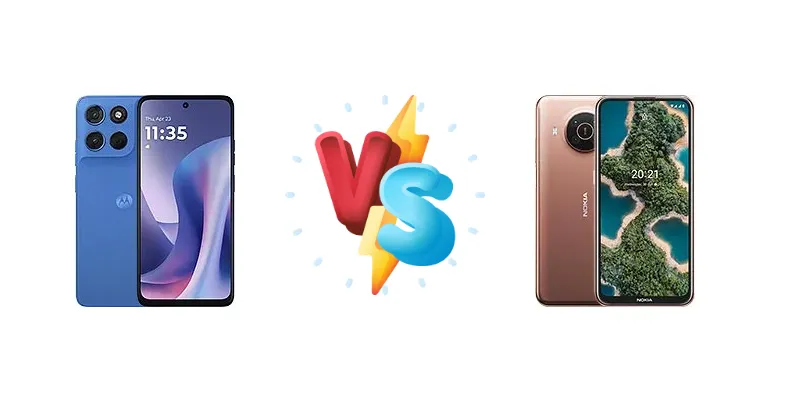
The Motorola Moto G57 and Nokia X20 represent different approaches to the budget 5G smartphone market. The G57, with its newer Snapdragon 6s Gen 4, aims for a performance edge, while the X20 prioritizes a clean software experience and a more established brand reputation. This comparison dissects the key differences to determine which device delivers the best overall value.
🏆 Quick Verdict
For the average user prioritizing responsiveness and future-proofing, the Motorola Moto G57 is the better choice. Its Snapdragon 6s Gen 4, built on a more efficient 4nm process, offers a noticeable performance uplift over the Nokia X20’s Snapdragon 480, translating to smoother multitasking and gaming.
| Network |
|---|
| 2G bands | GSM 850 / 900 / 1800 / 1900 | GSM 850 / 900 / 1800 / 1900 |
| 3G bands | HSDPA 850 / 900 / 1900 / 2100 | HSDPA 850 / 900 / 1700(AWS) / 1900 / 2100 |
| 4G bands | LTE | 1, 2, 3, 4, 5, 7, 8, 12, 20, 28, 66, 38, 39, 40, 41 |
| 5G bands | SA/NSA/Sub6 | 1, 2, 3, 5, 7, 28, 38, 41, 66, 78 SA/NSA/Sub6 |
| Speed | HSPA, LTE, 5G | HSPA, LTE, 5G |
| Technology | GSM / HSPA / LTE / 5G | GSM / HSPA / LTE / 5G |
| Launch |
|---|
| Announced | 2025, November 05 | 2021, April 08 |
| Status | Coming soon. Exp. release 2025, December | Available. Released 2021, May 12 |
| Body |
|---|
| Build | Glass front (Gorilla Glass 7i), plastic frame, silicone polymer (eco leather) back | - |
| Dimensions | - | 168.9 x 79.7 x 9.1 mm (6.65 x 3.14 x 0.36 in) |
| SIM | Nano-SIM + Nano-SIM | · Nano-SIM· Nano-SIM + Nano-SIM |
| Weight | - | 220 g (7.76 oz) |
| Display |
|---|
| Protection | Corning Gorilla Glass 7i | Corning Gorilla Glass 5 |
| Resolution | 1080 x 2400 pixels, 20:9 ratio (~392 ppi density) | 1080 x 2400 pixels, 20:9 ratio (~395 ppi density) |
| Size | 6.72 inches, 109.0 cm2 (~85.8% screen-to-body ratio) | 6.67 inches, 107.4 cm2 (~79.8% screen-to-body ratio) |
| Type | IPS LCD, 120Hz, 1050 nits (peak) | IPS LCD, 450 nits (typ) |
| Platform |
|---|
| CPU | Octa-core (4x2.4 GHz Cortex-A78 & 4x1.8 GHz Cortex-A55) | Octa-core (2x2.0 GHz Kryo 460 & 6x1.8 GHz Kryo 460) |
| Chipset | Qualcomm SM6435-AA Snapdragon 6s Gen 4 (4 nm) | Qualcomm SM4350 Snapdragon 480 5G (8 nm) |
| GPU | Adreno | Adreno 619 |
| OS | Android 16 | Android 11, upgradable to Android 14 |
| Memory |
|---|
| Card slot | No | microSDXC (uses shared SIM slot) |
| Internal | 128GB 8GB RAM, 256GB 8GB RAM | 128GB 6GB RAM, 128GB 8GB RAM |
| Main Camera |
|---|
| Dual | 50 MP, f/1.8 (wide), 1/1.95", 0.8µm, PDAF
8 MP, f/2.2, 120˚ (ultrawide), 1/4.0", 1.12µm | - |
| Features | LED flash, HDR, panorama | Zeiss optics, LED flash, HDR, panorama |
| Quad | - | 64 MP, (wide), PDAF
5 MP, (ultrawide)
2 MP (macro)
Auxiliary lens |
| Single | - | 32 MP, (wide) |
| Video | 1440p@30fps, 1080p@30fps | 1080p@30/60fps |
| Selfie camera |
|---|
| Features | HDR | - |
| Single | 8 MP, f/2.2, (wide), 1/4.0", 1.12µm | 32 MP, (wide) |
| Video | 1440p@30fps, 1080p@30fps | 1080p@30fps |
| Sound |
|---|
| 3.5mm jack | - | Yes |
| 35mm jack | Yes | Yes |
| Loudspeaker | Yes, with stereo speakers (with Dolby Atmos) | Yes |
| Comms |
|---|
| Bluetooth | 5.1, A2DP, LE | 5.0, A2DP, LE, aptX HD |
| NFC | Yes (market/region dependent) | Yes |
| Positioning | GPS, GALILEO, GLONASS, BDS, QZSS | GPS, GLONASS, GALILEO |
| Radio | Unspecified | FM radio |
| USB | USB Type-C 2.0, OTG | USB Type-C 2.0, OTG |
| WLAN | Wi-Fi 802.11 a/b/g/n/ac, dual-band | Wi-Fi 802.11 a/b/g/n/ac, dual-band, Wi-Fi Direct |
| Features |
|---|
| Sensors | Fingerprint (side-mounted), accelerometer, gyro, proximity, compass | Fingerprint (side-mounted), accelerometer, gyro, proximity |
| Battery |
|---|
| Charging | - | 18W wired |
| Type | 5200 mAh | Li-Po 4470 mAh |
| Misc |
|---|
| Colors | Pantone: Fluidity, Pink Lemonade, Corsair, Regatta | Midnight Sun, Nordic Blue |
| Models | - | TA-1341, TA-1344 |
| Price | About 200 EUR | About 130 EUR |
| SAR | - | 1.04 W/kg (head) 0.62 W/kg (body) |
| SAR EU | - | 0.51 W/kg (head) 1.29 W/kg (body) |
Motorola Moto G57
- More powerful Snapdragon 6s Gen 4 chipset
- Superior power efficiency (4nm process)
- Potentially better camera image processing
- Charging speed not specified
- Software update commitment unclear
Nokia X20
- 18W wired charging
- Clean stock Android experience
- Nokia’s reputation for software updates
- Older, less powerful Snapdragon 480 chipset
- Less efficient 8nm process
- Performance limitations with demanding apps
Display Comparison
Neither device is a display standout. While specific display specs (resolution, refresh rate) are missing, the focus here is on the underlying processing power impacting display responsiveness. The Snapdragon 6s Gen 4 in the G57 has an improved ISP which can contribute to better image processing for the display. The Nokia X20’s display performance will be limited by the older Snapdragon 480’s capabilities.
Camera Comparison
Without detailed camera specs, it’s difficult to make a definitive judgment. However, the Snapdragon 6s Gen 4’s improved ISP (Image Signal Processor) in the Moto G57 will likely result in better image quality, particularly in low-light conditions. The ISP handles noise reduction, dynamic range, and color accuracy. While the Nokia X20 may offer a decent camera experience, the G57’s chipset provides a foundation for superior image processing capabilities. We can assume both phones will feature standard camera setups for their price point, with the G57 having the potential for better software-driven enhancements.
Performance
The core difference lies in the chipsets. The Motorola Moto G57’s Qualcomm SM6435-AA Snapdragon 6s Gen 4 (4nm) is a significant upgrade over the Nokia X20’s Snapdragon 480 5G (8nm). The 4nm fabrication process of the 6s Gen 4 delivers superior power efficiency and thermal performance, allowing for sustained performance under load. The G57’s CPU, with its 4x2.4 GHz Cortex-A78 cores, provides a substantial boost in single-core and multi-core performance compared to the X20’s 2x2.0 GHz Kryo 460 cores. This translates to faster app loading times, smoother scrolling, and a more enjoyable gaming experience. The X20’s Snapdragon 480 is adequate for basic tasks, but will struggle with demanding applications.
Battery Life
The Nokia X20 includes 18W wired charging, a feature absent from the provided G57 specs. While the G57’s more efficient 4nm chipset will likely result in better battery life overall, the X20’s charging capability provides a faster top-up option. Without knowing the battery capacity of the G57, it’s hard to say which phone will offer longer runtime, but the 6s Gen 4’s efficiency gives the G57 an advantage. The X20’s 18W charging, while not exceptionally fast, is a tangible benefit.
Buying Guide
Buy the Motorola Moto G57 if you need a phone that feels snappy and responsive for everyday tasks and light gaming, and if you value a more modern chipset for potential software updates. Buy the Nokia X20 if you prefer a stock Android experience with guaranteed software updates (a Nokia strength) and prioritize a slightly more conservative, reliable performance profile over raw speed.
Frequently Asked Questions
❓ Will the Snapdragon 480 in the Nokia X20 struggle with graphically intensive games like PUBG Mobile?
Yes, the Snapdragon 480 is an entry-level 5G chipset. While it can run PUBG Mobile, you’ll likely need to lower the graphics settings significantly to achieve a playable frame rate. Expect stuttering and lag, especially in crowded scenes. The Moto G57’s Snapdragon 6s Gen 4 will provide a much smoother gaming experience.
❓ How does the 4nm process of the Snapdragon 6s Gen 4 benefit real-world battery life on the Moto G57?
The 4nm process allows the Snapdragon 6s Gen 4 to operate more efficiently, consuming less power for the same level of performance compared to the 8nm Snapdragon 480. This translates to longer battery life during typical usage, meaning you can go longer between charges. It also generates less heat, reducing thermal throttling and maintaining performance for extended periods.
❓ Does the Nokia X20’s 18W charging make a significant difference compared to a phone with no specified charging speed?
Yes, 18W charging is a tangible benefit. While not the fastest charging available, it will significantly reduce the time it takes to charge the Nokia X20 from 0% to 100% compared to a phone relying on slower, standard charging speeds. The Moto G57’s charging speed is currently unknown, making the X20’s 18W a clear advantage.