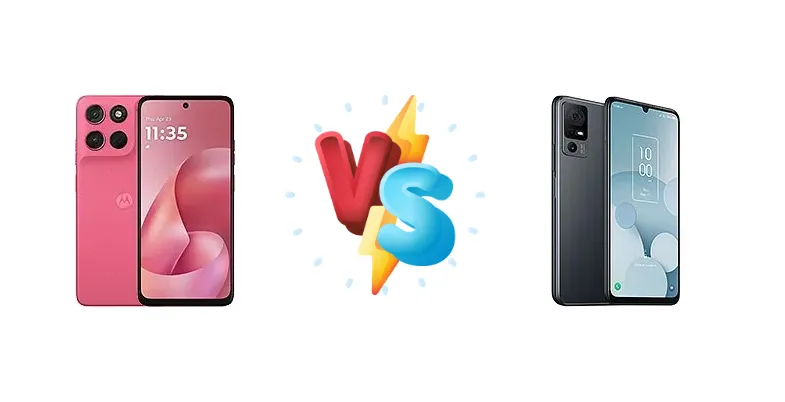
The Motorola Moto G57 Power and TCL 40 XL represent compelling options in the crowded budget smartphone market. While both aim to deliver essential features at an accessible price, they diverge significantly in their core hardware. This comparison dissects those differences, focusing on the impact of the Snapdragon 6s Gen 4 in the Moto G57 Power versus the MediaTek Helio G37 powering the TCL 40 XL, to determine which device offers the best value for your money.
🏆 Quick Verdict
For the average user prioritizing performance and future-proofing, the Motorola Moto G57 Power is the clear winner. Its Snapdragon 6s Gen 4 chipset provides a substantial leap in processing power and efficiency compared to the TCL 40 XL’s Helio G37, translating to smoother multitasking and a more responsive user experience. While the TCL 40 XL offers a slightly lower entry price, the G57 Power’s superior chipset justifies the potential cost difference.
| Network |
|---|
| 2G bands | GSM 850 / 900 / 1800 / 1900 | GSM 850 / 900 / 1800 / 1900 |
| 3G bands | HSDPA 850 / 900 / 1900 / 2100 | HSDPA 850 / 1700(AWS) / 1900 - USA |
| 4G bands | 1, 2, 3, 5, 7, 8, 20, 26, 28, 32, 38, 40, 41, 42, 71 - International | 2, 4, 5, 12, 13, 25, 26, 41, 66, 71 - USA |
| 5G bands | 1, 3, 5, 7, 8, 20, 26, 28, 38, 40, 41, 71, 75, 77, 78 SA/NSA/Sub6 - International | - |
| Speed | HSPA, LTE, 5G | HSPA, LTE |
| Technology | GSM / HSPA / LTE / 5G | GSM / HSPA / LTE |
| Launch |
|---|
| Announced | 2025, November 05 | 2023, February 26 |
| Status | Coming soon. Exp. release 2025, December 03 | Available. Released 2023, May |
| Body |
|---|
| Build | Glass front (Gorilla Glass 7i), plastic frame, silicone polymer (eco leather) back | Glass front, plastic frame, plastic back |
| Dimensions | 166.2 x 76.5 x 8.6 mm (6.54 x 3.01 x 0.34 in) | 167.9 x 76.5 x 8.8 mm (6.61 x 3.01 x 0.35 in) |
| SIM | · Nano-SIM + eSIM - International· Nano-SIM + Nano-SIM - India; other regions | · Nano-SIM + eSIM· Nano-SIM + Nano-SIM |
| Weight | 210.6 g (7.44 oz) | 195 g (6.88 oz) |
| Display |
|---|
| Protection | Corning Gorilla Glass 7i | - |
| Resolution | 1080 x 2400 pixels, 20:9 ratio (~392 ppi density) | 720 x 1600 pixels, 20:9 ratio (~260 ppi density) |
| Size | 6.72 inches, 109.0 cm2 (~85.8% screen-to-body ratio) | 6.75 inches, 110.0 cm2 (~85.6% screen-to-body ratio) |
| Type | IPS LCD, 120Hz, 1050 nits (peak) | IPS LCD, 90Hz |
| Platform |
|---|
| CPU | Octa-core (4x2.4 GHz Cortex-A78 & 4x1.8 GHz Cortex-A55) | Octa-core (4x2.3 GHz Cortex-A53 & 4x1.8 GHz Cortex-A53) |
| Chipset | Qualcomm SM6435-AA Snapdragon 6s Gen 4 (4 nm) | Mediatek MT6765 Helio G37 (12 nm) |
| GPU | Adreno | PowerVR GE8320 |
| OS | Android 16, planned upgrade to Android 17 | Android 13, TCL UI |
| Memory |
|---|
| Card slot | No | microSDXC |
| Internal | 128GB 8GB RAM, 256GB 8GB RAM, 256GB 12GB RAM | 128GB 4GB RAM, 256GB 6GB RAM |
| Main Camera |
|---|
| Dual | 50 MP, f/1.8 (wide), 1/1.95", 0.8µm, PDAF
8 MP, f/2.2, 120˚ (ultrawide), 1/4.0", 1.12µm | - |
| Features | LED flash, HDR, panorama | LED flash, HDR, panorama |
| Single | - | 8 MP, (wide) |
| Triple | - | 50 MP, (wide), PDAF
2 MP (macro)
Auxiliary lens |
| Video | 1440p@30fps, 1080p@30fps | 1080p@30fps |
| Selfie camera |
|---|
| Features | HDR | - |
| Single | 8 MP, f/2.2, (wide), 1/4.0", 1.12µm | 8 MP, (wide) |
| Video | 1440p@30fps, 1080p@30fps | 1080p@30fps |
| Sound |
|---|
| 3.5mm jack | - | Yes |
| 35mm jack | Yes | Yes |
| Loudspeaker | Yes, with stereo speakers (with Dolby Atmos) | Yes, with dual speakers |
| Comms |
|---|
| Bluetooth | 5.1, A2DP, LE | 5.1, A2DP, LE |
| NFC | Yes (market/region dependent) | No |
| Positioning | GPS, GALILEO, GLONASS, BDS, QZSS | GPS |
| Radio | FM radio | FM radio |
| USB | USB Type-C 2.0, OTG | USB Type-C 2.0 |
| WLAN | Wi-Fi 802.11 a/b/g/n/ac, dual-band | Wi-Fi 802.11 a/b/g/n/ac, dual-band, Wi-Fi Direct |
| Features |
|---|
| Sensors | Fingerprint (side-mounted), accelerometer, gyro, proximity, compass | Fingerprint (side-mounted), accelerometer, gyro, proximity, compass, barometer |
| Battery |
|---|
| Charging | 30W/33W wired | 18W wired |
| Type | Si/C Li-Ion 7000 mAh | Li-Ion 5000 mAh |
| Misc |
|---|
| Colors | Pantone: Fluidity, Pink Lemonade, Corsair, Meteorite, Regatta | Dark Gray |
| Models | - | T608M |
| Price | About 250 EUR | About 140 EUR |
Motorola Moto G57 Power
- Significantly faster processor for smoother performance
- More efficient chipset for longer battery life
- Faster charging speeds (30W/33W)
- Potentially slightly higher price
- May not have a dramatically better camera without further specs
TCL 40 XL
- Lower initial cost
- Potentially larger battery capacity (unconfirmed)
- Acceptable performance for basic tasks
- Slower processor and less responsive user experience
- Less efficient chipset leading to shorter battery life
- Slower charging speeds (18W)
Display Comparison
Neither device boasts a standout display. While specific display specs (resolution, panel type) are missing for both, the focus here is on the underlying performance. The chipset’s ability to efficiently drive the display is where the G57 Power gains an advantage. The Snapdragon 6s Gen 4’s integrated GPU will handle graphics rendering more smoothly, potentially resulting in a more fluid scrolling experience and better responsiveness in apps. The TCL 40 XL, with its Helio G37, will likely exhibit more noticeable lag during demanding visual tasks.
Camera Comparison
Without detailed camera specs, it’s difficult to make a definitive judgment. However, the chipset plays a role in image processing. The Snapdragon 6s Gen 4’s ISP (Image Signal Processor) is more advanced than the Helio G37’s, enabling faster image processing, better noise reduction, and improved dynamic range. This doesn’t guarantee better photos, but it provides the G57 Power with the *potential* for superior image quality, especially in challenging lighting conditions. The TCL 40 XL will likely rely more heavily on software processing to compensate for its less capable ISP.
Performance
The core difference lies in the chipsets. The Motorola Moto G57 Power’s Qualcomm Snapdragon 6s Gen 4 (4nm) is a significant upgrade over the TCL 40 XL’s MediaTek Helio G37 (12nm). The 4nm process node of the Snapdragon is far more efficient, generating less heat and consuming less power for the same level of performance. The Snapdragon 6s Gen 4’s CPU configuration – octa-core with 4x2.4 GHz Cortex-A78 and 4x1.8 GHz Cortex-A55 – is architecturally superior to the Helio G37’s 4x2.3 GHz Cortex-A53 and 4x1.8 GHz Cortex-A53. The Cortex-A78 cores in the G57 Power deliver substantially higher single-core performance, crucial for app launch speeds and overall responsiveness. This translates to a noticeably snappier experience on the Motorola.
Battery Life
Both phones aim for all-day battery life, but achieve it differently. The Moto G57 Power’s Snapdragon 6s Gen 4’s efficiency is key. While battery capacity isn’t specified, the 4nm process allows it to extract more usage from a given battery size. The TCL 40 XL, despite potentially having a larger battery, will likely drain faster due to the less efficient Helio G37. Furthermore, the G57 Power supports 30W/33W wired charging, significantly faster than the TCL 40 XL’s 18W charging, meaning quicker top-ups when needed.
Buying Guide
Buy the Motorola Moto G57 Power if you need a phone capable of handling demanding apps, moderate gaming, and benefit from a more efficient processor for longer battery life during intensive use. Buy the TCL 40 XL if you prioritize absolute lowest cost and your usage is limited to basic tasks like calls, texts, and light social media browsing, and are willing to accept slower performance.
Frequently Asked Questions
❓ Will the Motorola Moto G57 Power handle demanding games like PUBG Mobile?
While not a dedicated gaming phone, the Snapdragon 6s Gen 4 in the Moto G57 Power is capable of running PUBG Mobile at medium settings with acceptable frame rates. The Helio G37 in the TCL 40 XL will struggle with consistent performance, likely requiring lower settings and potentially experiencing noticeable lag.
❓ How much faster is the charging on the Moto G57 Power compared to the TCL 40 XL?
The Moto G57 Power supports 30W/33W charging, while the TCL 40 XL is limited to 18W. This means the G57 Power will significantly reduce charging times, potentially going from 0-50% in around 30-45 minutes, compared to potentially over an hour for the TCL 40 XL.
❓ Is the difference in chipsets noticeable for everyday tasks like browsing and social media?
Yes, the difference is noticeable. The Snapdragon 6s Gen 4’s faster CPU and GPU will result in smoother scrolling, quicker app launches, and a more responsive overall experience when browsing the web or using social media apps. The TCL 40 XL will feel comparatively sluggish.